Optispin runs telecom lead generation across Slovenia and Croatia with a team of five, around 100,000 active contacts and 15 partner relationships. Every lead arrives through Paperform, and Maya Varga changes the forms herself, daily, without waiting on a developer.
Most lead generation businesses hit the same bottleneck sooner or later. It's the gap between spotting a problem in the funnel and being allowed to fix it.
Optispin closed that gap eight years ago and hasn't looked back.
The company works in lead generation and comparison services, mainly telecommunications along with insurance and other consumer services. Users arrive to compare offers and get connected with a provider that suits them, while partners get qualified leads in return. In between sits the digital journey: the questionnaires that decide whether a visitor becomes a lead worth passing on.

That middle belongs to Maya Varga, who leads digital performance and lead generation, and she runs all of it in Paperform.
Key results
- Around 100,000 active contacts, with roughly 5,000 leads a month from Slovenia and another three to four thousand from Croatia in a normal month.
- 15 ongoing business partner relationships fed by those leads.
- Eight years on Paperform, with lead capture moved entirely off custom website forms.
- A separate form for every acquisition channel, each one reviewed against analytics daily.
- No developer involvement for form changes, so the marketer who spots the problem is the one who fixes it.
About Maya Varga

Maya's role sits where creativity, data and problem-solving overlap. She builds the questionnaires, improves the ones already running, and tests different questions, layouts and CTAs. Then she analyses how each change moves completion rates, lead quality and conversions.
I enjoy the mix of creativity, data and problem-solving that comes with constantly trying to make the user journey a little better.
She's also a mum of two who loves travelling and discovering different cultures. She's generally the kind of person always looking for ways to improve how things work, which makes her exactly the person you want holding the analytics tab open.
Name: Maya Varga
Role: Digital performance and lead generation
Business: Optispin
Industry: Lead generation and comparison services (telecommunications, insurance, consumer services)
Markets: Slovenia and Croatia
Team: Five, plus marketing
The challenge: leads used to live behind a developer
Optispin didn't start with Paperform. Leads came in through custom forms on the website, which worked well enough until the team wanted to change something.
"I don't come from a technical background, I come from marketing," shares Maya. "It's important for me to understand customer behaviour and to be able to change things without having to ask someone else. When we used the website, we had to talk to our developer and he had to make the changes."
The changes she needed weren't complicated ones either. Most of them came down to the way a form opens, the way it greets someone, or which image sits at the top.
The types of changes we need shouldn't require another person with a technical background to do. It's something that should be a quick fix. And another person loses time on something they shouldn't have to do.
For a team of five running thousands of leads a month, that's more than an inconvenience. It puts a cap on how fast the business can learn and adjust. When you use tools and platforms that insist on a trade of control for power, the people actually using them are held back.
Why Optispin moved everything to Paperform
But control and power weren't the only reasons Optispin moved everything over to Paperform.
A good form is only as good as the statistics and analytics you can manage in the back end. And that became one of the major reasons why Optispin's use of Paperform moved from a preference into a standard.
"We used to get leads through our website, but we found it more practical and easier to do it through Paperform. It's manageable — you can follow the statistics and the analytics, you can change everything and analyse everything as you go. So we moved to Paperform 100%."
Eight years later, that's still where things sit.
"All we've used in the last eight years is Paperform. We don't have any reason to change it."
How Optispin runs lead generation in Paperform
A different form for every channel
Optispin doesn't run one questionnaire and hope for the best. Maya explains that each channel gets its own form.
"We won't use the same form for one ad or CTA, because at the end of the day they won't have the same results. So we optimise by using multiple forms, making tiny changes and testing changes on every form."
Those forms all carry UTMs, so Maya and the team can see which channels and keywords are producing. They then shift spend towards what's working this month rather than what worked last quarter.
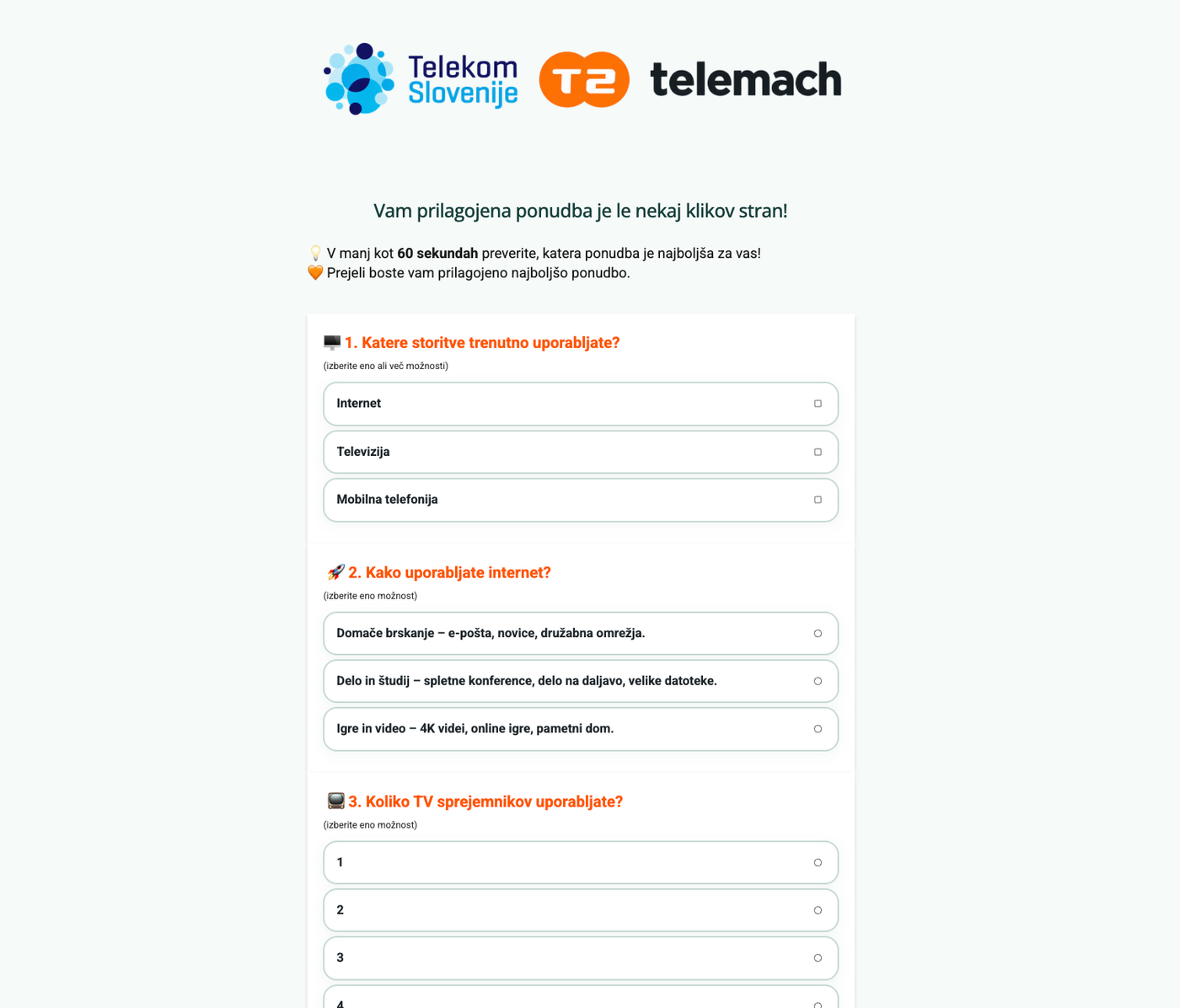
This allows Maya to review performance on every form, every day, from viewers and start rate through to conversion rate, completion rate and the drop-off percentage on each individual question.
"For my part, the most important thing is the analytics. There's nothing more important than that," explains Maya.
That per-question view is what makes the testing productive, because it doesn't just tell her a form is underperforming. It allows her to pinpoint the question where leads drop off.
"We check where users drop off, and whether they finish the questionnaire, so we know how to make it better. Avoiding a drop-off means more leads for us, and better sales for our partners."
Speed matters here, since she opens dozens of forms in a day.
"I have a list of analytics links for every single form. Because of the speed of Paperform, it doesn't take any time to open. I work with other websites where the data takes much longer to load. Paperform is basically my main work environment now."
Paperform also runs Optispin's internal work, from satisfaction surveys with partners through to feedback from the sales teams they support and feedback from leads about the journey they've just been through.
It's very useful to have that feedback all together in one place.
Longer forms, better leads
Optispin learned something unique about their customers that runs against standard lead gen advice. They discovered that making the form "easier" to finish actually made the leads worse.
"We discovered that the more information a user is prepared to give you, the more it shows how serious they are about their enquiry," explains Maya. "We tried forms that were really short — basically just contact information — and we found those aren't the best leads, because it's too easy to submit. The more they specify their needs in the questionnaire, the more serious they turn out to be."
And it reflects what Optispin is actually for.
"The primary goal of Optispin is to improve the user experience in telecommunications. If a customer doesn't really need the service right now, there's no use sending them to one of our partners. If they get what they need, then we all win."
So to find out how customers prefer to share their information, Optispin tested both the one-page and the one-question-at-a-time formats.
"Our questionnaires usually have about eight questions plus contact information. If every question is on its own page, it's so much more effort for the user to get from point A to point Z. For our users, the results show they prefer it all on one page."
Because of the way they are leveraging Paperform in their marketing and onboarding, they were able to uncover a customer pattern that improved the quality of their leads dramatically.
The result: a marketing team that moves at its own pace
The scale is real, with around 100,000 active contacts, thousands of leads a month and 15 partners depending on the quality of what arrives. Yet when Maya describes the outcome, she reaches for time first.
"With Paperform, you can get quicker results. And time is money," shares Maya. "It's stable and I know it — it's like my home now. I know exactly where everything is. Paperform is reliable; it's never been down or not worked. Once you get used to it, maybe a week, it's very easy to use, easy to change things, easy to upgrade."
And when she has needed help, she's had it.
"I contacted Paperform's customer service twice and they were really responsive. They put a lot of effort into solving my issue, and it got solved. I appreciate that."
Why this story matters for lead generation teams
Optispin's advantage isn't one clever form. It's the loop. Maya can move quickly to spot a drop-off, change the question, watch the number move and keep the version that converts. Run that loop daily for eight years and you end up somewhere your competitors can't easily follow.
Most teams can't run this type of loop, and not because they lack the idea. It's because, for many operators, every change has to be requested from a dev or tech team. That means changes are queued and shipped by someone else, so the loop stretches from a day to a fortnight.
Paperform allows Maya to operate a powerful form tool while maintaining control.
Maya's advice on using Paperform is her whole method in a sentence.
Follow the statistics — they always tell you how the user behaves. If you change your forms based on the results you see, you get better results, and more business, and your users get what they need faster. Everyone is happier.
FAQ
How does Optispin use Paperform for lead generation?
Each acquisition channel gets its own form, all of them tagged with UTMs and reviewed daily against views, start rate, completion rate and per-question drop-off. That way the marketing team can make and test changes continuously.
What has Optispin learned about form length and lead quality?
Short, contact-only forms produced weaker leads because they were too easy to submit. Longer questionnaires of around eight questions plus contact details produced people who were genuinely in market.
Can Paperform handle high lead volumes?
Yes. Optispin runs roughly 5,000 leads a month from Slovenia and another three to four thousand from Croatia, against a base of about 100,000 active contacts.
Do you need a developer to change a Paperform form?
No. Maya comes from marketing rather than engineering and makes every change herself, which is why Optispin moved off custom website forms in the first place.
What does Paperform's form analytics show?
Viewers, start rate, conversion rate, completion rate, and drop-off by individual question, for every form.
Take your funnel back
What Optispin got from Paperform was the ability to change their own funnel on the day they notice it needs changing. Then they used it every day for eight years.
If your lead generation is sitting in someone else's queue, consider using the form builder that doesn't trade power for control.
Build your first lead form free.