 By Dean McPherson, Co-founder & CTO, Paperform · Updated
Best SurveyMonkey Alternatives for 2026
The best SurveyMonkey alternative for most business teams is Paperform, because you can pay for it month to month: Pro is $59 month-to-month or $49/month billed annually, with unlimited submissions, while SurveyMonkey's Advantage, Premier and team plans are billed annually only. For formal market research with panels and MaxDiff, SurveyMonkey is still the stronger instrument.
If you are here, it is probably because of the bill, and in particular being asked to commit to a year when you only need a few months. Paperform's Pro and Business plans are both sold month to month as well as annually, and you can switch between the two on the billing page. Paid plans have unlimited submissions, so a survey that does well brings no overage bill.
The other frustration is finding the limit after the survey is built. SurveyMonkey's free plan lets you view a limited number of responses per survey even if you collect more, and the exact number isn't shown on its pricing page. Paperform publishes its limits on its own pricing page before you start, and submissions export as CSV on every plan.
| Feature | SurveyMonkey | Paperform | Typeform | Jotform | Google Forms | Cognito Forms | Tally |
|---|---|---|---|---|---|---|---|
| Form Building | |||||||
| Templates . The number of ready-made form templates in the tool’s template gallery. | 500+ (Individual Standard) | 30,000+ | 3,000+ | 20,000+ (starter) | 20+ | Yes | 100+ |
| Field types . How many kinds of question or input field the form builder offers, such as text, dropdown, date, file upload and signature. | 20+ | 26+ | 20+ | 30+ (starter) | 12 | 20+ | 20+ |
| Calculations . Compute totals, scores, prices or dates from answers while the form is being filled in. | No | Yes pro | Yes | Yes starter | No | Yes | Yes |
| E-signatures . Collect a signature, either with a signature field on the form or by sending a document out to be signed. | No | Yes | Yes growth flow | Yes starter | Yes Business Standard | Yes pro | Yes |
| Appointment booking . Let respondents pick and book a time slot directly in the form, with availability managed by the tool. | No | Yes | Yes business | Yes starter | Yes | Yes team | No |
| Payments | |||||||
| Payment gateways . The number of payment processors a form can take payments through. Where a vendor’s full count isn’t recorded, the cell lists the gateways we confirmed. | 2 (Individual Advantage) Stripe, PayPal | 5 Stripe, PayPal, Square, Braintree, Google Pay | 2 (basic) Stripe, PayPal | 34 (starter) options in its builder, incl. Stripe, PayPal, Square, Braintree | No | 5 Cognito Pay, Stripe, PayPal, Square, Google Pay | 1 Stripe |
| Subscriptions and recurring payments . Charge respondents on a repeating schedule, such as monthly or annually, from a form. | No | Yes pro | Yes basic | Yes starter | No | No | No |
| Product sales . Sell products from a form, with product listings, quantities and an order total. | No | Yes pro | Yes basic | Yes starter | No | Yes | Yes |
| Conditional pricing . Change the price or add fees automatically based on the answers given in the form. | Yes Individual Advantage | Yes pro | Yes basic | Yes starter | No | Yes | Yes |
| Coupons and discounts . Offer discount codes that respondents can apply to a payment or subscription on the form. | No | Yes pro | Yes basic | Yes starter | No | Yes | Yes |
| Design & Customization | |||||||
| Custom themes . Set your own logo, colours and fonts on forms and save them as reusable themes. | Yes Individual Standard | Yes pro | Yes basic | Yes starter | Yes | Yes pro | Yes |
| Custom CSS . Add your own CSS (and in some tools HTML) for styling beyond the built-in theme options. | Yes enterprise | Yes pro | No | Yes starter | No | Yes pro | Yes pro |
| Remove vendor branding . Remove the form builder’s own logo or badge so forms carry only your branding. | Yes Individual Premier | Yes pro | Yes plus | Yes bronze | No | Yes pro | Yes pro |
| Custom domain . Host forms on your own domain, such as forms.yourcompany.com, instead of the vendor’s. | No | Yes business | Yes enterprise | Yes enterprise | No | No | Yes pro |
| Custom form URL . Choose a readable link for a form instead of a random string. | Yes Individual Standard | Yes pro | Yes plus | Yes starter | No | Yes | Yes pro |
| Analytics | |||||||
| Response reports . Built-in summaries and charts of the answers a form has collected. | Yes | Yes | Yes | Yes starter | Yes | Yes | Yes |
| Form analytics (views and drop-off) . Track how many people view, start and finish a form, and where they abandon it. | Not recorded | Yes pro | Yes business | Yes starter | No | Not recorded | Yes pro |
| Partial submissions . See the answers people entered before leaving a form without submitting it. | Yes Individual Advantage | Yes pro | Yes basic | No | No | Not recorded | Yes pro |
| Custom tracking scripts . Add your own analytics or conversion-tracking scripts to a form. | Not recorded | Yes pro | Yes business | No | Not recorded | No | Yes pro |
| AI response insights . AI-written summaries and insights generated from the responses a form has collected. | Yes Individual Advantage | Yes pro | Yes growth flow | Yes starter | Yes Business Standard | Not recorded | No |
| Collaboration | |||||||
| Team members . Invite colleagues into the same account to build forms and work with responses together. | Yes Team Advantage | Unlimited | Yes plus | Yes enterprise | Yes | Yes pro | Yes pro |
| Roles and permissions . Give team members different levels of access, such as admin, editor or viewer. | Yes Team Advantage | Yes business | Yes plus | Yes enterprise | Yes | Yes pro | No |
| Advanced permissions and admin controls . Fine-grained, organisation-wide controls over who can access what, usually on enterprise plans. | Yes enterprise | Yes enterprise | Yes enterprise | Yes enterprise | Yes Business Starter | Yes business | No |
| Workspaces . Separate spaces or folders for organising forms by team, client or project. | Yes | Yes | Yes | Yes enterprise | Yes | Yes pro | Yes pro |
| Security | |||||||
| Require 2FA for the whole team . Admins can make two-factor authentication mandatory for everyone in the account. | Yes enterprise | Yes business | Not recorded | Yes enterprise | Yes Business Starter | Yes enterprise | No |
| SSO (SAML) . Team members sign in through your company’s identity provider, such as Okta or Microsoft Entra ID, using SAML single sign-on. | Yes enterprise | Yes business | Yes enterprise | Yes enterprise | Yes Business Starter | Yes enterprise | No |
| HIPAA compliance . Whether the vendor supports collecting US protected health information under HIPAA, typically by signing a business associate agreement on an eligible plan. | Yes enterprise | No | Yes enterprise | Yes gold | Yes Business Starter | Yes enterprise | No |
| SOC 2 . Whether the vendor holds a SOC 2 audit report covering its security controls. | Yes | Yes | Yes | Yes enterprise | Yes Business Starter | Yes | No |
| Data residency . Choose the region, such as the EU, where your form data is stored. | Yes enterprise | Yes enterprise | Yes enterprise | Yes starter | Yes Business Standard | No | No |
| Integrations & API | |||||||
| Native integrations . Apps the tool connects to directly, without going through a third-party connector such as Zapier or Make. | 200+ | 500+ | 300+ | 150+ (starter) | Yes | 28 | 13 |
| Zapier . Connect forms to thousands of other apps through Zapier. | Yes | Yes | Yes | Yes starter | Yes | Yes pro | Yes |
| Workflow automation . A built-in builder for multi-step automations that act on submissions, such as approvals, routing and syncing data to other systems. | Not recorded | Yes | Yes growth flow | Yes starter | Yes Business Starter | Yes team | No |
| Webhooks . Send each new submission to a URL of your choice as soon as it arrives. | Yes enterprise | Yes pro | Yes basic | Yes starter | No | Yes pro | Yes |
| WordPress plugin . A plugin for adding forms to a WordPress site. | No | Yes | No | Yes starter | No | Yes | No |
— means we haven't recorded it for that tool.
The Five Dimensions That Decide It
SurveyMonkey wins two of these comfortably and loses three. Here is where it lands against the alternatives on each.
Pricing
Every SurveyMonkey paid plan except the $149/month Standard Monthly is annual-commitment only, starting at $39/month billed annually ($468 a year) for Advantage with a 15,000-response yearly cap and a per-response charge beyond it. Premier is $139/month annually for 40,000 responses, Team Advantage $30/user/month annually with a three-user minimum ($1,080/year) and Team Premier $92/user/month annually ($3,312/year). Paperform Pro is $59/month, or $49/month billed annually, with unlimited submissions and unlimited seats within fair use. Tally Pro is $24/month annually, Typeform Basic $28/month annually for 100 responses, Jotform Bronze $34/month annually for 1,000 submissions, Cognito Forms Pro $19/month annually, Google Forms free. SurveyMonkey's annual entry is cheaper than Paperform's; Paperform has no paid tier below $49.
Integrations & API
SurveyMonkey lists 200+ integrations with an API, including Salesforce, Tableau, Power BI, Marketo, Microsoft Teams and, since September 2026, ChatGPT, Workday and BambooHR. For an enterprise analytics stack that connector list is a real asset, and unlimited API access is an Enterprise feature. Paperform counts 9,800+ integrations across native connectors, Stepper workflows, Zapier, Make, webhooks and a REST API, with the Business API on the $124/month annual tier. Jotform has 150+ natives, Typeform 300+, Tally 13 natives plus Zapier, Make, n8n, Pipedream and IFTTT, and Google Forms roughly 20 confined to Workspace.
Conditional logic & calculations
SurveyMonkey has skip logic, page logic and advanced branching from the Individual Advantage tier, and no calculation field at all. Quiz mode scores answers and that is the extent of it, so there is nothing to price a line item, apply a discount code, add tax or compute a value that changes the rest of the submission. Paperform's calculations are Excel-style and reach past the screen: a calculated value can control question and page visibility, decide which conditional email sends and what it contains, shape the integration payload, and set the success page. Cognito Forms is the closest rival on calculation depth with repeating sections and line items. Tally includes a formula editor free; Typeform includes basic calculations on every plan, Free included.
Payments
SurveyMonkey supports 2 payment processors, Stripe and PayPal, and only from Individual Advantage upward, with no subscriptions, coupons, product catalog, tax calculation or refunds. Jotform supports 30+ processors on every plan including free. Paperform supports 5 (Stripe, PayPal, Square, Braintree, Google Pay) with a full commerce layer behind them and no transaction fee of its own. Cognito Forms adds PayPal and Square from Business alongside its own Cognito Pay. Typeform supports Stripe and PayPal, and Tally is Stripe-only. Google Forms takes no payments of any kind.
Compliance (HIPAA / GDPR / SOC 2)
SurveyMonkey is HIPAA, GDPR, SOC 2, CCPA and ISO 27001 compliant, with PCI DSS 4.0 and Section 508, though HIPAA, SSO and PII restrictions are gated to Enterprise with a five-user minimum and a custom quote. This is SurveyMonkey's strongest dimension on paper. Jotform, Typeform, Google Forms and Cognito Forms are all HIPAA, GDPR and SOC 2 compliant. Paperform is SOC 2 Type II, GDPR and CCPA compliant with SAML SSO and enforced 2FA published at $124/month annually on Business, but it is not HIPAA compliant and signs no BAAs, so protected health information is out of scope for it. Tally holds GDPR only, with no SOC 2 and no SSO at any price.
 #1 Paperform — Best When the Answers Have to Do Something
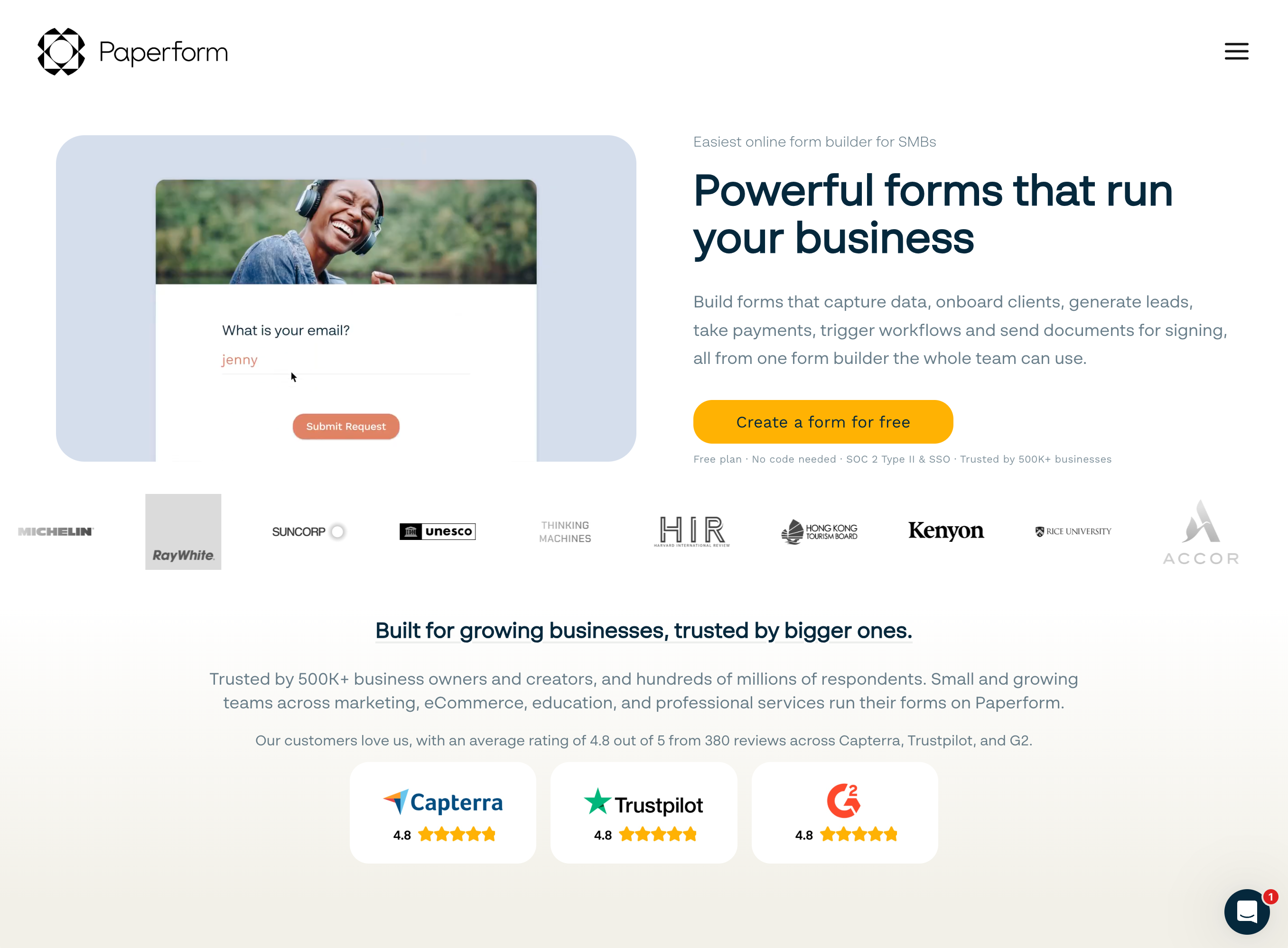
The clearest functional gap between the two products is arithmetic. SurveyMonkey can grade a quiz and nothing more; Paperform runs Excel-style calculations, and the calculated value is not stuck on the screen where it was produced. It can hide or reveal later questions and whole pages, choose which conditional email goes out and what that email says, change the payload that reaches the CRM or the spreadsheet, and write the success page the respondent lands on. That is the difference between a form that records an answer and a form that resolves a quote: quantity times tier price, minus the promo code, plus regional tax, routed to the right approver, confirmed with the right template, all inside one submission.
The second argument is what sits around that submission. SurveyMonkey ends at the response, which is why a SurveyMonkey shop usually also runs a signing tool and an automation tool, and why the person keeping all three in step is an employee rather than a product. One Paperform subscription covers Paperform, Papersign eSignatures and Stepper workflow automation on every plan, from one account, one dashboard, one bill and one permission model. Collect, price, sign and route stop being four vendors. Pro includes 25 signed documents a month with unlimited workflow steps on 20,000 automation credits; Business includes 100 documents and 100,000 credits.
On pricing the model differs rather than the discount. Paperform does not meter submissions or seats on paid plans within fair use, so a campaign that outperforms costs the same as one that flops, and adding the designer, the reviewer and the contractor costs nothing. Support is built into the seat price instead of sold as a separate enablement fee at signing. Paperform has been bootstrapped and profitable since 2016, which is worth knowing when the form becomes a system of record, though SurveyMonkey is by some distance the older and larger company.
- Strengths over SurveyMonkey: Excel-style calculations driving visibility, emails, integrations and success pages; Papersign and Stepper in the same subscription; unlimited submissions and unlimited seats within fair use; month-to-month billing available; 5 payment gateways with products, subscriptions, coupons and tax; custom HTML and CSS with custom domains; 30,000+ templates; 9,800+ integrations; signature, booking and API-powered dropdown fields
- Limitations: $49/month billed annually is a higher floor than SurveyMonkey's $39 annual entry; not HIPAA compliant and signs no BAAs; no research panel, MaxDiff or Van Westendorp tooling; Stepper automation credits are metered; no mobile editor; a much smaller review footprint than SurveyMonkey's 23,500+ G2 reviews
- Best for: Operators whose forms produce a price, a contract and a next step rather than a dataset
 #2 Jotform — Best If You Need the BAA Without the Enterprise Quote
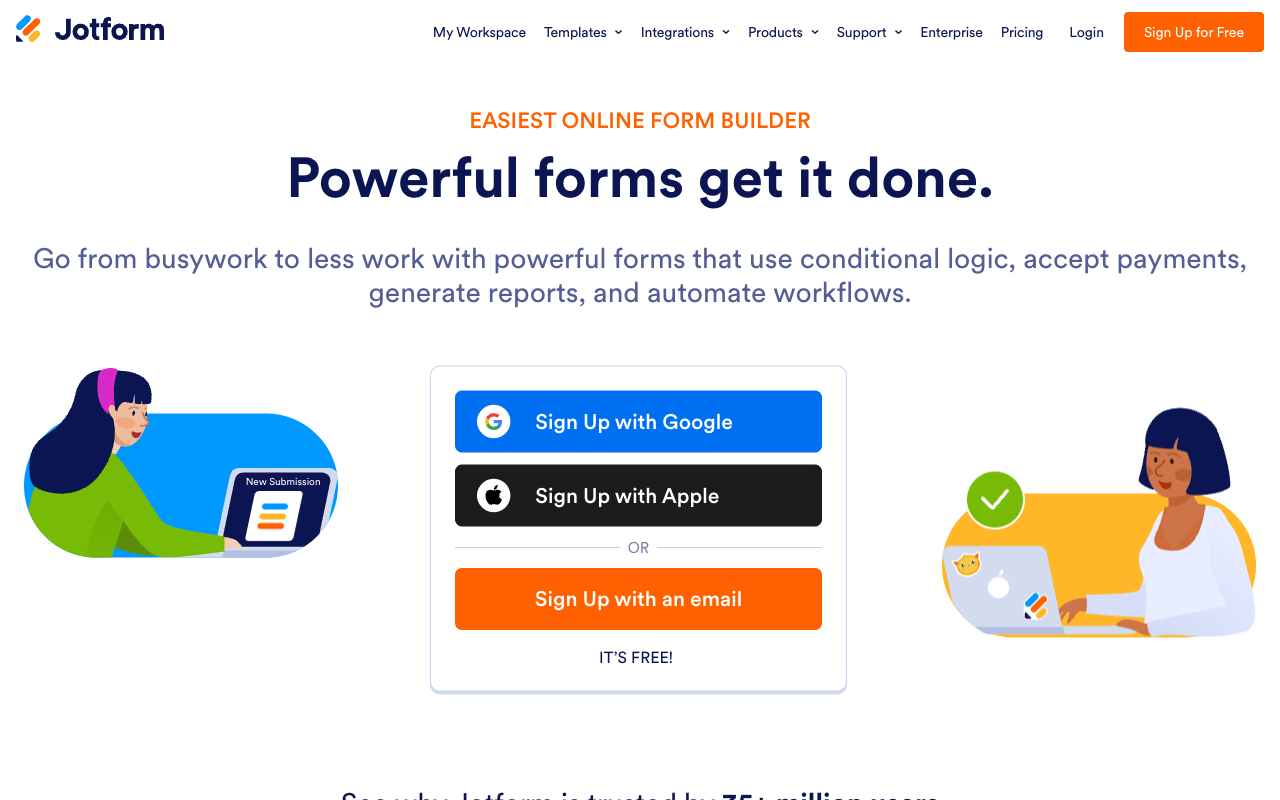
Jotform solves the specific frustration of being told that HIPAA is an Enterprise conversation. It publishes HIPAA with a signed BAA on its Gold tier at $99/month billed annually, alongside SOC 2, ISO 27001, PCI DSS Level 1, FERPA and StateRAMP, with no five-user minimum and no quote to wait for. It also demolishes SurveyMonkey's payment ceiling, moving from two processors gated above the free tier to more than thirty available on every plan. Founded in 2006 and still bootstrapped, it has the stability that a 27-year-old competitor usually claims as its own advantage.
The catch is that breadth has been accumulating for twenty years and it shows. Reviewers regularly describe the editor as cluttered, with settings buried in nested menus, and individual features that work less reliably than the feature list suggests. It is also metered in more places than SurveyMonkey is: submissions, forms, form views, storage, fields per form and signed documents all carry quotas, and every self-serve tier from Starter to Gold is single-user. Anyone leaving SurveyMonkey to escape counting will find a different set of counters. Our Jotform alternatives page breaks the quota structure down.
- Strengths over SurveyMonkey: HIPAA with a BAA at a published $99/month annual price, 30+ payment processors on every plan, approval workflows and PDF generation, 150+ native integrations, native mobile apps, no annual-only commitment
- Limitations: Submissions, views, storage and fields all metered; single-user on every self-serve tier; cluttered interface; weaker analytics and no research methodology tooling
- Best for: Regulated teams that need a BAA and real payment breadth without entering a procurement cycle
 #3 Typeform — Best for Completion Rates on Short, Public-Facing Surveys
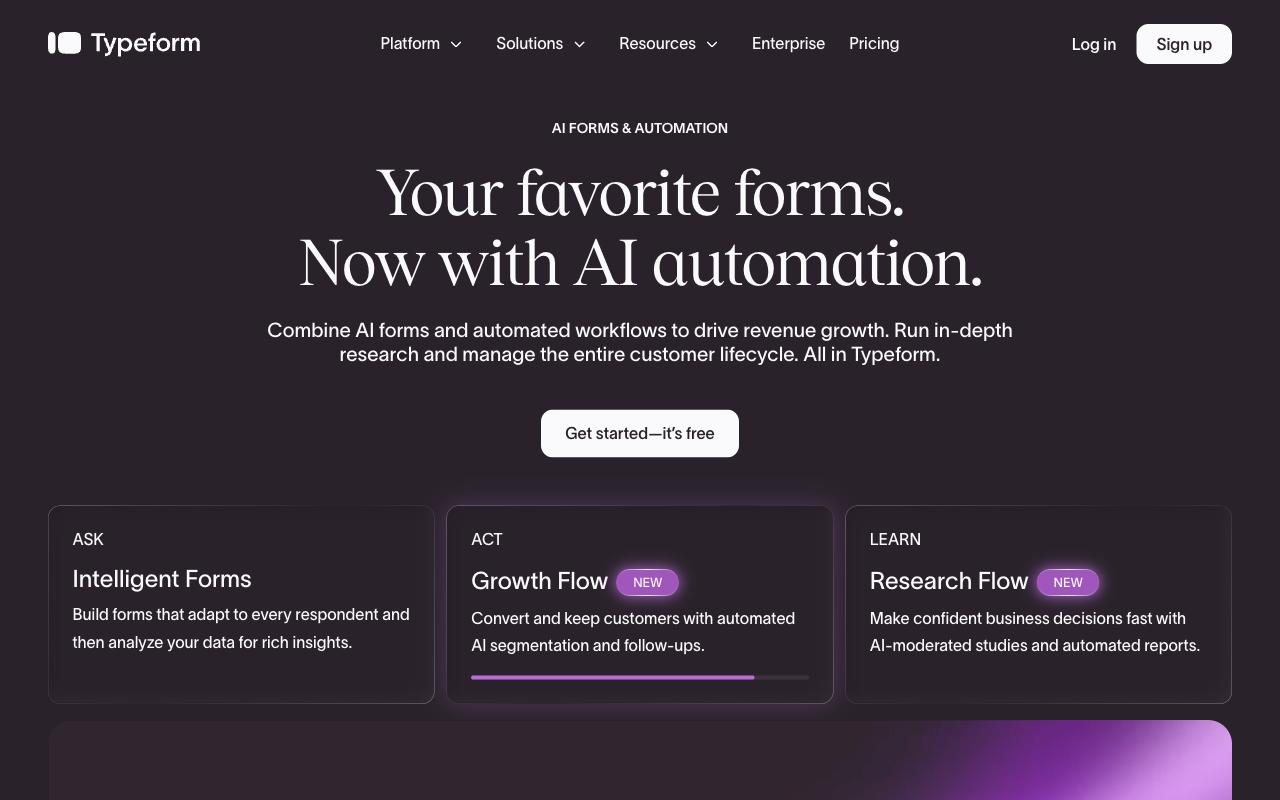
If the reason your response rate is disappointing is that the survey looks like a survey, Typeform is the direct fix. SurveyMonkey can display one question at a time, but Typeform built its whole product around the format and the polish is not comparable. It is HIPAA compliant on Enterprise and holds ISO 27001, 27017, 27018 and ISO/IEC 42001, so swapping does not mean dropping down a compliance tier. Design control is also substantially better than SurveyMonkey's theme-and-logo ceiling.
Typeform meters exactly the way SurveyMonkey does, only harder at the low end: 100 responses and one user on Basic at $28/month billed annually, 1,000 responses and three users on Plus at $56/month annually, 10,000 and five on Business at $91/month annually. Payments run through Stripe and PayPal only, calculations are simple arithmetic, and there is no answer for research methodology, benchmarks or an audience panel. Anyone moving from SurveyMonkey for analysis reasons will find Typeform a downgrade; anyone moving for presentation reasons will not. See our Paperform vs Typeform comparison for the detail.
- Strengths over SurveyMonkey: Best-in-class conversational format and completion rates, far better visual design control, HIPAA on Enterprise, ISO/IEC 42001 for AI governance, month-to-month billing
- Limitations: 100 responses a month on the entry plan, seats capped on every tier, Stripe and PayPal only, no research methodologies or panel
- Best for: Marketing and CX teams running short, brand-facing surveys where low volume makes the response caps survivable
 #4 Cognito Forms — Best Budget Route to Real Calculations
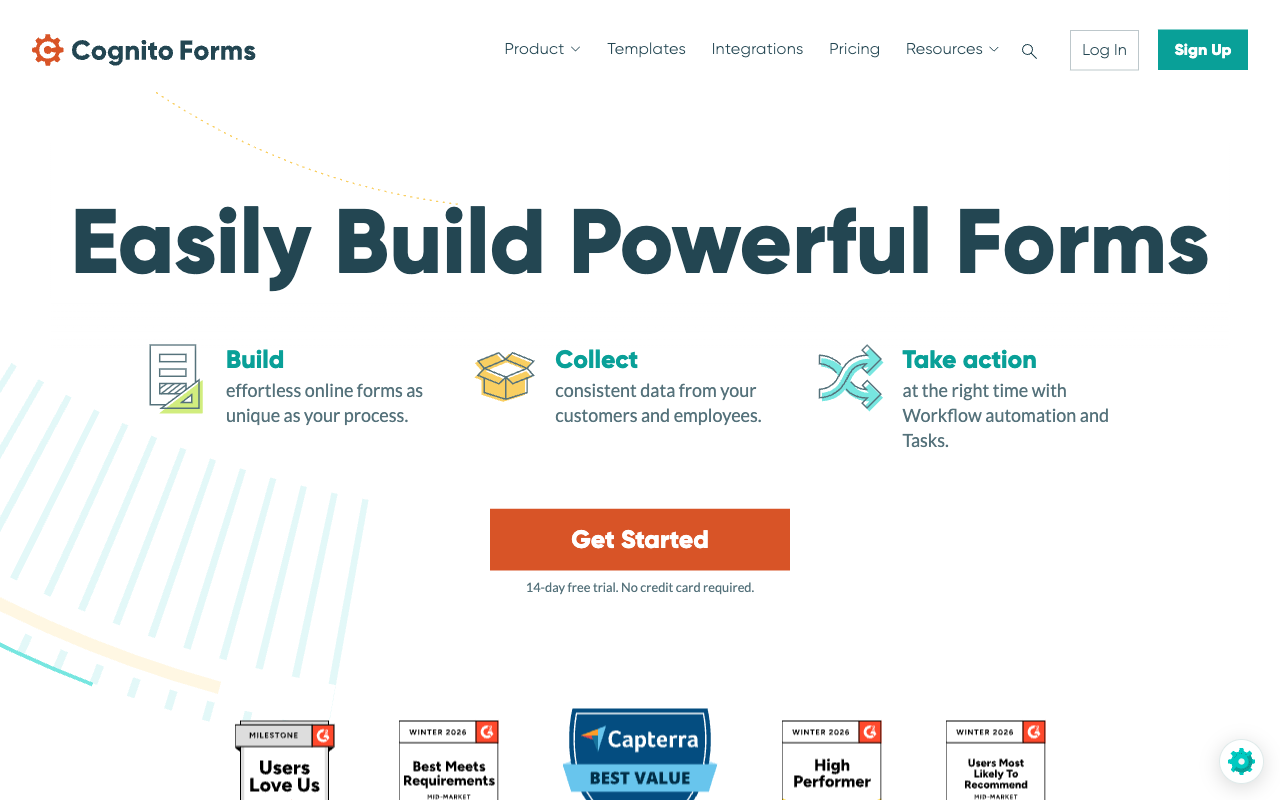
Cognito Forms exists at the opposite end of the spectrum from a research platform, and that is the point. Its calculation engine handles repeating sections, line-item order forms and nested conditional maths, which covers the registration-with-pricing and application-with-fees use cases that SurveyMonkey users tend to bolt together out of a survey and a spreadsheet. It is HIPAA compliant with a BAA and SOC 2 certified, and Pro is $19/month billed annually, well under SurveyMonkey's $39 annual entry. Cognito Pay handles cards natively with Apple Pay and Google Pay, and PayPal and Square arrive on Business.
What you give up is everything SurveyMonkey is famous for. Analysis is basic, there are no benchmarks, no methodology templates and no panel, and the forms look like forms from a decade ago unless somebody writes CSS. It is also metered in four directions at once: entries, users, storage and guest collaborators each carry their own quota, so Pro stops at 2,000 entries and one user with extra people at $5 each per month. Development moves slowly. Our Cognito Forms alternatives page covers where that ceiling sits.
- Strengths over SurveyMonkey: Deep calculation engine with repeating sections and line items, HIPAA with a BAA at a published price, lower entry cost at $19/month annually, more payment options, no annual-only commitment
- Limitations: Dated visual design, weak analytics and reporting, metered on entries, users, storage and guests, slow release cadence
- Best for: Small teams whose surveys are really priced registration or application forms
 #5 Tally — Best Escape From the Response Meter
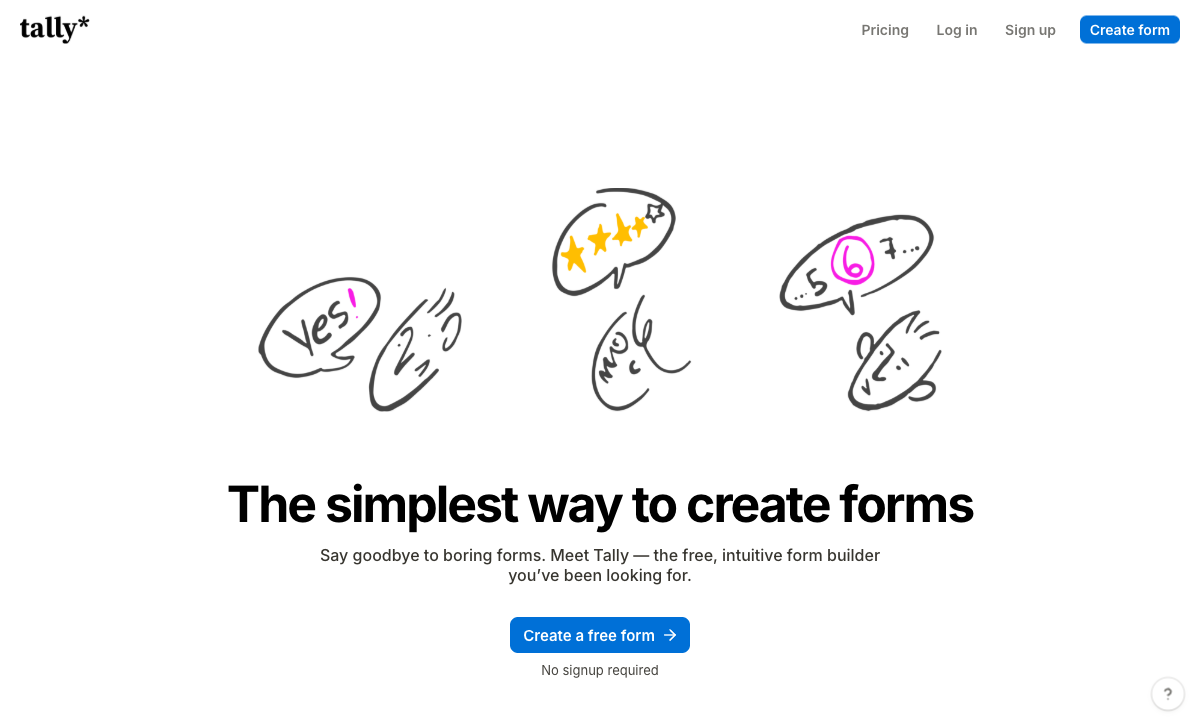
Tally is the cleanest answer to the specific complaint that brings most people to this page. It does not count responses and it does not count seats, on any plan including the free one, within a published fair use policy. Pro at $24/month billed annually removes branding, adds custom domains, custom CSS and workspaces, and Business tops out at $74/month annually. Against a $1,080/year floor on SurveyMonkey Team Advantage with 50,000 shared responses and a per-response charge after that, the arithmetic is not close. Tally also includes a free formula editor and a free AI builder, and it is bootstrapped, EU-hosted and made by a team of around ten.
That small team is also the risk. Tally holds GDPR and nothing else: no SOC 2, no ISO 27001, no HIPAA, and no SSO or enforced 2FA on any tier including the $89/month Business plan. Anyone who chose SurveyMonkey partly because procurement approved it will find that swap impossible to get signed off. Analysis is statistical only, there is no workflow builder, and payments are Stripe-only. Our Tally alternatives page covers where that wall appears.
- Strengths over SurveyMonkey: No response cap and no seat cap on any plan, free formula editor and AI builder, $24/month annual Pro against a $1,080/year team floor, modern document-style editor, custom CSS and domains
- Limitations: No SOC 2, no ISO 27001, no HIPAA, no SSO or enforced 2FA at any price, Stripe-only payments, statistical analysis only, no workflow automation, roughly ten people behind the product
- Best for: Teams sending high volumes of unregulated feedback surveys who want the meter gone entirely
 #6 Google Forms — Best If the Survey Was Never Worth Paying For
A good share of SurveyMonkey spend goes on internal surveys that nobody outside the organisation will ever see. For those, Google Forms is free with unlimited forms and up to 500,000 responses per form, HIPAA-eligible under a Workspace BAA, and covered by SOC 2, ISO 27001 and FedRAMP through Google Cloud, with SSO and admin controls inherited from Workspace at no extra cost. If the organisation already pays for Workspace from $7 per user per month, replacing an annual SurveyMonkey commitment for internal use is the easiest saving on this page.
It is a straightforward downgrade everywhere else. There are no payments, roughly 20 integrations confined to the Google ecosystem, no calculations, no branding control, no custom domains and no analysis beyond summary charts and a Sheets export. Every research capability SurveyMonkey sells is absent. Use it for the internal half of the workload and keep a real tool for anything customer-facing; our Google Forms alternatives page covers the upgrade paths.
- Strengths over SurveyMonkey: Free with unlimited forms and up to 500,000 responses per form, HIPAA-eligible under a Workspace BAA, SOC 2 and ISO 27001 through Google Cloud, SSO and admin controls included, zero learning curve
- Limitations: No payments, no calculations, no design control, about 20 integrations, no research methodologies, benchmarks, panel or advanced analysis
- Best for: Internal feedback and employee surveys inside an organisation that already runs Workspace
Full Feature Comparison
Every feature across SurveyMonkey and its alternatives, grouped by category. The calculations, payments and workflow rows are where a research platform and a form platform stop overlapping.
| Feature | SurveyMonkey | Paperform | Typeform | Jotform | Google Forms | Cognito Forms | Tally |
|---|---|---|---|---|---|---|---|
| Form Building | |||||||
| AI form builder . Describe the form you need in plain language and the tool drafts the questions for you. | Yes | Yes | Yes | Yes starter | Yes Business Standard | Yes | Yes |
| Templates . The number of ready-made form templates in the tool’s template gallery. | 500+ (Individual Standard) | 30,000+ | 3,000+ | 20,000+ (starter) | 20+ | Yes | 100+ |
| Field types . How many kinds of question or input field the form builder offers, such as text, dropdown, date, file upload and signature. | 20+ | 26+ | 20+ | 30+ (starter) | 12 | 20+ | 20+ |
| Conditional logic . Show, hide or skip questions and pages based on how someone has answered earlier questions. | Yes Individual Standard | Yes | Yes | Yes starter | Yes | Yes | Yes |
| Calculations . Compute totals, scores, prices or dates from answers while the form is being filled in. | No | Yes pro | Yes | Yes starter | No | Yes | Yes |
| Multi-page forms . Split a long form across several pages that respondents move through in order. | Yes | Yes | Yes | Yes starter | Yes | Yes | Yes |
| One question at a time . A conversational layout that shows a single question per screen, popular for surveys on mobile. | Yes | Yes | Yes | Yes starter | Not recorded | Yes | Yes |
| Answer piping . Insert a respondent’s earlier answer, such as their name, into later questions or text on the form. | Yes Individual Advantage | Yes | Yes | Yes starter | Not recorded | Yes | Yes |
| Pre-filling and hidden fields . Fill in answers ahead of time from a link or existing data, and pass along values the respondent never sees. | Yes Individual Advantage | Yes | Yes | Yes starter | Yes | Yes | Yes |
| File uploads . Let respondents attach files such as documents and photos to their submission. | Yes Individual Advantage | Yes | Yes basic | Yes starter | Yes | Yes | Yes |
| E-signatures . Collect a signature, either with a signature field on the form or by sending a document out to be signed. | No | Yes | Yes growth flow | Yes starter | Yes Business Standard | Yes pro | Yes |
| Appointment booking . Let respondents pick and book a time slot directly in the form, with availability managed by the tool. | No | Yes | Yes business | Yes starter | Yes | Yes team | No |
| Quiz scoring . Give answers point values so the form can score quizzes and assessments automatically. | Yes | Yes pro | Yes | Yes starter | Yes | Yes | Yes |
| Save and resume . Respondents can leave a form part-way through and come back later to finish it. | Yes Individual Advantage | Yes | Yes | Yes starter | Yes | Yes pro | Yes |
| Close forms by date or response limit . Stop accepting submissions automatically on a set date or once a set number of responses has arrived. | Yes Individual Advantage | Yes pro | Yes business | Yes starter | Yes | Yes | Yes |
| Payments | |||||||
| Payment gateways . The number of payment processors a form can take payments through. Where a vendor’s full count isn’t recorded, the cell lists the gateways we confirmed. | 2 (Individual Advantage) Stripe, PayPal | 5 Stripe, PayPal, Square, Braintree, Google Pay | 2 (basic) Stripe, PayPal | 34 (starter) options in its builder, incl. Stripe, PayPal, Square, Braintree | No | 5 Cognito Pay, Stripe, PayPal, Square, Google Pay | 1 Stripe |
| Subscriptions and recurring payments . Charge respondents on a repeating schedule, such as monthly or annually, from a form. | No | Yes pro | Yes basic | Yes starter | No | No | No |
| Product sales . Sell products from a form, with product listings, quantities and an order total. | No | Yes pro | Yes basic | Yes starter | No | Yes | Yes |
| Conditional pricing . Change the price or add fees automatically based on the answers given in the form. | Yes Individual Advantage | Yes pro | Yes basic | Yes starter | No | Yes | Yes |
| Coupons and discounts . Offer discount codes that respondents can apply to a payment or subscription on the form. | No | Yes pro | Yes basic | Yes starter | No | Yes | Yes |
| Tax calculations . Add sales tax to payments on the form automatically. | No | Yes | Not recorded | Yes starter | No | Yes | Yes |
| Refunds . Refund a payment from inside the form tool rather than going to the payment processor. | No | Yes | No | No | No | Yes | Not recorded |
| Design & Customization | |||||||
| Custom themes . Set your own logo, colours and fonts on forms and save them as reusable themes. | Yes Individual Standard | Yes pro | Yes basic | Yes starter | Yes | Yes pro | Yes |
| Custom CSS . Add your own CSS (and in some tools HTML) for styling beyond the built-in theme options. | Yes enterprise | Yes pro | No | Yes starter | No | Yes pro | Yes pro |
| Remove vendor branding . Remove the form builder’s own logo or badge so forms carry only your branding. | Yes Individual Premier | Yes pro | Yes plus | Yes bronze | No | Yes pro | Yes pro |
| Custom domain . Host forms on your own domain, such as forms.yourcompany.com, instead of the vendor’s. | No | Yes business | Yes enterprise | Yes enterprise | No | No | Yes pro |
| Custom form URL . Choose a readable link for a form instead of a random string. | Yes Individual Standard | Yes pro | Yes plus | Yes starter | No | Yes | Yes pro |
| Emails from your own domain . Send notification and confirmation emails from your own email domain instead of the vendor’s. | Yes enterprise | Yes business | Yes plus | Yes starter | Yes Business Starter | Yes team | Yes pro |
| Multi-language forms . Show a form’s questions, buttons and messages in languages other than English. | Yes Individual Premier | Yes | Yes business | Yes starter | Not recorded | Yes pro | Yes |
| Analytics | |||||||
| Response reports . Built-in summaries and charts of the answers a form has collected. | Yes | Yes | Yes | Yes starter | Yes | Yes | Yes |
| Form analytics (views and drop-off) . Track how many people view, start and finish a form, and where they abandon it. | Not recorded | Yes pro | Yes business | Yes starter | No | Not recorded | Yes pro |
| Partial submissions . See the answers people entered before leaving a form without submitting it. | Yes Individual Advantage | Yes pro | Yes basic | No | No | Not recorded | Yes pro |
| Google Analytics and Meta Pixel . Connect a form to Google Analytics or the Meta (Facebook) Pixel to track visits and conversions. | Not recorded | Yes pro | Yes business | Yes starter | Not recorded | Yes pro | Yes pro |
| Custom tracking scripts . Add your own analytics or conversion-tracking scripts to a form. | Not recorded | Yes pro | Yes business | No | Not recorded | No | Yes pro |
| AI response insights . AI-written summaries and insights generated from the responses a form has collected. | Yes Individual Advantage | Yes pro | Yes growth flow | Yes starter | Yes Business Standard | Not recorded | No |
| Collaboration | |||||||
| Team members . Invite colleagues into the same account to build forms and work with responses together. | Yes Team Advantage | Unlimited | Yes plus | Yes enterprise | Yes | Yes pro | Yes pro |
| Roles and permissions . Give team members different levels of access, such as admin, editor or viewer. | Yes Team Advantage | Yes business | Yes plus | Yes enterprise | Yes | Yes pro | No |
| Advanced permissions and admin controls . Fine-grained, organisation-wide controls over who can access what, usually on enterprise plans. | Yes enterprise | Yes enterprise | Yes enterprise | Yes enterprise | Yes Business Starter | Yes business | No |
| Workspaces . Separate spaces or folders for organising forms by team, client or project. | Yes | Yes | Yes | Yes enterprise | Yes | Yes pro | Yes pro |
| Security | |||||||
| Two-factor authentication . Users can protect their login with a second step, such as a code from an authenticator app. | Yes | Yes | Yes | Yes starter | Yes | Yes | Yes |
| Require 2FA for the whole team . Admins can make two-factor authentication mandatory for everyone in the account. | Yes enterprise | Yes business | Not recorded | Yes enterprise | Yes Business Starter | Yes enterprise | No |
| SSO (SAML) . Team members sign in through your company’s identity provider, such as Okta or Microsoft Entra ID, using SAML single sign-on. | Yes enterprise | Yes business | Yes enterprise | Yes enterprise | Yes Business Starter | Yes enterprise | No |
| HIPAA compliance . Whether the vendor supports collecting US protected health information under HIPAA, typically by signing a business associate agreement on an eligible plan. | Yes enterprise | No | Yes enterprise | Yes gold | Yes Business Starter | Yes enterprise | No |
| SOC 2 . Whether the vendor holds a SOC 2 audit report covering its security controls. | Yes | Yes | Yes | Yes enterprise | Yes Business Starter | Yes | No |
| GDPR . Whether the vendor states that it complies with the EU General Data Protection Regulation. | Yes | Yes | Yes | Yes starter | Yes Business Starter | Yes | Yes |
| Data residency . Choose the region, such as the EU, where your form data is stored. | Yes enterprise | Yes enterprise | Yes enterprise | Yes starter | Yes Business Standard | No | No |
| Store files in your own S3 bucket . Send uploaded files and exports to your own Amazon S3 storage instead of the vendor’s. | Not recorded | Yes business | Not recorded | Not recorded | No | No | Not recorded |
| Spam protection (CAPTCHA) . Block bot and spam submissions with reCAPTCHA or a similar challenge. | Yes | Yes | Yes plus | Yes starter | Not recorded | Yes | Yes |
| Integrations & API | |||||||
| Native integrations . Apps the tool connects to directly, without going through a third-party connector such as Zapier or Make. | 200+ | 500+ | 300+ | 150+ (starter) | Yes | 28 | 13 |
| Zapier . Connect forms to thousands of other apps through Zapier. | Yes | Yes | Yes | Yes starter | Yes | Yes pro | Yes |
| Make . Connect forms to other apps through Make (formerly Integromat). | Yes | Yes | Yes | Yes starter | Yes | Yes pro | Yes |
| Workflow automation . A built-in builder for multi-step automations that act on submissions, such as approvals, routing and syncing data to other systems. | Not recorded | Yes | Yes growth flow | Yes starter | Yes Business Starter | Yes team | No |
| Webhooks . Send each new submission to a URL of your choice as soon as it arrives. | Yes enterprise | Yes pro | Yes basic | Yes starter | No | Yes pro | Yes |
| API access . A developer API for reading forms and submissions, or managing them, from your own code. | Yes enterprise | Yes pro | Yes | Yes starter | Yes | Yes pro | Yes |
| MCP server / AI assistant connector . An official connector, such as an MCP server, that lets AI assistants like Claude or ChatGPT work with your forms and responses. | Yes | Yes | Yes | Yes starter | Not recorded | Yes pro | Yes |
| WordPress plugin . A plugin for adding forms to a WordPress site. | No | Yes | No | Yes starter | No | Yes | No |
— means we haven't recorded it for that tool.
Pricing Comparison
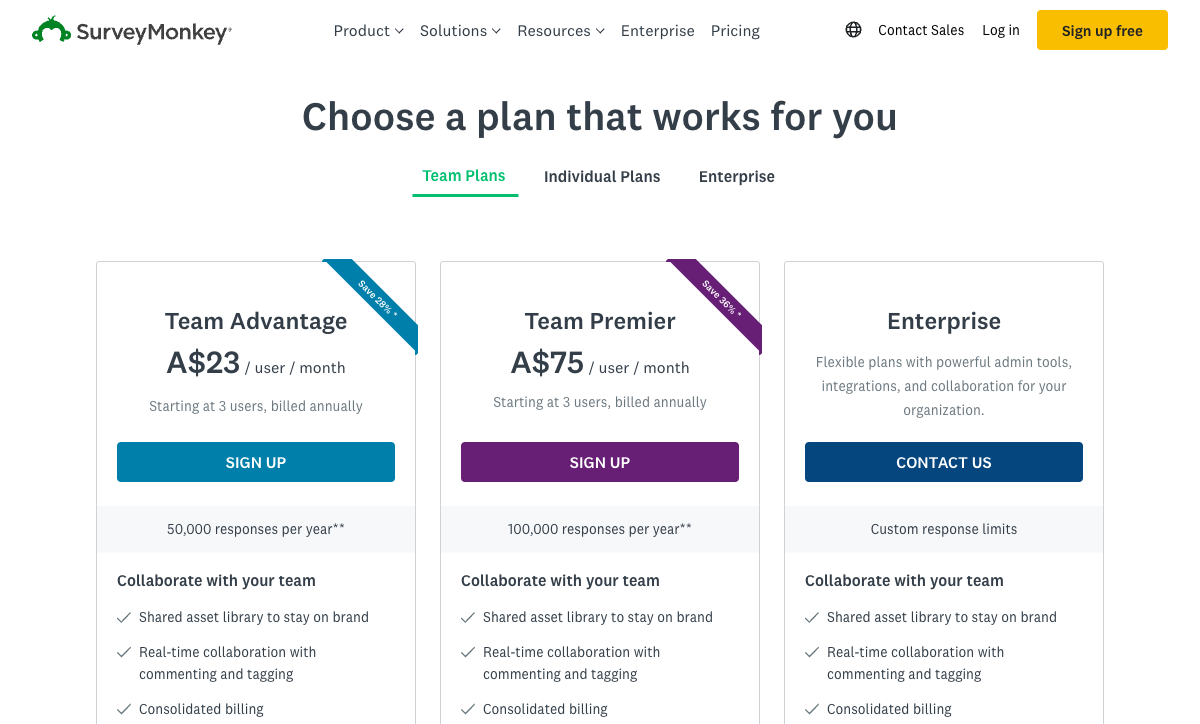
SurveyMonkey's annual entry price of $39/month is genuinely lower than Paperform's $49, and the caps are the reason. Read this table for what each plan's allowance costs once you exceed it, not only for the headline figure.
What will it cost you?
Paperform plans
- FreeFreeForms Unlimited, Submissions 30/month, Team Unlimited, Storage Unlimited
- ProMatches$49/moForms Unlimited, Submissions Unlimited, Team Unlimited, Storage Unlimited
- Business$124/moForms Unlimited, Submissions Unlimited, Team Unlimited, Storage Unlimited
| Plan | Price | Forms | Submissions | Team | Storage |
|---|---|---|---|---|---|
| Free | Free | Unlimited | 30/month | Unlimited | Unlimited |
| ProMatches | $49/mo | Unlimited | Unlimited | Unlimited | Unlimited |
| Business | $124/mo | Unlimited | Unlimited | Unlimited | Unlimited |
SurveyMonkey plans
- Basic (Free)FreeForms Unlimited, Submissions Limited per survey (exact number now only shown after sign-up/login), Team 1, Storage N/A
- Individual Standard$149/momonthly onlyForms Unlimited, Submissions 1,000/month, Team 1, Storage N/A
- Individual Advantage$39/moForms Unlimited, Submissions 15,000 per year, Team 1, Storage N/A
- Individual Premier$139/moForms Unlimited, Submissions 40,000 per year, Team 1, Storage N/A
- Team AdvantageCheck limits$30/moForms Unlimited, Submissions 50,000 per year (shared), Team 3 minimum, Storage N/A
- Team Premier$92/moForms Unlimited, Submissions 100,000 per year (shared), Team 3 minimum, Storage N/A
| Plan | Price | Forms | Submissions | Team | Storage |
|---|---|---|---|---|---|
| Basic (Free) | Free | Unlimited | Limited per survey (exact number now only shown after sign-up/login) | 1 | N/A |
| Individual Standard | $149/momonthly only | Unlimited | 1,000/month | 1 | N/A |
| Individual Advantage | $39/mo | Unlimited | 15,000 per year | 1 | N/A |
| Individual Premier | $139/mo | Unlimited | 40,000 per year | 1 | N/A |
| Team AdvantageCheck limits | $30/mo | Unlimited | 50,000 per year (shared) | 3 minimum | N/A |
| Team Premier | $92/mo | Unlimited | 100,000 per year (shared) | 3 minimum | N/A |
| Product | Plan | Monthly Price | Annual Price (per month) | Free Plan | Free Trial | Limits |
|---|---|---|---|---|---|---|
| SurveyMonkey | Basic (Free) | Free | Free | Yes | No | forms: Unlimited, submissions: Limited per survey (exact number now only shown after sign-up/login), storage: N/A, users: 1 |
| SurveyMonkey | Individual Standard | $149/mo | Not listed | forms: Unlimited, submissions: 1,000/month, storage: N/A, users: 1 | ||
| SurveyMonkey | Individual Advantage | Annual billing only | $39/mo billed annually | forms: Unlimited, submissions: 15,000 per year, storage: N/A, users: 1 | ||
| SurveyMonkey | Individual Premier | Annual billing only | $139/mo billed annually | forms: Unlimited, submissions: 40,000 per year, storage: N/A, users: 1 | ||
| SurveyMonkey | Team Advantage | Annual billing only | $30/mo billed annually | forms: Unlimited, submissions: 50,000 per year (shared), storage: N/A, users: 3 minimum | ||
| SurveyMonkey | Team Premier | Annual billing only | $92/mo billed annually | forms: Unlimited, submissions: 100,000 per year (shared), storage: N/A, users: 3 minimum | ||
| Paperform | Free | Free | Free | Yes | 7 days | forms: Unlimited, submissions: 30/month, storage: Unlimited, users: Unlimited, file uploads: 100 MB |
| Paperform | Pro | $59/mo | $49/mo billed annually | forms: Unlimited, submissions: Unlimited, storage: Unlimited, users: Unlimited, file uploads: 10 GB | ||
| Paperform | Business | $149/mo | $124/mo billed annually | forms: Unlimited, submissions: Unlimited, storage: Unlimited, users: Unlimited, file uploads: 100 GB | ||
| Typeform | Free | Free | Free | Yes | 14 days | forms: Unlimited, submissions: 10/month, users: 1 |
| Typeform | Basic | $39/mo | $28/mo billed annually | forms: Unlimited, submissions: 100/month, storage: 1 GB, users: 1 | ||
| Typeform | Plus | $79/mo | $56/mo billed annually | forms: Unlimited, submissions: 1,000/month, storage: 2 GB, users: 3 | ||
| Typeform | Business | $129/mo | $91/mo billed annually | forms: Unlimited, submissions: 10,000/month, storage: 4 GB, users: 5 | ||
| Typeform | Growth Flow | $379/mo | $266/mo billed annually | forms: Unlimited, submissions: 10,000/month, storage: 4 GB, users: 5 | ||
| Typeform | Talent | $169/mo | $119/mo billed annually | forms: Unlimited, submissions: 3,000/month, users: 3 | ||
| Jotform | Starter | Free | Free | Yes | No | forms: 5, submissions: 100/month, storage: 100 MB, users: 1 |
| Jotform | Bronze | $39/mo | $34/mo billed annually | forms: 25, submissions: 1,000/month, storage: 1 GB, users: 1 | ||
| Jotform | Silver | $49/mo | $39/mo billed annually | forms: 50, submissions: 2,500/month, storage: 10 GB, users: 1 | ||
| Jotform | Gold | $129/mo | $99/mo billed annually | forms: 100, submissions: 10,000/month, storage: 100 GB, users: 1 | ||
| Google Forms | Free (Personal) | Free | Free | Yes | 14 days | forms: Unlimited, submissions: 500,000 per form, storage: 15 GB (shared across Google Drive), users: 1, file uploads: Count against the owner's 15 GB Google Account storage |
| Google Forms | Business Starter | $8.4/mo | $7/mo billed annually | forms: Unlimited, submissions: 500,000 per form, storage: 30 GB per user, users: Up to 300, file uploads: Count against the owner's pooled Drive storage | ||
| Google Forms | Business Standard | $16.8/mo | $14/mo billed annually | forms: Unlimited, submissions: 500,000 per form, storage: 2 TB per user, users: Up to 300, file uploads: Count against the owner's pooled Drive storage | ||
| Google Forms | Business Plus | $26.4/mo | $22/mo billed annually | forms: Unlimited, submissions: 500,000 per form, storage: 5 TB per user, users: Up to 300, file uploads: Count against the owner's pooled Drive storage | ||
| Cognito Forms | Individual (Free) | Free | Free | Yes | 14 days | forms: Unlimited, submissions: 100 entries/month, storage: 100 MB, users: 1 |
| Cognito Forms | Pro | $24/mo | $19/mo billed annually | forms: Unlimited, submissions: 2,000 entries/month, storage: 1 GB, users: 1 | ||
| Cognito Forms | Team | $62/mo | $49/mo billed annually | forms: Unlimited, submissions: 10,000 entries/month, storage: 10 GB, users: 5 | ||
| Cognito Forms | Business | $129/mo | $99/mo billed annually | forms: Unlimited, submissions: 25,000 entries/month, storage: 50 GB, users: 10 | ||
| Cognito Forms | Enterprise | $199/mo | $149/mo billed annually | forms: Unlimited, submissions: Unlimited, storage: 100 GB, users: 20 | ||
| Tally | Free | Free | Free | Yes | No | forms: Unlimited, submissions: Unlimited, storage: N/A, users: 1, file uploads: 10 MB per file |
| Tally | Pro | $29/mo | $24/mo billed annually | forms: Unlimited, submissions: Unlimited, storage: N/A, users: Unlimited, file uploads: Unlimited | ||
| Tally | Business | $89/mo | $74/mo billed annually | forms: Unlimited, submissions: Unlimited, storage: N/A, users: Unlimited |
One practical note: SurveyMonkey geo-serves currency, so the figure you see depends on where you are browsing from, and several published pricing guides still quote plans the vendor no longer lists. Check the live page from your own region before committing to a year.
Review Ratings Across Platforms
SurveyMonkey holds 4.4 on G2 across more than 23,500 reviews and 4.6 on Capterra across 10,508, with ease of use at 4.6 and value for money its weakest sub-score at 4.4. Trustpilot is the outlier at 2.7 across 1,068 reviews, where 63% are one star and the complaints are overwhelmingly about auto-renewal and cancellation rather than the product.
Verdict: Which SurveyMonkey Alternative Should You Choose?
Start by deciding what you are actually buying. If the answer is a research instrument, SurveyMonkey is still the best one here and nothing on this list is close: methodology templates, MaxDiff and Van Westendorp, crosstabs, benchmarks, 70+ languages and a 335M-person panel are not things a form builder replaces. Renew it and stop reading.
If the answer is the platform the work runs on, Paperform is the recommendation. Excel-style calculations mean the submission can price itself, and that calculated value then decides what the respondent sees next, which email fires, what reaches the CRM and what the success page says. Papersign and Stepper come in the same subscription, so the contract and the approval chain live where the form does instead of with two more vendors and you in the middle. Submissions and seats are unlimited within fair use, month to month is available at $59, and $49/month billed annually is the entry price. It is higher than SurveyMonkey's $39, and it is a number that does not move when the campaign works.
For narrower problems, pick the tool that removes the one blocker. Jotform if you need a BAA at a published price and payments beyond Stripe and PayPal. Typeform if the survey needs to look like a brand rather than a questionnaire. Cognito Forms if calculations are the whole requirement and the budget is small. Tally if you simply want the response meter gone and compliance is not in scope. Google Forms for the internal surveys that were never worth an annual commitment. For a wider view of the field, see our best form builders roundup.
Frequently Asked Questions
Can I still pay for SurveyMonkey month to month, and what does that mean for me?
Only at a price. Standard Monthly, the one plan SurveyMonkey bills month to month, is $149/month for 1,000 responses a month. Everything else is annual: Advantage Annual at $39/month billed annually ($468 a year) and Premier Annual at $139/month billed annually ($1,668 a year), and Team Advantage and Team Premier are annual too, with a three-user minimum. In practice, unless you pay $149 a month, you commit to a year before you have run a single real survey. Plan line-ups and prices have moved during 2026, so check the live page rather than third-party guides. Paperform sells Pro at $59/month month to month, or $49/month billed annually, so the annual discount is a choice rather than the only door.
What happens if I go over my SurveyMonkey response limit?
You are billed for every response above the cap. On the annual plans the caps are yearly, not monthly: 15,000 responses on Individual Advantage, 40,000 on Individual Premier, 50,000 shared on Team Advantage and 100,000 shared on Team Premier. A survey that lands better than expected adds a per-response charge to a plan you already paid for up front. Teams handle that by rationing, which means dropping the reminder email or closing the survey early. Paperform Pro and Business carry no submission cap within fair use and no per-response charge, so the tenth thousand costs exactly what the first one did.
Can SurveyMonkey calculate a price, a quote or a score inside the form?
Not beyond quiz scoring. SurveyMonkey has quiz mode with automatic grading, but no calculation field, so there is no way to price a line item, apply a discount code, add regional tax or derive a value that then changes what the respondent sees next. Paperform's calculations are Excel-style and are not confined to producing a number on screen: a calculated value can control which questions and pages appear, decide which conditional email fires and what it says, shape the payload sent to an integration, and set the content of the success page. Cognito Forms is the other strong answer here, with a calculation engine that handles repeating sections and line-item order forms.
Does SurveyMonkey take payments, and is Stripe plus PayPal enough?
SurveyMonkey supports two payment processors, Stripe and PayPal, and only from Individual Advantage upward. There is no Square, no Braintree and no native Google Pay, and no product catalog, subscriptions, coupons, tax calculation, invoicing or refund handling around them. That collects a fixed amount; it does not run an order. Paperform supports five gateways (Stripe, PayPal, Square, Braintree, Google Pay) with products, subscriptions, coupons, pricing rules, tax and refunds, and takes no transaction fee of its own. Jotform is the breadth option with 30 or more processors including regional gateways, available on every plan.
Is there a SurveyMonkey alternative that is HIPAA compliant without an Enterprise quote?
Yes. SurveyMonkey will sign a BAA, but HIPAA sits behind Enterprise, which now states a five-user minimum and a custom quote, so a checkbox becomes a procurement cycle. Jotform includes HIPAA with a signed BAA on its Gold tier at $99/month billed annually, and Cognito Forms offers HIPAA with a BAA on its Enterprise plan at a published $149/month billed annually. Google Forms is HIPAA-eligible under a Workspace BAA. Being plain about it: Paperform is not HIPAA compliant and signs no BAAs today, so protected health information is one job where SurveyMonkey Enterprise or Jotform is the correct answer and Paperform is not.
Why is SurveyMonkey rated 4.6 on Capterra but 2.7 on Trustpilot?
The two sites are measuring different moments. Capterra and G2 reviewers are rating the product in use, and they rate it well: 4.6 overall on Capterra across 10,508 reviews, 4.4 on G2 across more than 23,500. Trustpilot has fallen to 2.7 across 1,068 reviews, with 63% of them one star, and the complaints cluster on auto-renewal billing, price increases, account lockouts and cancellation difficulty. That is a renewal experience, not a builder experience. It is worth weighing if you are about to sign an annual commitment with a metered cap attached.
Can I get rid of the three-user minimum on SurveyMonkey Team plans?
No. Team Advantage and Team Premier both start at three users billed annually, which puts the floor at $1,080/year and $3,312/year respectively, before anyone logs in. Enterprise now states a five-user minimum. Seats are also split into Full Access and Analyst types chosen at checkout, so you end up deciding who is allowed to build rather than who needs to. Paperform has no per-seat pricing on any paid plan: a seat covers forms, eSignatures and workflows together, and one person counts once however many of them they use.
How do I move survey data and workflows off SurveyMonkey?
Data export is the easy half. SurveyMonkey exports to CSV, Excel, PDF, Google Sheets and SPSS, and has a documented API, so historical responses travel. Surveys themselves do not transfer automatically, and neither does anything downstream, because SurveyMonkey has no eSignature product and no visual workflow builder. Whatever you built in Zapier or in a spreadsheet to move responses into a contract, an approval or a CRM record has to be rebuilt as well. Paperform gives you 30,000+ templates to start from, plus Papersign and Stepper in the same subscription so the downstream half has somewhere to live. There is a permanent free plan that needs no card.
Who owns SurveyMonkey now, and does that change anything?
SurveyMonkey was founded in 1999, went public as SVMK in 2018, and was taken private in 2023 by an investor group led by Symphony Technology Group. It is now a private company of 1,001 to 5,000 people serving 260,000+ organisations. Longevity is a genuine trust signal, and a 27-year-old company is not going anywhere. What private-equity ownership tends to change is the shape of the price sheet rather than the product, and the 2026 push towards annual-commitment plans is consistent with that. Paperform has been building forms since 2016 and is bootstrapped and profitable, with no per-seat and no per-response line item for a renewal to move.
Is SurveyMonkey still the right tool for formal market research?
For genuine research work, yes, and the alternatives on this page do not pretend otherwise. Concept testing, MaxDiff, Van Westendorp price optimisation, A/B testing, crosstabs, industry benchmarks, 70+ survey languages, 500+ expert-built templates and an audience panel of 335M+ people in 130+ countries are capabilities no form builder here matches. The AI Analysis Suite queries results in plain English. If your question is "what do these 4,000 people think", stay on SurveyMonkey. If your question is "how does this submission turn into a priced quote, a signed contract and a CRM record", that is a different tool.
Can a SurveyMonkey form look like it belongs to my brand?
Only up to a point. SurveyMonkey offers custom themes and logos on paid plans, but custom CSS is Enterprise-only (styling, with no HTML access) and there is no custom domain, so the finished survey reads as a SurveyMonkey survey. For an internal engagement survey that is entirely fine. For a customer-facing order form, application or client intake it is the wrong signal. Paperform's editor takes custom HTML and CSS, branding comes off from Pro, and custom domains are $20/month each on Pro with one included on Business. Typeform is the other option if presentation is the whole point, and Tally is the cheapest way to get an unbranded form at $24/month billed annually.
Does SurveyMonkey have anything like eSignatures or approval workflows?
No to both. There is no signature field, no appointment booking field and no visual workflow automation builder, so anything after the response is handled by one of the 200+ integrations or by a person. That pattern is how a research subscription turns into three subscriptions: the survey tool, the signing tool and the automation tool, with you as the glue between them and a separate invoice for each. One Paperform subscription covers forms, Papersign eSignatures and Stepper workflow automation on one account and one permission model. Pro includes 25 signed documents a month and 20,000 automation credits; Business includes 100 documents and 100,000 credits. Automation credits are metered, which is worth sizing up front.
Sources & References
- SurveyMonkey Pricing Guide 2026: Costs, Plans, and Hidden Fees — Featurebase, 2026
- SurveyMonkey Pricing 2026: $27–$60/user/month (Teams, 3+ Users) — Full Plan Breakdown — Usercall, September 2026
- SurveyMonkey Unveils Sweeping Platform Upgrades to Put Real Human Insight at the Center of Every Business Decision — TechEdge AI, September 2026
- New at SurveyMonkey: Edit surveys through chat and uncover Insights — SurveyMonkey, July 2026
- SurveyMonkey reviews and ratings — Capterra, 2026
- SurveyMonkey customer reviews — Trustpilot, 2026
Unlimited plans are subject to each vendor's fair use policy.
Ready to try Paperform?
Create beautiful forms, payment pages, and workflows — no code required.