Paperform vs Google Forms: Which Is Better in 2026?
Google Forms is the better choice for simple surveys, quizzes and internal data collection, because it is free, familiar and HIPAA compliant. Paperform, at $49 per month on Pro billed annually, is the better choice once the form has to take payments, branch properly, carry your brand and hand off to a signature or an approval.
This comparison is unusual because one side costs nothing. Google Forms is free with any Google account, has unlimited forms and unlimited responses, and is rated 4.7 on Capterra across more than 11,500 reviews. If the job is to collect some answers, look presentable and land the results in a spreadsheet, Google Forms does that job well and nothing on this page should talk you out of it.
The comparison becomes real at a specific point: when the work stops being a form and becomes a process. Multiple brands or clients. Money changing hands with pricing rules attached. A contract that has to be signed and filed. An approval chain. A compliance checklist somebody else wrote. Google Forms collects answers and stops, so everything past that point becomes a stack you assemble and maintain yourself.
Quick Verdict
Choose Google Forms if:
- The form is a survey, quiz, RSVP or internal request
- Protected health information is involved and you need HIPAA
- Your team already lives in Sheets, Drive and Classroom
- Several people need to co-edit the form in real time
- Budget for form software is genuinely zero
- Nobody outside the organisation will judge the design
Choose Paperform if:
- The form has to take a payment, a deposit or a subscription
- Logic has to work per question, not just per section
- The form is customer-facing and has to look like yours
- A signature or an approval has to follow the submission
- You are currently paying for a form tool, DocuSign and Zapier
- You need drop-off analytics, partials and your own tracking scripts
Five Facts That Settle Most of This
Pricing
Google Forms costs $0 with any Google account and its form features are identical on every paid Workspace tier ($8.40, $16.80 and $26.40 per user per month flexible; $7, $14 and $22 on an annual commitment). Paperform Pro is $59 per month, or $49 billed annually, with unlimited submissions and unlimited seats within fair use.
Integrations and API
Paperform reaches 4,000+ integrations natively and through Zapier, Make, webhooks and a REST API. Google Forms lists roughly 20 native integrations, almost all of them Google properties, and has no webhook support; anything outside the ecosystem runs through Zapier, Make or Apps Script.
Conditional logic
Google Forms branches at section level only, from multiple choice and dropdown answers. Paperform branches at question and page level off any answer, with Excel-style calculations driving visibility, conditional emails, integration data and success pages.
Payments
Paperform supports 5 payment gateways: Stripe, PayPal, Square, Braintree and Google Pay. Google Forms supports 0 and has no payment field at any tier.
Compliance
Google Forms is HIPAA, GDPR, CCPA, SOC 2 and ISO 27001 compliant, with FedRAMP, ISO 27017, ISO 27018 and ISO 27701 on top. Paperform is SOC 2 Type II, GDPR and CCPA compliant, and is not HIPAA compliant and does not sign BAAs. On regulated health data, Google Forms wins outright.
Feature Comparison
Read the table below as two different product categories rather than two products. Google Forms is a survey tool with a world-class free tier and a deep spreadsheet connection. Paperform is a platform that happens to start with a form and continues through payments, signatures and automation.
| Feature | Paperform | Google Forms |
|---|---|---|
| Form Building | ||
| Document-style editor | Yes | No |
| AI form creation | Yes | Yes paid |
| Field types | 26+ | 11 |
| File uploads | Yes | Yes |
| Multi-page forms | Yes | Yes |
| Guided mode (one question at a time) | Yes | No |
| Conditional logic | Yes | Yes |
| Calculations field | Yes pro | No |
| AI calculations assistant | Yes pro | No |
| Scoring | Yes pro | Yes |
| Answer piping | Yes | No |
| Pre-filling and hidden fields | Yes pro | Yes |
| Save and resume | Yes | No |
| Auto-close by number | Yes pro | Yes |
| Auto-close by date | Yes pro | Yes |
| Appointment/booking field | Yes | No |
| Signature field | Yes | No |
| Color picker field | Yes | No |
| API-powered dropdowns | Yes business | No |
| Google address search | Yes business | No |
| AI quiz generation | No | Yes paid |
| Payments | ||
| Stripe payments | Yes | No |
| PayPal payments | Yes | No |
| Square payments | Yes | No |
| Braintree payments | Yes | No |
| Google Pay | Yes | No |
| Product sales (eCommerce) | Yes pro | No |
| Subscriptions | Yes pro | No |
| Coupons and discounts | Yes pro | No |
| Custom pricing rules | Yes pro | No |
| Tax calculations | Yes | No |
| Quotes/invoices | Yes | No |
| Refunds | Yes | No |
| 3D Secure | Yes | No |
| Design & Customization | ||
| Template gallery | 30,000+ | 20+ |
| Rich media (images, GIFs, videos) | Yes | Yes |
| Unsplash and Giphy integration | Yes | No |
| Image editor | Yes | No |
| Adobe Creative Cloud | Yes | No |
| Language translation | Yes | No |
| Advanced theming | Yes pro | No |
| Custom form URL | Yes pro | No |
| Custom domains | Yes pro | No |
| Custom HTML & CSS | Yes pro | No |
| Remove branding | Yes pro | No |
| Custom email domains | Yes business | Yes Business Starter |
| Analytics | ||
| Submission results and reports | Yes | Yes |
| AI report insights | Yes pro | Yes Business Standard |
| Paperform analytics | Yes pro | No |
| Drop-off analysis | Yes pro | No |
| Google Analytics & Facebook Pixel | Yes pro | No |
| Custom analytics scripts | Yes pro | No |
| Partial submissions | Yes pro | No |
| Collaboration | ||
| Multi-user accounts | Yes pro | Yes |
| User permissions and management | Yes pro | Yes |
| Advanced permissions & admin | Yes enterprise | Yes Business Starter |
| Form sharing (templates) | Yes | Yes |
| Spaces and tag management | Yes | No |
| Security | ||
| SOC 2 Type II | Yes | Yes |
| GDPR compliant | Yes | Yes |
| SSL encryption | Yes | Yes |
| Two-factor authentication | Yes | Yes |
| Enforce 2FA for all users | Yes business | Yes Business Starter |
| SSO (SAML) | Yes business | Yes Business Plus |
| reCAPTCHA | Yes | No |
| Local data residency | Yes enterprise | Yes Business Plus |
| Custom S3 storage (BYO) | Yes business | No |
| Integrations & API | ||
| Native integrations | 4,000+ | No |
| Zapier | Yes | Yes |
| Make (Integromat) | Yes | Yes |
| Webhooks | Yes pro | No |
| Standard API | Yes pro | Yes |
| Business API | Yes business | No |
| WordPress plugin | Yes | No |
| oEmbed support | Yes | No |
Where Google Forms Wins
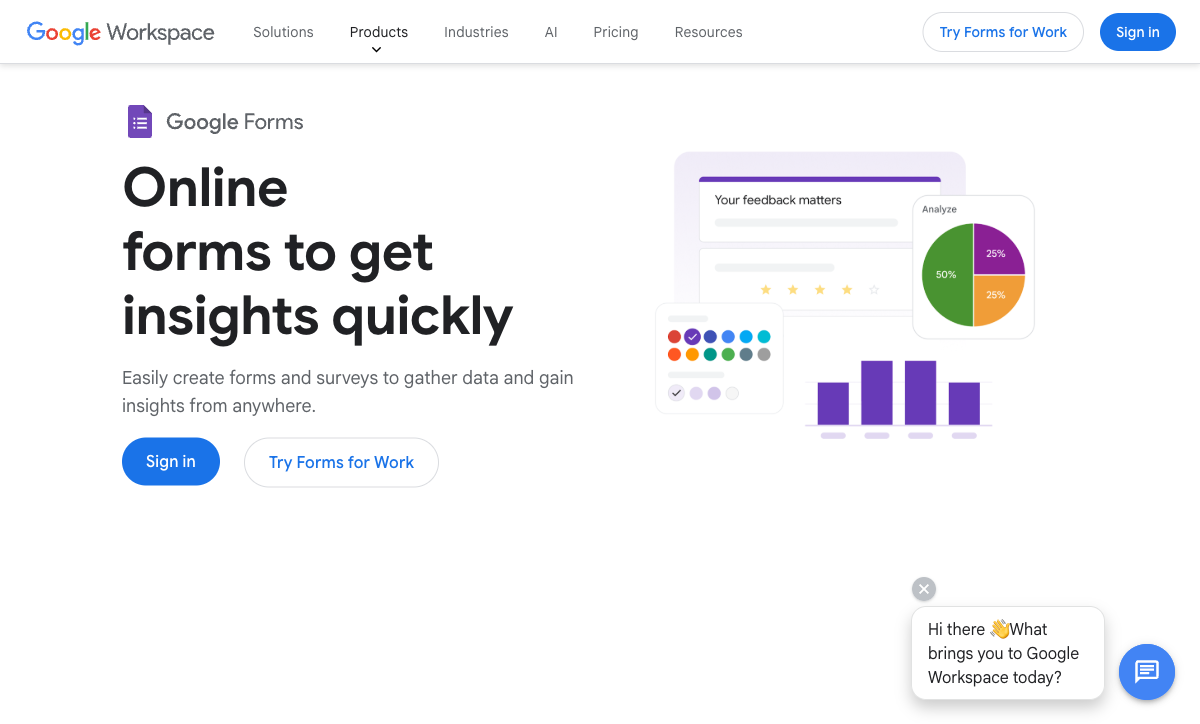
It is free, and free is a real answer
Google Forms costs nothing for unlimited forms and unlimited responses, with file uploads drawing on the 15 GB of Drive storage that comes with a personal account. No competitor matches that on price at that volume. Capterra reviewers score it 4.8 for value for money, which is the highest score in this comparison on any dimension. Paperform's cheapest paid plan is $49 per month billed annually, and pretending that gap does not matter would waste your time.
Nobody needs to be taught how to use it
Ease of use rates 4.7 on Capterra, ease of setup 93% on G2 and usability 9.2 out of 10 on TrustRadius. A department head with no training builds a working form in ten minutes, and respondents recognise the layout instantly because almost everyone has filled one in before. Kevin Stratvert's beginner walkthrough, embedded further down, runs the entire product in well under an hour, which tells you something about the surface area.
Real-time co-editing and the Sheets pipeline
Google Forms is built on the same collaboration engine as Docs and Sheets, so several people edit one form simultaneously with no locking or version conflicts. Responses flow into a Google Sheet automatically, and from there into Looker Studio, Apps Script or whatever the analyst already built. Paperform integrates with Google Sheets and does it well, but the connection is an integration rather than the same underlying document.
HIPAA, FedRAMP and the rest of Google's compliance shelf
Google Workspace's certification list runs to HIPAA, SOC 1, SOC 2, SOC 3, ISO 27001, ISO 27017, ISO 27018, ISO 27701 and FedRAMP, and Forms inherits all of it. Paperform holds SOC 2 Type II, GDPR and CCPA and does not hold HIPAA or ISO 27001. A clinic collecting patient intake or a public agency with a FedRAMP requirement should stop reading here and use Google Forms.
Editing from a phone, and a review record nobody can match
Neither product has a dedicated mobile editing app, but Google Forms is workable in a mobile browser in a way a document-style builder is not, so a quick edit on the train is realistic. Google Forms also carries around 11,572 Capterra reviews and 948 on TrustRadius, against Paperform's 104 and its roughly 498 reviews in total. More evidence is better evidence, and buyers are right to weight it.
Where Paperform Wins
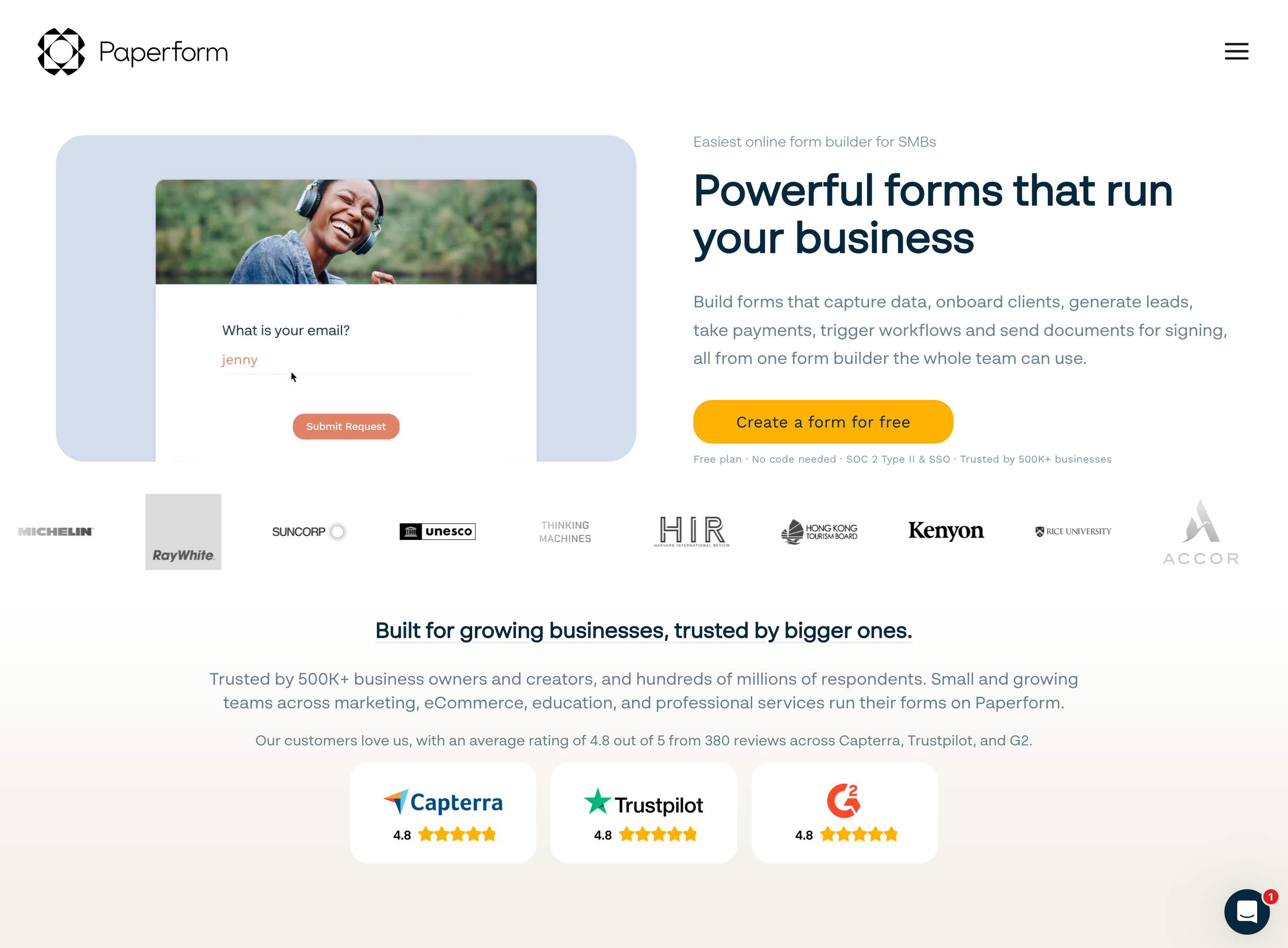
A decade on one problem, and no investor clock running
Paperform was founded in 2016, is bootstrapped, is profitable and has never taken venture funding. Ten years is long enough to have handled the unglamorous cases properly: retention rules, permissioning, partial data, the compliance questions that only surface during procurement. Against most of the field, that tenure argument runs against venture money or a private-equity acquisition. Against Google it runs differently and, for anyone building a process rather than a survey, more sharply.
Forms is one tile in a suite with 3 billion users, and its roadmap serves Workspace strategy. That is why payments have never arrived despite Google owning a payments business, why the integration list is still almost entirely Google properties, and why the biggest Forms release in recent years was Gemini summarisation on paid tiers. Google has retired or absorbed a long list of products adjacent to Forms, and while Forms itself is safe, "safe" and "invested in" are different things. Paperform's entire company is forms, signatures and workflow. When something in that surface is broken or missing, it is the roadmap rather than an item competing with search and cloud for attention.
One subscription instead of Forms plus DocuSign plus Zapier
Count what a Google Forms process actually costs once it grows up. Forms is free. The contract that follows the submission goes to DocuSign or similar. The routing between systems goes to Zapier or Make. The Workspace seats underneath are billed per user per month and climb with headcount. Four vendors, four renewal dates, four admin consoles, and your team owning every join between them.
A Paperform subscription covers three products on every plan: Paperform for forms, Papersign for eSignatures and Stepper for workflow automation, from one account. Pro at $49 per month annually includes 25 signed documents per month and 20,000 automation credits; Business at $124 per month annually includes 100 signed documents, 100,000 credits, 10 workspaces, SSO and the Business API. Seats are unlimited on both paid plans, and a person using all three products counts once. Automation credits are the one metered lever, at $10 per month per additional 10,000 on Pro, which is worth naming rather than burying.
The form can charge people
This is the cleanest illustration of the boundary. A form that asks what someone wants is free in Google Forms. A form that charges them for it does not exist there at any tier. Paperform runs the transaction inside the form across five gateways, with a product catalogue, subscriptions, coupons, discount rules, tax calculation, invoicing and refunds, and prices computed live as the respondent picks options. There is no Paperform transaction fee, and because submissions are unlimited on paid plans, a busy month costs the same as a quiet one.
Logic and calculations that reach past the form
Google Forms jumps between sections. Paperform's calculation engine is written in familiar spreadsheet syntax and decides which questions and pages appear, what a quote totals after discounts and tax, which conditional email fires, what payload an integration receives and what the success page shows. A registration form that applies an early-bird rate until a date, a configurator that prices by square metre, an assessment that routes by band: configuration, not development work. When the branching needs to continue after submission into approvals and handoffs, Stepper carries it in the same subscription.
A page that reads as yours, and analytics that show the funnel
Google branding stays on every form, the URL stays on docs.google.com and customisation stops at four fonts and a header image. Paperform's document-style editor mixes headings, copy, images, video and fields in any order, with custom HTML and CSS, custom fonts and full theming, on your own domain. Paperform is not the only builder with a document-style editor, so judge it on the output rather than the category. Underneath, Paperform reports drop-off and completion, captures partial submissions and lets you run your own Google Analytics, Meta Pixel and custom scripts. Google hosts forms on its own domain, which makes script injection structurally impossible, so conversion tracking on a Google Form does not exist.
Fields for the work, and 30,000+ templates for the flows
Google Forms offers about 11 question types and roughly 20 templates. Paperform offers 26+ field types including appointment booking, payments and products, matrix, colour picker and API-powered dropdowns, plus 30,000+ templates. The useful templates are the ones Google Forms has no version of to template: an order form with pricing logic, a booking that holds a slot, an intake that ends in a signature.
Where Google Forms Falls Short
- No payments at all: zero gateways, no payment field, nothing added by any paid Workspace tier.
- Section-level logic only: no question-level show/hide, no chained conditions, no branching on a calculated value.
- Google branding is permanent: and every form sits on a docs.google.com URL with no custom domain option.
- About 11 question types: no signature, no booking, no rating scales beyond linear, no colour picker.
- No custom scripts: no Google Analytics, no Meta Pixel, no drop-off analysis and no partial submission capture.
- No save and resume: respondents must be signed in to Google to return to a long form, which is both drop-off and an access problem for public audiences.
- Roughly 20 native integrations: almost all Google properties, with no webhooks and no native CRM, marketing or payment connectors.
- No eSignature, workflow automation or document generation: each one becomes a separate vendor.
- Per-user Workspace billing: the seats underneath the free form are $7 to $22 per person per month on an annual commitment.
- About 20 templates: against Paperform's 30,000+.
Where Paperform Falls Short
- No HIPAA compliance and no BAAs: a hard stop for protected health information, where Google Forms is covered.
- No ISO 27001 or FedRAMP: Paperform holds SOC 2 Type II, GDPR and CCPA and nothing from the ISO family.
- It costs money: $49 per month on Pro billed annually against $0, with nothing sold below Pro.
- Smaller review footprint: around 498 reviews in total against Google's five figures.
- No real-time co-editing: Paperform has unlimited seats and roles, but not simultaneous multi-cursor editing of one form.
- No mobile editor: forms are fully responsive for respondents, but building happens at a desktop.
- Automation credits are metered: 20,000 per month on Pro, then $10 per additional 10,000.
- Custom domains cost extra: $20 per month per domain on Pro, with one included on Business.
- Wrong tool for a five-question survey: for that job, use Google Forms. Paperform is built for the workflow behind the form.
See Both Builders in Action
Independent walkthroughs are the quickest way to judge how far each builder goes before you commit anything.
Pricing Comparison
Google Forms' form features are identical on every tier, free through Business Plus, so paying Google more does not buy a better form. Paperform's two paid tiers buy capability rather than capacity, since submissions and seats are unlimited on both. That is the structural difference the table below is showing.

| What you need | Google Forms | Paperform | Net effect |
|---|---|---|---|
| A survey with unlimited responses | $0 | Pro: $59/mo, $49 annually | Google Forms wins on price and there is no argument to make |
| Team accounts and admin controls | $7 to $22 per user per month annually | Included: unlimited seats, no per-user pricing | Google's bill scales with headcount; Paperform's does not |
| Payments inside the form | Not available at any price | Included: 5 gateways, no transaction fee | The Google path is a second checkout tool plus reconciliation |
| Signed contract after submission | Separate eSignature vendor | Papersign: 25 docs/mo on Pro, 100 on Business | One subscription absorbs a second line item |
| Multi-step routing and approvals | Zapier, Make or Apps Script | Stepper: 20,000 credits on Pro, 100,000 on Business | One subscription absorbs a third line item |
Paperform
Google Forms
| Product | Plan | Monthly Price | Annual Price (per month) | Free Plan | Free Trial | Limits |
|---|---|---|---|---|---|---|
| Paperform | Free | Free | Free | Yes | 7 days | forms: Unlimited, submissions: 30/month, storage: Unlimited, users: Unlimited, file uploads: 100 MB |
| Paperform | Pro | $59/mo | $49/mo billed annually | forms: Unlimited, submissions: Unlimited, storage: Unlimited, users: Unlimited, file uploads: 10 GB | ||
| Paperform | Business | $149/mo | $124/mo billed annually | forms: Unlimited, submissions: Unlimited, storage: Unlimited, users: Unlimited, file uploads: 100 GB | ||
| Google Forms | Free (Personal) | Free | Free | Yes | 14 days | forms: Unlimited, submissions: Unlimited, storage: 15 GB (shared across Google Drive), users: 1, file uploads: Included in 15 GB storage |
| Google Forms | Business Starter | $8.4/mo | $7/mo billed annually | forms: Unlimited, submissions: Unlimited, storage: 30 GB per user, users: Up to 300, file uploads: Included in storage | ||
| Google Forms | Business Standard | $16.8/mo | $14/mo billed annually | forms: Unlimited, submissions: Unlimited, storage: 2 TB per user, users: Up to 300, file uploads: Included in storage | ||
| Google Forms | Business Plus | $26.4/mo | $22/mo billed annually | forms: Unlimited, submissions: Unlimited, storage: 5 TB per user, users: Up to 300, file uploads: Included in storage |
Two footnotes on the Google side. The Gemini features inside Forms, including quiz generation and text-response insights, require Business Standard at $14 per user per month annually or above. And the paid Workspace tiers are per user, so a ten-person team on Business Standard is $1,680 a year before anyone has touched a form. Paperform's trial runs 7 days with no credit card required.
What Users Say
Google Forms rates 4.7 on Capterra across 11,572 reviews, with 4.7 for ease of use, 4.8 for value for money and 4.4 for features. TrustRadius puts it at 4.3 across 948 reviews with usability at 9.2 out of 10. The pattern is consistent: people love using it and rate the feature set lowest of the four dimensions, which is exactly the shape you would expect from a free tool that does a narrow job well. Paperform's footprint is far smaller at 104 Capterra reviews and roughly 498 in total, averaging 4.8, with support consistently the top-rated dimension at 4.7 on Capterra and 4.9 on GetApp. Support is included in the seat price on every Paperform plan rather than sold as an enablement fee, which is the practical difference from a free product where the support channel is a help centre article.
The Verdict
Choose Google Forms for surveys, quizzes, RSVPs, internal requests and anything touching protected health information. It is free, everyone already knows it, the Sheets pipeline is excellent and the compliance shelf is deeper than Paperform's. For that work, paying for a form builder is money spent on nothing.
Choose Paperform when the form is one step in a process rather than the whole of it. The moment money has to move, the branding has to be yours, the logic has to work per question, a contract has to be signed or a workflow has to run afterwards, the Google path becomes three or four vendors that you personally hold together. Paperform charges $49 per month on Pro billed annually and covers all of it in one subscription with no per-seat pricing and no metered submissions, from a company that has spent ten profitable years on exactly this problem and answers to its customers rather than to an investor or a suite roadmap.
If you want a wider field before deciding, see our full list of Google Forms alternatives or the overall form builder ranking. Teams weighing Google Forms against a more design-led option should read Paperform vs Typeform.
Frequently Asked Questions
Can I charge someone money through a Google Form?
No, and not on any paid Workspace tier either. Google Forms has no payment field, no Stripe connection and no product catalogue, so the usual workaround is a Forms link followed by a manual invoice, or a second checkout tool with a reconciliation job attached. Paperform takes payments through five gateways: Stripe, PayPal, Square, Braintree and Google Pay, with products, subscriptions, coupons, tax and refunds handled inside the same form. Paperform charges no transaction fee of its own, and because submissions are not metered on paid plans, a strong sales month does not raise the bill.
Does upgrading to a paid Google Workspace plan unlock better forms?
Barely. Workspace Business Starter is $8.40 per user per month flexible, or $7 on an annual commitment, and the money buys storage, admin controls and a business email domain rather than form features. Business Standard at $16.80 (or $14 annually) adds the Gemini features inside Forms: help me create, AI quiz generation and text-response summaries. The form engine itself is the same on the free tier as on Business Plus at $26.40. Payments, custom domains, branding removal, question-level logic and drop-off analytics do not appear at any price.
Is Google Forms HIPAA compliant when Paperform is not?
Yes. Google Forms is covered by Google Workspace's HIPAA compliance, along with GDPR, CCPA, SOC 2, ISO 27001 and FedRAMP. Paperform holds SOC 2 Type II and is GDPR and CCPA compliant, but it is not HIPAA compliant and does not sign Business Associate Agreements. If protected health information passes through the form, Google Forms on an appropriately configured Workspace account is the correct answer between these two and we would rather say so than talk around it.
Why can't I show or hide individual questions in Google Forms?
Google Forms branches at the section level only, using "go to section based on answer" from a multiple choice or dropdown field. There is no way to reveal a single question, chain conditions together or branch on a calculated value. That handles a quiz that forks two ways and falls over on an eligibility check or a tiered quote. Paperform branches at both question and page level off any answer, and Excel-style calculations feed the same logic into conditional emails, integration payloads and success page content.
Can I put a Google Form on my own domain or take the Google branding off?
No. Every Google Form lives on docs.google.com with an auto-generated URL, and Google branding stays on the page at every tier. Customisation stops at a header image, a theme colour, a background colour and four fonts. Paperform serves forms on your own domain with your own slugs and removes Paperform branding from Pro up. The cost is worth stating plainly: custom domains are an extra $20 per month each on Pro, while Business at $124 per month billed annually includes one.
Will Google Forms still exist in five years, and does that matter?
Forms is unlikely to be retired; it underpins Google Classroom and has enormous internal usage. The question is a different one for anyone building a process on top of it. Google has closed or folded away a long list of products around Forms over the years, and the Forms roadmap answers to Workspace strategy rather than to form builders. Paperform was founded in 2016, is bootstrapped and is profitable, and forms, signatures and workflows are the whole company rather than a checkbox in a suite. For a workflow you intend to still be running in 2031, that difference in incentive is worth weighing.
Sources & References
- Google Workspace Pricing — Google, 2026
- Google Forms Review: Is This the Best Free Survey Tool? — TechRadar, 2025
- The 6 best Google Forms alternatives in 2026 — Zapier, 2026
- Top 8 alternatives to Google Forms (paid and free) 2026 — SmartSurvey, April 2026
- Best Google Forms Alternatives in 2026 (Free and Paid Options Compared) — Qualtir, September 2026
- Google Forms API documentation — Google for Developers, 2026
Updates
We re-audit the form builders we compare on a regular cadence and log every change here — a public record of what changed and when.
- Updated September 22, 2026 — Written against the September 2026 data re-audit. Paperform pricing reflects the current Free/Pro/Business/Enterprise lineup (Pro $59/$49, Business $149/$124, unlimited submissions and seats, Papersign and Stepper included on every plan). Google Workspace pricing verified at $8.40/$16.80/$26.40 flexible and $7/$14/$22 on annual commitment, with Gemini-in-Forms features gated to Business Standard and above. Google Forms review counts updated to 11,572 on Capterra.
Last updated September 22, 2026
Ready to try Paperform?
Create beautiful forms, payment pages, and workflows — no code required.