Paperform vs Microsoft Forms: Which Is Better in 2026?
Microsoft Forms is the better choice for internal surveys and quizzes inside a tenant you already pay for, and for anything needing HIPAA with a signed BAA. Paperform is the better choice for customer-facing work, because at $49/month billed annually it adds payments, eSignatures, automation and human support without charging per seat.
These two products are not really competing for the same budget line. Microsoft Forms arrives with a Microsoft 365 subscription, costs nothing extra on top of it, and does a small set of things well enough that nobody needs to justify using it. For a staff engagement survey, a meeting poll or a graded quiz, it is the right answer and this page will not pretend otherwise. Paperform is bought deliberately, on its own terms, to run work that faces a customer and continues after the submit button.
The interesting comparison is what each one costs once the work stops being simple. Forms does its piece and then hands off: Power Automate for the routing, a separate vendor for the signature, Excel for the analysis. Every handoff is another licence, usually metered per user, and the person maintaining the joins is you. That is the real price of the free tool.
Quick Verdict
Stay with Microsoft Forms if:
- The forms are internal and the audience is colleagues
- You need HIPAA with a BAA, FERPA or FedRAMP coverage
- Quizzes with auto-grading are the main use case
- Results need to land in Excel, Teams or Power BI and stop there
- Everyone who will touch a form already holds an M365 licence
- Response volume is enormous and presentation does not matter
Choose Paperform if:
- A customer or prospect will see the form and judge your brand by it
- The form has to take money
- People outside your tenant need to build or edit forms
- You want an answer from a human when something breaks
- A signature or a multi-step approval follows the submission
- You need webhooks, a REST API or non-Microsoft integrations
Five Numbers Worth Writing Down
Pricing
Microsoft Forms costs nothing beyond a Microsoft 365 licence: $7/user/month annually on Business Basic, $14 on Standard, $22 on Premium. Paperform Pro is $59/month, or $49 billed annually, flat, with unlimited submissions and unlimited seats within fair use.
Integrations and API
Paperform connects 4,000+ integrations and ships webhooks plus a REST API. Microsoft Forms lists roughly 20 native connections, all Microsoft, with no public API, no webhooks, no Zapier and no Make.
Conditional logic
Both branch on answers. Microsoft Forms stops at branching and quiz scoring, with no calculation fields and no answer piping. Paperform's Excel-style calculations drive question and page visibility, conditional emails, integration payloads and success page content.
Payments
Paperform supports 5 payment gateways: Stripe, PayPal, Square, Braintree and Google Pay. Microsoft Forms supports 0.
Compliance
Microsoft Forms inherits Microsoft 365 compliance: HIPAA with a BAA, GDPR, CCPA, SOC 2, ISO 27001, FERPA and FedRAMP. Paperform is SOC 2 Type II, GDPR and CCPA compliant, and is not HIPAA compliant and signs no BAAs. On protected health information and on US public sector work, Microsoft wins outright.
Feature Comparison
The feature table reads lopsided because the two products were built for different jobs. Microsoft Forms was built to collect answers from people who are already signed in. Paperform was built to be the front door of a business process, so most of the rows below describe things Forms was never scoped to do.
| Feature | Paperform | Microsoft Forms |
|---|---|---|
| Form Building | ||
| Document-style editor | Yes | No |
| AI form creation | Yes | Yes copilot |
| Field types | 26+ | No |
| File uploads | Yes | No |
| Multi-page forms | Yes | Yes |
| Guided mode (one question at a time) | Yes | No |
| Conditional logic | Yes | Yes |
| Calculations field | Yes pro | No |
| AI calculations assistant | Yes pro | No |
| Scoring | Yes pro | Yes |
| Answer piping | Yes | No |
| Pre-filling and hidden fields | Yes pro | No |
| Save and resume | Yes | No |
| Auto-close by number | Yes pro | Yes |
| Auto-close by date | Yes pro | Yes |
| Appointment/booking field | Yes | No |
| Signature field | Yes | No |
| Color picker field | Yes | No |
| API-powered dropdowns | Yes business | No |
| Google address search | Yes business | No |
| AI agent (Surveys Agent) | No | Yes copilot |
| Payments | ||
| Stripe payments | Yes | No |
| PayPal payments | Yes | No |
| Square payments | Yes | No |
| Braintree payments | Yes | No |
| Google Pay | Yes | No |
| Product sales (eCommerce) | Yes pro | No |
| Subscriptions | Yes pro | No |
| Coupons and discounts | Yes pro | No |
| Custom pricing rules | Yes pro | No |
| Tax calculations | Yes | No |
| Quotes/invoices | Yes | No |
| Refunds | Yes | No |
| 3D Secure | Yes | No |
| Design & Customization | ||
| Template gallery | 30,000+ | Yes |
| Rich media (images, GIFs, videos) | Yes | Yes |
| Unsplash and Giphy integration | Yes | No |
| Image editor | Yes | No |
| Adobe Creative Cloud | Yes | No |
| Language translation | Yes | Yes |
| Advanced theming | Yes pro | No |
| Custom form URL | Yes pro | No |
| Custom domains | Yes pro | No |
| Custom HTML & CSS | Yes pro | No |
| Remove branding | Yes pro | No |
| Custom email domains | Yes business | No |
| Analytics | ||
| Submission results and reports | Yes | Yes |
| AI report insights | Yes pro | Yes |
| Paperform analytics | Yes pro | No |
| Drop-off analysis | Yes pro | No |
| Google Analytics & Facebook Pixel | Yes pro | No |
| Custom analytics scripts | Yes pro | No |
| Partial submissions | Yes pro | No |
| Collaboration | ||
| Multi-user accounts | Yes pro | Yes |
| User permissions and management | Yes pro | Yes |
| Advanced permissions & admin | Yes enterprise | Yes enterprise |
| Form sharing (templates) | Yes | Yes |
| Spaces and tag management | Yes | No |
| Security | ||
| SOC 2 Type II | Yes | Yes |
| GDPR compliant | Yes | Yes |
| SSL encryption | Yes | Yes |
| Two-factor authentication | Yes | Yes |
| Enforce 2FA for all users | Yes business | Yes enterprise |
| SSO (SAML) | Yes business | Yes |
| reCAPTCHA | Yes | No |
| Local data residency | Yes enterprise | Yes enterprise |
| Custom S3 storage (BYO) | Yes business | No |
| Integrations & API | ||
| Native integrations | 4,000+ | No |
| Zapier | Yes | No |
| Make (Integromat) | Yes | No |
| Webhooks | Yes pro | No |
| Standard API | Yes pro | No |
| Business API | Yes business | No |
| WordPress plugin | Yes | No |
| oEmbed support | Yes | Yes |
| 4000+ integrations | No | No |
What Microsoft Forms Gets Right
It costs nothing you are not already spending
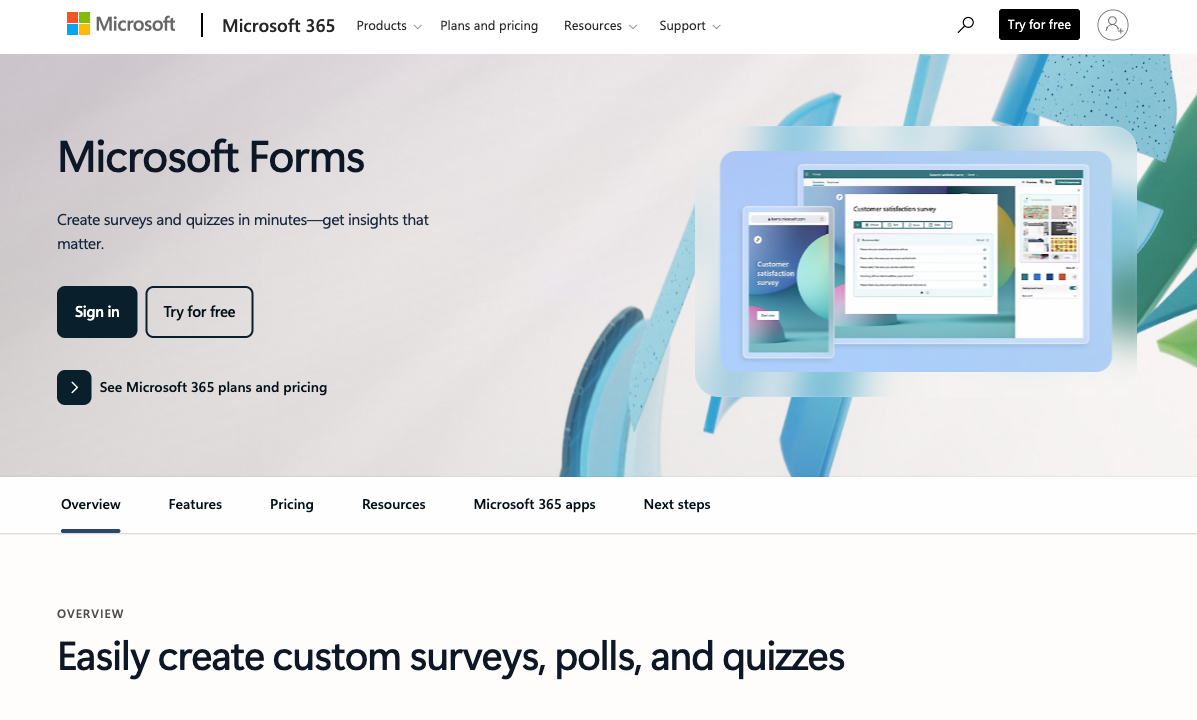
Microsoft Forms is included in every Microsoft 365 plan and in free personal Microsoft accounts. If your organisation runs on M365, the marginal cost of building a survey this afternoon is zero, and no procurement conversation is required. That is a genuine advantage over any standalone tool including Paperform, whose cheapest paid plan is $49/month billed annually. For an HR pulse survey sent to 300 colleagues, spending $49 would be hard to defend.
A compliance posture most vendors cannot match
Forms inherits the full Microsoft 365 compliance estate: HIPAA with a signed BAA, ISO 27001, SOC 2, GDPR, CCPA, FERPA and FedRAMP, with data residency options and Entra ID single sign-on. Paperform holds SOC 2 Type II, GDPR and CCPA, and is not HIPAA compliant. A clinic collecting patient intake or a school district under FERPA has a short list, and Paperform is not on it. Worth verifying one detail with your own team: Microsoft's HIPAA/HITECH offering page does not name Forms as an in-scope service, even though the tenant-level BAA is real.
Scale, and the ecosystem around it
Forms handles up to 5,000,000 responses per form and 400 forms per user on M365 plans, which is more headroom than most businesses will ever need. Results flow straight into Excel, forms can be answered inside a Teams meeting, and Power BI picks up the data without anybody writing a connector. Co-authoring works the way it does everywhere else in Office. None of that is glamorous and all of it removes friction for an internal team.
Quizzes, done properly
Auto-grading, manual grading, per-question comments and math support make Forms a strong assessment tool, which is why it is so widely used in education. Paperform can score a quiz with calculations, but Forms has the grading workflow teachers actually want, in the place they already work. Reviewers agree on the ease of use: 4.6 on G2 and 4.7 on Capterra.
What You Get for $49 a Month
Support that is in the price rather than on a separate invoice
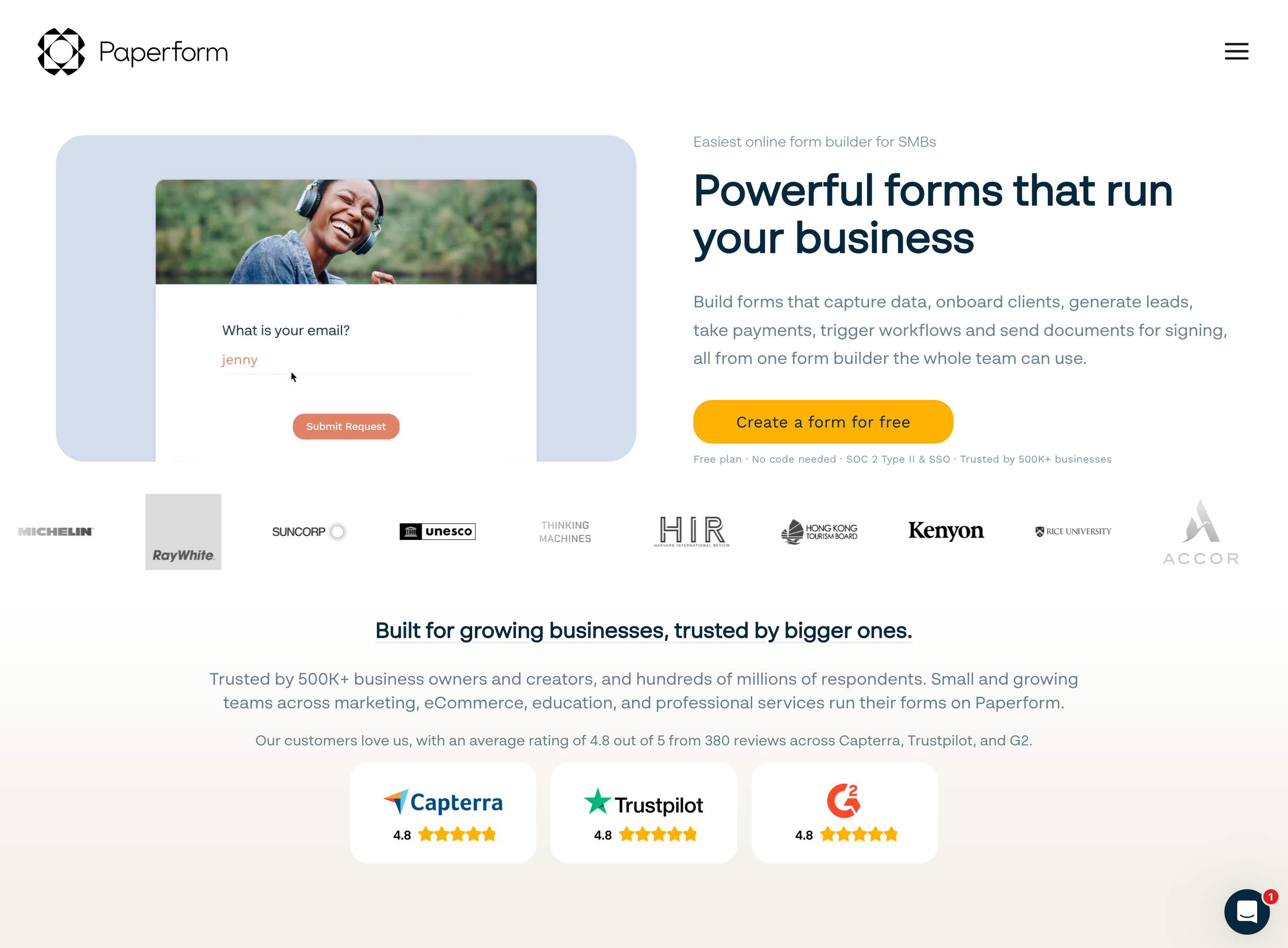
Paperform includes live chat with its Customer Success team on every plan, and support is consistently its highest-rated dimension: 4.7 on Capterra and 4.9 on GetApp. That is a deliberate commercial choice. Enterprise software habitually splits the licence from the enablement, so the contract that looked like $X a seat arrives with a $5,000 to $8,000 onboarding and training line attached at signature. Paperform prices seats the way it does precisely because support is inside them, which means the number on the pricing page is the cost of getting the team running.
Microsoft Forms has no support relationship of its own. When something goes wrong, the path runs through your tenant administrator into the general Microsoft 365 queue, alongside every mailbox and Teams incident in the organisation, and there is no Forms specialist at the end of it. Microsoft Forms scores 4.0 for customer support on G2 and 4.3 on Capterra, its weakest numbers on both platforms, against 4.6 and 4.7 for ease of use. The product is easy; getting help with it is not.
Ten years of building nothing but this
Paperform was founded in 2016, is bootstrapped, and is profitable. There is no investor clock and no parent company whose strategy could reorganise the roadmap. Microsoft Forms was also launched in 2016, but as a bundled feature inside a suite, which means it has no customers of its own to answer to and its capability arrives on Microsoft 365 licensing decisions rather than on demand from people building forms.
The evidence is on the record. The public Forms API has been promised and slipped for years and is now signposted for CY26H1. The July 2026 Copilot chat pane in Forms shipped behind a commercial Microsoft 365 Copilot licence at $21/user/month annually, or $30 on the enterprise SKU, and Surveys Agent is limited to Copilot customers too. Neither decision was about forms. When forms are the entire business, the roadmap answers to the people paying for it, and there is somebody to escalate to who owns the outcome.
The moment money is involved, Forms is out
Microsoft Forms has no payment capability at all. Not a limited one; none. Selling a ticket, taking a deposit or collecting a registration fee means building a checkout somewhere else and reconciling it by hand. Paperform runs the whole order on the form: five gateways, a product catalogue, subscriptions, coupons, tax, quotes and refunds, with the total recalculated live as the respondent picks options. Paperform takes no transaction fee of its own.
Calculations that decide what the form does
Forms can score a quiz. It has no calculation fields, no answer piping and no pre-fill. Paperform's calculations use familiar spreadsheet syntax and reach well past arithmetic: they decide which questions and pages appear, what a quote totals after discount and tax, which conditional email sends, what payload an integration receives and what the success page says. A pricing configurator, an eligibility check that routes by band, an application that computes a fee from three inputs: configuration, not a development project.
One subscription instead of a licensing diagram
Getting from a Microsoft Forms submission to a signed agreement takes Forms, plus Power Automate with premium connectors, plus DocuSign or Adobe Sign. Three renewals, three admin consoles, three per-user meters and your team maintaining the joins. A Paperform subscription covers all three jobs: Papersign for eSignatures at 25 signed documents a month on Pro and 100 on Business, and Stepper for workflow automation with 20,000 automation credits on Pro and 100,000 on Business. The signed document links back to the submission that produced it.
Nobody needs a licence to help
Every person who edits a Microsoft Form needs an M365 seat, from $7 to $99 a month depending on the suite. The freelance designer, the agency partner and the seasonal events coordinator each cost money before they open anything. Paperform seats are unlimited within fair use on every plan and one seat covers forms, signatures and workflows, so adding the sixth or the sixteenth person changes nothing on the invoice. Business adds admin and per-product roles for scoping access.
Where Microsoft Forms Runs Out
- No payments of any kind: no gateway, no products, no subscriptions, coupons, tax or refunds.
- No public API and no webhooks: Power Automate is the only supported exit, licensed per user with premium connectors gated above that.
- No third-party integrations: no Zapier, no Make, no WordPress plugin. The connector list is Microsoft and Microsoft only.
- Customisation stops at a header image and a colour: no custom CSS, no custom domain, no custom form URL, and Microsoft branding cannot be removed.
- Missing everyday fields: no signature, no booking or appointment field, no answer piping, no pre-fill or hidden fields, no save and resume.
- 22 templates: enough for internal surveys and quizzes, nowhere near enough for order forms, onboarding or applications.
- Analytics end at the export: no partial submission tracking, no conversion analytics, no Google Analytics or Facebook Pixel, so the people who abandoned the form never appear in the numbers.
- Not usable outside a Microsoft account: Forms is a feature of a suite, not a standalone product you can buy.
- The better AI is a separate licence: the 2026 Copilot chat experience and Surveys Agent both require Microsoft 365 Copilot at $21 or $30 per user per month.
- No reCAPTCHA: spam prevention leans on account authentication, which does nothing for a genuinely public form.
Where Paperform Runs Out
- No HIPAA compliance and no BAAs: a hard stop for protected health information, and Microsoft covers it.
- No ISO 27001, FERPA or FedRAMP: Paperform holds SOC 2 Type II, GDPR and CCPA, and nothing from that list.
- It costs real money: $49/month billed annually against a licence you already own.
- No native Teams, SharePoint or Power BI experience: integrations exist, but forms do not live inside a Teams meeting the way a Microsoft Form does.
- A far smaller review footprint: around 78 G2 reviews and 104 on Capterra, against 436 and 330 for Microsoft Forms.
- Automation credits are metered: 20,000/month on Pro, then $10 per additional 10,000.
- Custom domains cost extra: $20/month per domain on Pro, with one included on Business.
- No mobile editor: Microsoft Forms can be edited from a phone browser; Paperform building happens on a desktop, though forms are fully responsive for respondents.
- Overkill for a three-question poll: for a simple internal survey, use the simple tool. Paperform is built for the work behind the form.
See Them in Action
Two independent walkthroughs, one per product, are a faster way to judge the builders than any feature table.
Pricing Comparison
Microsoft Forms has no price of its own; it is bundled into Microsoft 365, which is billed per user per month. Paperform is billed per account, flat, with no per-seat charge. Comparing them honestly means counting heads.

| Scenario | Microsoft Forms | Paperform | What decides it |
|---|---|---|---|
| One internal survey | $0 extra on your existing M365 licence | $49/month annually on Pro | Microsoft, comfortably. Use the simple tool for the simple job |
| Eight people building forms | 8 × $7 to $22/user/month on Business Basic through Premium | $49/month annually, seats unlimited | Paperform stops charging as the team grows |
| A form that takes payment | Not possible; needs a separate checkout | 5 gateways included, no transaction fee | Paperform. There is no Microsoft configuration that solves this |
| Form, signature, then approval | Forms + Power Automate premium + DocuSign or Adobe Sign | One subscription: Paperform, Papersign, Stepper | Three renewals and three consoles, or one |
| Conversational AI in the builder | Copilot add-on at $21/user/month annually, $30 enterprise | AI form creation and AI Insights included | Paperform, unless you already hold Copilot licences |
| Patient intake under HIPAA | Covered by the tenant BAA | Not supported, no BAA | Microsoft, outright |
Paperform
Microsoft Forms
| Product | Plan | Monthly Price | Annual Price (per month) | Free Plan | Free Trial | Limits |
|---|---|---|---|---|---|---|
| Paperform | Free | Free | Free | Yes | 7 days | forms: Unlimited, submissions: 30/month, storage: Unlimited, users: Unlimited, file uploads: 100 MB |
| Paperform | Pro | $59/mo | $49/mo billed annually | forms: Unlimited, submissions: Unlimited, storage: Unlimited, users: Unlimited, file uploads: 10 GB | ||
| Paperform | Business | $149/mo | $124/mo billed annually | forms: Unlimited, submissions: Unlimited, storage: Unlimited, users: Unlimited, file uploads: 100 GB | ||
| Microsoft Forms | Free (Personal Microsoft Account) | Free | Free | Yes | 1 month | forms: 400, submissions: 200/form, storage: N/A, users: 1 |
| Microsoft Forms | Microsoft 365 Business Basic | $8.4/mo | $7/mo billed annually | forms: 400, submissions: 5,000,000/form, storage: 1 TB OneDrive per user, users: Per user (1-300 employees) | ||
| Microsoft Forms | Microsoft 365 Business Standard | $16.8/mo | $14/mo billed annually | forms: 400, submissions: 5,000,000/form, storage: 1 TB OneDrive per user, users: Per user (1-300 employees) | ||
| Microsoft Forms | Microsoft 365 Business Premium | $26.4/mo | $22/mo billed annually | forms: 400, submissions: 5,000,000/form, storage: 1 TB OneDrive per user, users: Per user (1-300 employees) | ||
| Microsoft Forms | Microsoft 365 Business Standard with Copilot | Not listed | $23.5/mo billed annually | forms: 400, submissions: 5,000,000/form, storage: 1 TB OneDrive per user, users: Per user (1-300 employees) | ||
| Microsoft Forms | Microsoft 365 Business Premium with Copilot | Not listed | $32/mo billed annually | forms: 400, submissions: 5,000,000/form, storage: 1 TB OneDrive per user, users: Per user (1-300 employees) | ||
| Microsoft Forms | Microsoft 365 Apps for business | Not listed | $10/mo billed annually | forms: 400, submissions: 5,000,000/form, storage: 1 TB OneDrive per user, users: Per user |
Two details the table cannot hold. Microsoft raised Business Basic to $7/user/month annually and Standard to $14 on July 1, 2026, with month-to-month billing carrying roughly a 20% premium, so the per-seat number is a moving target. And Paperform's 7-day trial takes no credit card, while a Microsoft 365 trial does.
What Users Say
Microsoft Forms rates 4.4 on G2 across 436 reviews and 4.5 on Capterra and GetApp across 330 each, and the shape of those scores is consistent: ease of use is the high point at 4.6 and 4.7, value for money follows at 4.5 and 4.6, and customer support sits lowest at 4.0 and 4.3. Capterra scores features at 4.3, the weakest of its four dimensions. Reviewers on G2 describe it as very basic, citing the absence of people fields, date-and-time handling and term store links. Paperform's footprint is much smaller at 78 G2 reviews and 104 on Capterra, and its ratings run higher at 4.8, with support the highest-rated dimension rather than the lowest.
The Verdict
Stay with Microsoft Forms for internal work. A survey for colleagues, a quiz for students, a poll in a Teams meeting, a registration list that ends in an Excel file: Forms does all of it at no additional cost, at enormous scale, under a compliance umbrella that includes HIPAA, FERPA and FedRAMP. Choosing anything else for that job is paying for capability you will not use.
Choose Paperform when the form faces outward. Once a customer sees it, once it takes money, once a signature and an approval chain follow it, or once people who do not hold an M365 licence need to build one, Forms stops being free and starts being the first of four line items with you as the integration between them. The $49 a month buys the whole path in one subscription, with a human on live chat included in the seat price rather than quoted as enablement, from a company that has done nothing but build forms since 2016 and does not answer to an investor or a parent.
Comparing more of the field first is reasonable. See our full list of Microsoft Forms alternatives, the overall form builder ranking, or Google Forms vs Microsoft Forms if the real decision is between the two suite-bundled options.
Frequently Asked Questions
Who do I actually contact when a Microsoft Form breaks?
Your tenant administrator, and then Microsoft 365 support on the same ticket queue that handles Exchange and Teams. Forms is a bundled feature rather than a product with its own support desk, so there is no Forms specialist to escalate to and no commercial relationship that is specifically about your forms. Microsoft Forms rates 4.0 for customer support on G2, the lowest of its scored dimensions. Paperform puts live chat with the Customer Success team into every plan at no separate cost, and support scores 4.7 on Capterra and 4.9 on GetApp.
Does Microsoft charge extra for onboarding or training on Forms?
Not for Forms itself, because there is nothing to onboard onto beyond the M365 licence you already bought. The cost lands elsewhere. The parts that make Forms do real work are separately licensed: Power Automate premium connectors, a signature vendor, and Microsoft 365 Copilot at $21/user/month annually on Copilot Business or $30 on the enterprise SKU for the July 2026 Copilot chat pane and Surveys Agent. Enterprise platform deals routinely add a $5,000 to $8,000 enablement line at signing. Paperform builds support into the seat price, so the number on the pricing page is the cost of getting a team running.
Can I collect payments through Microsoft Forms?
No. Microsoft Forms has zero payment processing: no Stripe, no PayPal, no product catalogue, no subscriptions, coupons, tax calculation or refunds. Collecting money means building a checkout beside the form or moving to a different tool entirely. Paperform supports five gateways natively (Stripe, PayPal, Square, Braintree and Google Pay), charges no transaction fee of its own, and computes totals, discounts and tax in the form with Excel-style calculations.
Is there a Microsoft Forms API or webhook I can build against?
No. There is no public REST API for Microsoft Forms and no webhook support. Some operations are reachable through Microsoft Graph, and a dedicated Forms API has been signposted repeatedly, most recently for CY26H1, without shipping. Power Automate is the supported route out, and it is licensed per user with premium connectors gated above that. Paperform ships a REST API and webhooks on paid plans, a separate Business API on the $124/month annual tier, and 4,000+ integrations.
Microsoft Forms is HIPAA compliant. Is Paperform?
No, and this is the clearest case for staying with Microsoft. Microsoft Forms inherits Microsoft 365 compliance including HIPAA with a signed BAA, ISO 27001, FERPA and FedRAMP. Paperform holds SOC 2 Type II and is GDPR and CCPA compliant, but it is not HIPAA compliant and signs no BAAs. One caveat worth checking with your own compliance team: Microsoft's HIPAA/HITECH offering page does not enumerate Forms as a named in-scope service, so confirm coverage before routing protected health information through it.
How many people can build forms, and what does each one cost?
In Microsoft Forms, everyone who touches a form needs a licence: $7/user/month annually on Business Basic after the July 1, 2026 increase, $14 on Standard, $22 on Premium, and $39 to $99 on the E3, E5 and E7 suites. A contractor or an agency partner who needs to edit one form costs a seat. Paperform does not price by seat at all. Seats are unlimited on every plan within fair use, one seat covers forms, signatures and workflows, and Business adds admin and per-product roles to scope who sees what.
Sources & References
- Microsoft 365 Business Plans and Pricing — Microsoft, September 2026
- Microsoft Forms review — TechRadar, 2026
- Microsoft Forms Reviews — G2, September 2026
- Microsoft Forms Reviews — Capterra, September 2026
- Best Online Form Builder to Use in 2026: Top 20 Tools — EmailToolTester, 2026
- The 13 best online form builder apps — Zapier, 2026
Updates
We re-audit the form builders we compare on a regular cadence and log every change here — a public record of what changed and when.
- Updated September 22, 2026 — Written against the September 2026 data re-audit. Paperform pricing reflects the current Free/Pro/Business/Enterprise lineup (Pro $59/$49, Business $149/$124, unlimited submissions and seats). Microsoft 365 pricing reflects the July 1, 2026 increase (Business Basic $7, Standard $14, Premium $22 per user per month annually) plus the Microsoft 365 Copilot add-on at $21/$30 per user per month, the July 2026 Copilot chat pane in Forms, and the Forms public API slipping to CY26H1.
Last updated September 22, 2026
Ready to try Paperform?
Create beautiful forms, payment pages, and workflows — no code required.