 By Dean McPherson, Co-founder & CTO, Paperform · Updated
Airtable Forms vs Formstack: Database Widget or Enterprise Suite? (2026)
Airtable Forms is a free data entry widget — a form view within Airtable's database platform that creates simple intake forms for populating bases. Formstack is an enterprise form and workflow platform with conditional logic, payment processing, e-signatures, document generation, HIPAA compliance, and approval workflows starting at ~$83/month (annual).
These tools serve very different needs. Airtable Forms is for quick internal data entry into Airtable. Formstack is for enterprise teams that need professional forms, compliance, document workflows, and governance. If you're comparing them, you're likely deciding between "free and basic" or "paid and comprehensive."
Quick Verdict
Choose Airtable Forms if:
- You already use Airtable and need simple record intake
- Budget is the primary concern (free with Airtable)
- The form is internal, with no logic, payments, or compliance needed
- You need Airtable's relational views and automations on the backend
Choose Formstack if:
- You need conditional logic, branching, or multi-page forms
- You need HIPAA compliance or enterprise governance
- You need e-signatures and document generation
- You need payment processing and approval workflows
- You need SSO, role-based access, and audit trails
Feature Comparison
Formstack is an enterprise form suite; Airtable Forms is a database widget. The gap reflects their different purposes.
| Feature | Airtable Forms | Formstack |
|---|---|---|
| Form Building | ||
| AI form builder . Describe the form you need in plain language and the tool drafts the questions for you. | Yes | Yes forms |
| Templates . The number of ready-made form templates in the tool’s template gallery. | 5 | Yes forms |
| Field types . How many kinds of question or input field the form builder offers, such as text, dropdown, date, file upload and signature. | Yes | 20+ (forms) |
| Conditional logic . Show, hide or skip questions and pages based on how someone has answered earlier questions. | Yes | Yes forms |
| Calculations . Compute totals, scores, prices or dates from answers while the form is being filled in. | No | Yes forms |
| Multi-page forms . Split a long form across several pages that respondents move through in order. | No | Yes forms |
| One question at a time . A conversational layout that shows a single question per screen, popular for surveys on mobile. | No | Yes forms |
| Answer piping . Insert a respondent’s earlier answer, such as their name, into later questions or text on the form. | No | Yes forms |
| Pre-filling and hidden fields . Fill in answers ahead of time from a link or existing data, and pass along values the respondent never sees. | Yes | Yes forms |
| File uploads . Let respondents attach files such as documents and photos to their submission. | Yes | Yes forms |
| E-signatures . Collect a signature, either with a signature field on the form or by sending a document out to be signed. | No | Yes forms |
| Appointment booking . Let respondents pick and book a time slot directly in the form, with availability managed by the tool. | No | Not recorded |
| Quiz scoring . Give answers point values so the form can score quizzes and assessments automatically. | No | Yes forms |
| Save and resume . Respondents can leave a form part-way through and come back later to finish it. | No | Yes forms |
| Close forms by date or response limit . Stop accepting submissions automatically on a set date or once a set number of responses has arrived. | No | Yes forms |
| Payments | ||
| Payment gateways . The number of payment processors a form can take payments through. Where a vendor’s full count isn’t recorded, the cell lists the gateways we confirmed. | No | 3 (forms) Stripe, Authorize.net, PayPal |
| Subscriptions and recurring payments . Charge respondents on a repeating schedule, such as monthly or annually, from a form. | No | Yes forms |
| Product sales . Sell products from a form, with product listings, quantities and an order total. | No | Yes forms |
| Conditional pricing . Change the price or add fees automatically based on the answers given in the form. | No | Yes forms |
| Coupons and discounts . Offer discount codes that respondents can apply to a payment or subscription on the form. | No | Yes forms |
| Tax calculations . Add sales tax to payments on the form automatically. | No | Not recorded |
| Refunds . Refund a payment from inside the form tool rather than going to the payment processor. | No | Not recorded |
| Design & Customization | ||
| Custom themes . Set your own logo, colours and fonts on forms and save them as reusable themes. | Yes Team | Yes forms |
| Custom CSS . Add your own CSS (and in some tools HTML) for styling beyond the built-in theme options. | No | Yes forms |
| Remove vendor branding . Remove the form builder’s own logo or badge so forms carry only your branding. | Yes Team | Yes forms |
| Custom domain . Host forms on your own domain, such as forms.yourcompany.com, instead of the vendor’s. | No | Yes |
| Custom form URL . Choose a readable link for a form instead of a random string. | No | Yes forms |
| Emails from your own domain . Send notification and confirmation emails from your own email domain instead of the vendor’s. | No | Yes |
| Multi-language forms . Show a form’s questions, buttons and messages in languages other than English. | No | Yes forms |
| Analytics | ||
| Response reports . Built-in summaries and charts of the answers a form has collected. | Yes | Yes forms |
| Form analytics (views and drop-off) . Track how many people view, start and finish a form, and where they abandon it. | No | Yes forms |
| Partial submissions . See the answers people entered before leaving a form without submitting it. | No | No |
| Google Analytics and Meta Pixel . Connect a form to Google Analytics or the Meta (Facebook) Pixel to track visits and conversions. | No | No |
| Custom tracking scripts . Add your own analytics or conversion-tracking scripts to a form. | No | Not recorded |
| AI response insights . AI-written summaries and insights generated from the responses a form has collected. | Yes | Not recorded |
| Collaboration | ||
| Team members . Invite colleagues into the same account to build forms and work with responses together. | Yes | Yes forms |
| Roles and permissions . Give team members different levels of access, such as admin, editor or viewer. | Yes | Yes forms |
| Advanced permissions and admin controls . Fine-grained, organisation-wide controls over who can access what, usually on enterprise plans. | Yes Business | Yes enterprise |
| Workspaces . Separate spaces or folders for organising forms by team, client or project. | Yes | Yes forms |
| Security | ||
| Two-factor authentication . Users can protect their login with a second step, such as a code from an authenticator app. | Yes | Yes forms |
| Require 2FA for the whole team . Admins can make two-factor authentication mandatory for everyone in the account. | Yes Enterprise Scale | Yes forms |
| SSO (SAML) . Team members sign in through your company’s identity provider, such as Okta or Microsoft Entra ID, using SAML single sign-on. | Yes Business | Yes enterprise |
| HIPAA compliance . Whether the vendor supports collecting US protected health information under HIPAA, typically by signing a business associate agreement on an eligible plan. | Yes Enterprise Scale | Yes enterprise |
| SOC 2 . Whether the vendor holds a SOC 2 audit report covering its security controls. | Yes | Yes |
| GDPR . Whether the vendor states that it complies with the EU General Data Protection Regulation. | Yes | Yes forms |
| Data residency . Choose the region, such as the EU, where your form data is stored. | Yes Enterprise Scale | No |
| Store files in your own S3 bucket . Send uploaded files and exports to your own Amazon S3 storage instead of the vendor’s. | No | Yes forms |
| Spam protection (CAPTCHA) . Block bot and spam submissions with reCAPTCHA or a similar challenge. | No | Yes forms |
| Integrations & API | ||
| Native integrations . Apps the tool connects to directly, without going through a third-party connector such as Zapier or Make. | Yes | Not recorded |
| Zapier . Connect forms to thousands of other apps through Zapier. | Yes | Yes forms |
| Make . Connect forms to other apps through Make (formerly Integromat). | Yes | Not recorded |
| Workflow automation . A built-in builder for multi-step automations that act on submissions, such as approvals, routing and syncing data to other systems. | Yes | Yes suite |
| Webhooks . Send each new submission to a URL of your choice as soon as it arrives. | No | Yes forms |
| API access . A developer API for reading forms and submissions, or managing them, from your own code. | Yes | Yes enterprise |
| MCP server / AI assistant connector . An official connector, such as an MCP server, that lets AI assistants like Claude or ChatGPT work with your forms and responses. | Yes | Not recorded |
| WordPress plugin . A plugin for adding forms to a WordPress site. | No | Yes forms |
— means we haven't recorded it for that tool.
Where Airtable Forms Wins
Free With Airtable
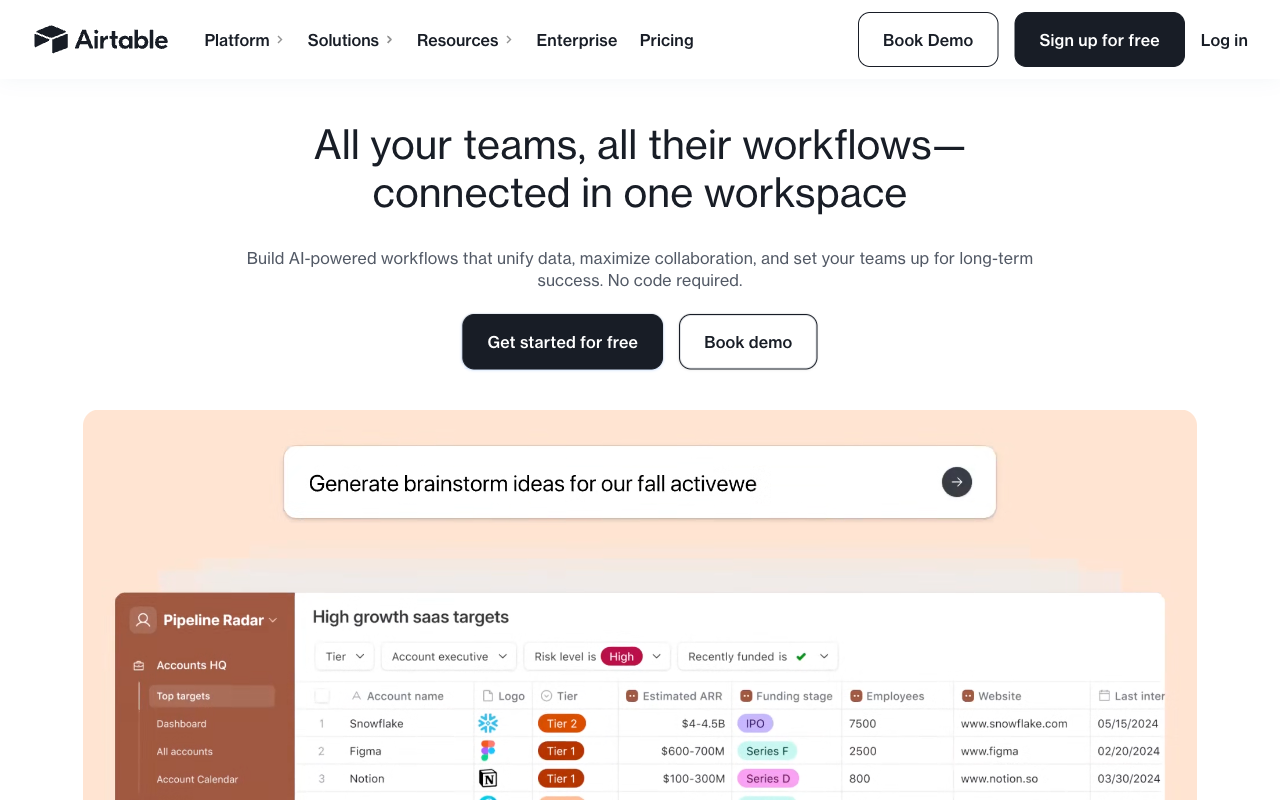
Airtable Forms is included with every Airtable plan. Formstack starts at approximately $83/month (annual) with no free tier. For teams that need basic forms and already use Airtable, the cost difference is significant, especially for small teams where Formstack's enterprise pricing feels disproportionate to their needs.
Relational Database Backend
Submissions become Airtable records instantly: linked records, multiple views, automations, and formulas apply automatically. Formstack stores data in its own system, which is table-based without relational features. For teams that need to relate form data across tables, track it in Kanban boards, or trigger database automations, Airtable's backend is stronger.
Simplicity
Airtable Forms is dead simple: select fields from your base, share the link. No learning curve, no configuration. Formstack is a feature-rich platform with conditional logic, workflow builders, approval chains, and document generation, all powerful but with a steeper learning curve. For basic intake forms, Airtable's simplicity is a feature.
Where Formstack Wins
Conditional Logic and Branching
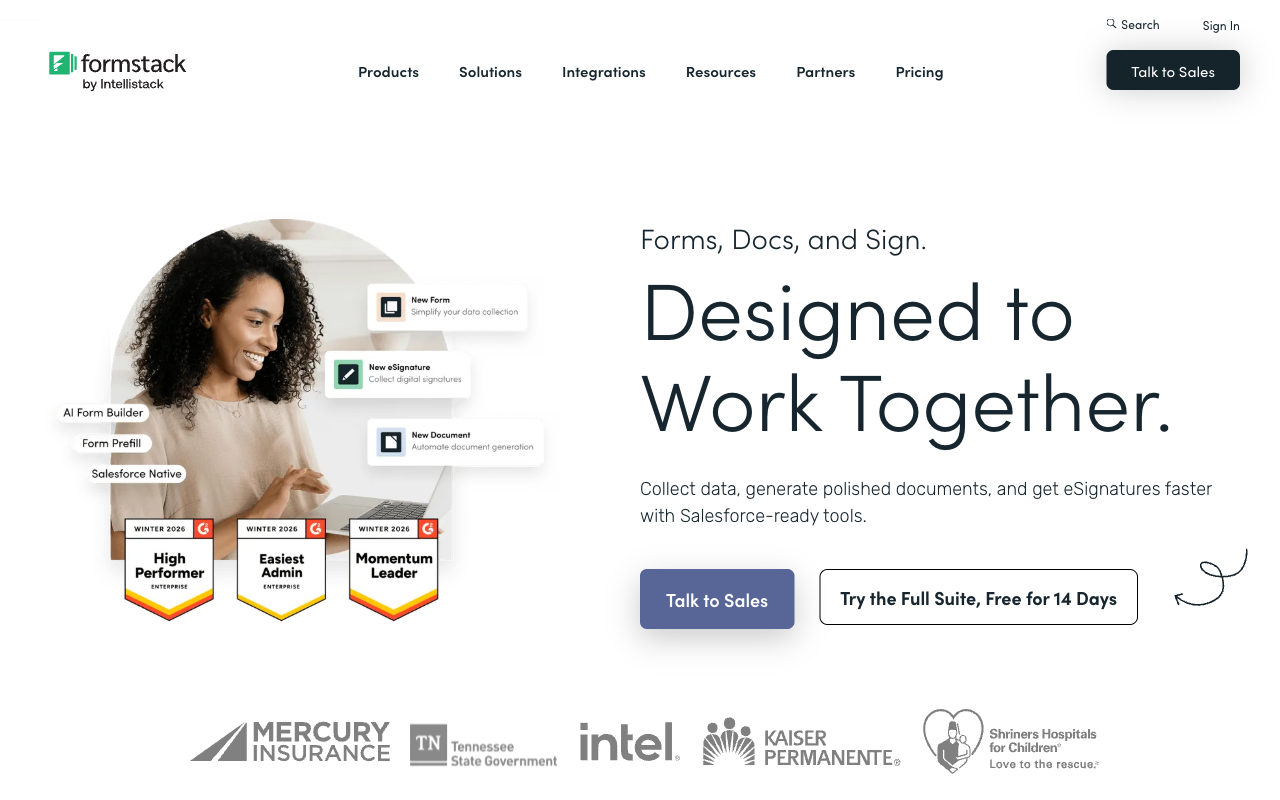
Formstack supports advanced conditional logic: show/hide fields, skip pages, route respondents based on answers, and create dynamic multi-step experiences. Airtable Forms has only basic conditional field visibility (show/hide fields; conditional groups require the Business plan) with no page-level branching or multi-step logic. For applications, surveys, registrations, or diagnostic forms, Formstack is the stronger option here.
E-Signatures and Document Generation
Formstack includes Formstack Sign for electronic signatures and Formstack Documents for automated document generation from form data. Contracts, agreements, proposals, and PDFs are generated automatically from submissions. Airtable Forms has no signature field, no document generation, and no PDF output of any kind.
Enterprise Compliance
Formstack offers HIPAA compliance with BAA, SSO, role-based access, and audit trails. For healthcare providers, financial institutions, and enterprises with governance requirements, these capabilities are non-negotiable. Airtable's compliance options are limited to Enterprise Scale (custom pricing) and don't cover the forms feature specifically.
Payment Processing
Formstack integrates with Stripe, PayPal and Authorize.net for payment collection on forms. Airtable Forms has zero payment capability. For event registrations, product orders, or donation forms, Formstack is the only option between these two.
Approval Workflows
Formstack includes approval workflows: submissions can route through review chains with approve/reject actions, notifications, and escalation. Airtable Automations exist but aren't designed as form-level approval workflows. For HR, procurement, or any process requiring review before action, Formstack's native approvals are purpose-built.
Where Airtable Forms Falls Short
- Limited conditional logic: Basic show/hide field visibility only (conditional groups require the Business plan). No page-level branching or skip logic.
- No e-signatures or documents: No signature field, no document generation, no PDF output.
- No payment processing: Zero payment gateway support.
- Limited compliance on lower plans: SOC 2 Type II is included, but HIPAA and advanced governance require the Enterprise Scale plan.
- No approval workflows: No built-in review/approve chain for submissions.
- Minimal design control: Cover image and description only.
Where Formstack Falls Short
- Expensive: Starting at ~$83/month (annual) with no free plan. The Suite plan exceeds $250/month.
- No relational database: Submissions stored as flat records, not in a relational database with views.
- No native Airtable integration: Connecting to Airtable requires Zapier.
- Complex for simple use cases: The enterprise feature set is overkill for basic data collection.
- Template library is moderate: Fewer templates than some competitors like Jotform or Paperform.
- Design feels corporate: Forms are functional but lack the visual appeal of newer form builders.
Pricing Comparison
Free database widget vs paid enterprise suite, at very different price points.
| Tier | Airtable (includes Forms) | Formstack | Key Difference |
|---|---|---|---|
| Free / Starter | Free — 1,000 records/base | Forms: ~$83/mo (annual) — 25 forms, logic | Airtable is free; Formstack starts at ~$83/mo |
| Team / Mid | Team: $20/user/mo — 50K records | Suite: ~$250/mo (annual) — e-signatures, documents | Formstack adds e-sig and doc gen at this tier |
| Enterprise | Enterprise Scale: Custom | Enterprise: Custom — HIPAA, SSO, approvals | Formstack adds compliance; Airtable adds platform admin |
What will it cost you?
Airtable Forms plans
- FreeCheck limitsFreeForms No published cap (unlimited bases), Submissions 1,000 records per base (total, not per month), Team 5, Storage 1GB per base
- Team$20/moForms No published cap (unlimited bases), Submissions 50,000 records per base (total, not per month), Team Unlimited editors, each billed per seat, Storage 20GB per base
- Business$45/moForms No published cap (unlimited bases), Submissions 125,000 records per base (total, not per month), Team Unlimited editors, each billed per seat, Storage 100GB per base
- Enterprise ScaleCustomForms No published cap (unlimited bases), Submissions 500,000 records per base (total, not per month), Team Unlimited editors, each billed per seat, Storage 1,000GB per base
| Plan | Price | Forms | Submissions | Team | Storage |
|---|---|---|---|---|---|
| FreeCheck limits | Free | No published cap (unlimited bases) | 1,000 records per base (total, not per month) | 5 | 1GB per base |
| Team | $20/mo | No published cap (unlimited bases) | 50,000 records per base (total, not per month) | Unlimited editors, each billed per seat | 20GB per base |
| Business | $45/mo | No published cap (unlimited bases) | 125,000 records per base (total, not per month) | Unlimited editors, each billed per seat | 100GB per base |
| Enterprise Scale | Custom | No published cap (unlimited bases) | 500,000 records per base (total, not per month) | Unlimited editors, each billed per seat | 1,000GB per base |
Formstack plans
- Forms$83/moForms 25, Submissions 1,000/form, Team 1, Storage 2 GB
- SuiteCheck limits$250/moForms 100, Submissions 5,000/form, Team 3, Storage 10 GB
| Plan | Price | Forms | Submissions | Team | Storage |
|---|---|---|---|---|---|
| Forms | $83/mo | 25 | 1,000/form | 1 | 2 GB |
| SuiteCheck limits | $250/mo | 100 | 5,000/form | 3 | 10 GB |
| Product | Plan | Monthly Price | Annual Price (per month) | Free Plan | Free Trial | Limits |
|---|---|---|---|---|---|---|
| Airtable Forms | Free | Free | Free | Yes | 14 days | forms: No published cap (unlimited bases), submissions: 1,000 records per base (total, not per month), storage: 1GB per base, users: 5 |
| Airtable Forms | Team | $24/mo | $20/mo billed annually | forms: No published cap (unlimited bases), submissions: 50,000 records per base (total, not per month), storage: 20GB per base, users: Unlimited editors, each billed per seat | ||
| Airtable Forms | Business | $54/mo | $45/mo billed annually | forms: No published cap (unlimited bases), submissions: 125,000 records per base (total, not per month), storage: 100GB per base, users: Unlimited editors, each billed per seat | ||
| Airtable Forms | Enterprise Scale | Custom | Custom | forms: No published cap (unlimited bases), submissions: 500,000 records per base (total, not per month), storage: 1,000GB per base, users: Unlimited editors, each billed per seat | ||
| Formstack | Forms | $99/mo | $83/mo billed annually | No | 14 days | forms: 25, submissions: 1,000/form, storage: 2 GB, users: 1, file uploads: 2 GB |
| Formstack | Suite | $299/mo | $250/mo billed annually | forms: 100, submissions: 5,000/form, storage: 10 GB, users: 3, file uploads: 10 GB |
What Users Say
Formstack is praised by enterprise users for compliance, e-signatures, and workflow automation. Criticism centres on pricing and a learning curve. Airtable reviews focus on the database platform; form-specific feedback consistently notes the builder is too basic. For enterprise form needs, Formstack is the consensus choice. For database-centric workflows, Airtable wins as a platform.
Consider Paperform
If Formstack's enterprise pricing is too high and Airtable Forms is too limited, Paperform fills the middle ground. Paperform's document-style editor creates forms resembling designed landing pages, with an Excel-style calculation engine that powers dynamic pricing, scoring, and conditional totals across questions, pages, emails, integrations, and success pages.
The deeper difference is what gets metered. Formstack meters forms and submissions, and Airtable meters records and per-user seats, so growth raises the bill. Paperform meters none of them: submissions, seats and automation runs are unlimited on every paid plan, starting at $49/month billed annually ($59 monthly). Airtable Forms is still cheaper at entry, since it costs nothing, but it is a data-entry widget rather than a form platform.
One subscription also covers all three products rather than three vendors stitched together: Paperform for forms, Papersign for eSignatures and Stepper for workflow automation. That replaces the Formstack Forms + Sign + Documents stack, and the Zapier hop to Airtable, with a single bill. It includes five payment gateways, conditional logic, 9,800+ integrations (including Airtable), and 30,000+ templates, on a permanent free plan with no card required. Founded in 2016, bootstrapped and profitable. See our full ranking.
The Verdict
Formstack wins on every form-building dimension. Conditional logic, e-signatures, document generation, payment processing, HIPAA compliance, approval workflows, and enterprise governance — Formstack is a professional form platform. Airtable Forms is a widget.
Airtable Forms wins on cost and data backend. Free with Airtable, zero configuration, and a relational database with views and automations behind it. If basic data entry into Airtable is all you need, paying $83+/month for Formstack is overkill.
Both companies are established. Formstack (founded 2006) has been serving enterprise customers for nearly two decades. Airtable (founded 2012, $735M raised) is one of the most well-funded productivity platforms. Platform longevity isn't a concern for either.
Frequently Asked Questions
Is Formstack worth the price over free Airtable Forms?
If you need a real form builder, yes. Formstack offers conditional logic, payment processing, e-signatures (via Formstack Sign), document generation, HIPAA compliance (included on Enterprise, a paid add-on on Forms), and workflow automation. Airtable Forms has none of these beyond basic field visibility, and Airtable's HIPAA sits on Enterprise Scale. The $99/month price is justified for businesses that need professional forms with logic, payments, and compliance. If you genuinely only need basic data entry into Airtable, the free forms are adequate.
Can Formstack send data to Airtable?
Yes. Formstack integrates with Airtable through Zapier, sending form submissions to Airtable bases automatically. This gives you Formstack's full form-building suite on the frontend with Airtable's relational database on the backend. The integration adds a step, but the result is more capable than either tool alone.
Which is better for enterprise use?
Formstack is designed for enterprise. It offers HIPAA compliance with BAA, SSO, role-based access, approval workflows, and document generation. Airtable has enterprise features for the database platform but the forms feature itself remains basic regardless of plan. For enterprise form requirements such as compliance, governance and workflows, Formstack is purpose-built.
Does Formstack have a free plan?
No. Formstack starts at approximately $83/month annual ($99/month) on the Forms plan. There's a 14-day free trial but no permanent free tier. Airtable Forms is free with any Airtable account. If cost is the primary factor and you don't need form logic, payments, or compliance, Airtable Forms wins on price alone.
Sources & References
- Formstack vs Airtable Comparison — G2, 2026
- Airtable Form View Documentation — Airtable, 2026
Updates
We re-audit the form builders we compare on a regular cadence and log every change here — a public record of what changed and when.
- Updated June 4, 2026 — Corrected Formstack pricing to ~$83/month annual and renamed its plans from 'Starter' and 'Teams' to 'Forms' and 'Suite' (Suite now exceeds $250/month). Reframed Airtable Forms as having basic conditional field visibility rather than none, clarified its SOC 2 and HIPAA compliance, and dropped Make from the Airtable integration path.
Unlimited plans are subject to each vendor's fair use policy.
Ready to try Paperform?
Create beautiful forms, payment pages, and workflows — no code required.