Fillout vs Gravity Forms: Which Is Better in 2026?
Gravity Forms is better if you run WordPress and want unlimited entries for $59 to $259 a year on infrastructure you control. Fillout is better if you want a hosted form with SOC 2 attestation, 50+ native integrations and payments working today, and you can live inside its monthly response cap.
These two products disagree about who should own the plumbing. Gravity Forms has sold the same answer since 2008: buy a licence, install it on your own WordPress site, and everything after that is yours to run. Fillout, founded in 2022 and now trading as Fillout by Zite, sells the opposite deal. It hosts the form, the storage, the scheduling, the PDF generation and the integrations, and it prices that by how many responses you collect each month.
So the real question is not which builder has more fields. It is whether you would rather pay a flat annual licence and accept a maintenance job, or pay a monthly subscription that rises with your own success. Both answers are defensible. They are also both incomplete once the form is the front door to a process rather than the whole task, which is where the third option at the bottom of this page comes in.
Quick Verdict
Choose Fillout if:
- You do not run WordPress, or do not want to
- You need a vendor with a SOC 2 Type 2 attestation on file
- Airtable, Notion or HubSpot is the destination for your data
- Stripe is your processor and you want payments live immediately
- Your volume sits comfortably under the tier you are paying for
Choose Gravity Forms if:
- Your site is WordPress and the form belongs inside it
- Response volume is high and you refuse to be billed for it
- You have a developer who will use the 500+ hooks and the REST API
- You need PayPal, Square or Mollie rather than Stripe alone
- Form data must stay in a database you own
Feature Comparison
Fillout ships more product out of the box; Gravity Forms ships more extensibility. The table below is generated from our audited feature data for both tools.
| Feature | Fillout | Gravity Forms |
|---|---|---|
| Form Building | ||
| Document-style editor | No | No |
| AI form creation | Yes | Yes Basic |
| AI agent in the form editor (Form Agent) | Yes | No |
| Field types | 50+ | No |
| Multi-page forms | Yes | Yes Basic |
| Guided mode (one question at a time) | No | Yes Elite |
| Conditional logic | Yes | Yes Basic |
| Calculations field | Yes | Yes Basic |
| AI calculations assistant | No | No |
| Scoring | Yes | Yes Elite |
| Answer piping | Yes | Yes Basic |
| Pre-filling and hidden fields | Yes | Yes Basic |
| Save and resume | Yes | Yes Basic |
| Auto-close by number | Yes | No |
| Auto-close by date | Yes | No |
| Appointment/booking field | Yes starter | No |
| Signature field | Yes starter | Yes Elite |
| Color picker field | No | No |
| API-powered dropdowns | No | No |
| Google address search | Yes conversion-kit | No |
| File uploads | Yes | No |
| Drag-and-drop builder | No | Yes Basic |
| 30+ field types | No | Yes Basic |
| Payments | ||
| Stripe payments | Yes | Yes Pro |
| PayPal payments | No | Yes Pro |
| Square payments | No | Yes Pro |
| Braintree payments | No | No |
| Google Pay | No | Yes Pro |
| Product sales (eCommerce) | Yes | Yes Basic |
| Subscriptions | Yes | Yes Pro |
| Coupons and discounts | Yes | Yes Elite |
| Custom pricing rules | Yes | No |
| Tax calculations | No | No |
| Quotes/invoices | No | No |
| Refunds | No | Yes Pro |
| 3D Secure | No | Yes Pro |
| Design & Customization | ||
| Template gallery | Yes | Yes Basic |
| Rich media (images, GIFs, videos) | Yes | Yes Basic |
| Unsplash and Giphy integration | No | No |
| Image editor | No | No |
| Adobe Creative Cloud | No | No |
| Language translation | No | Yes Basic |
| Advanced theming | Yes starter | Yes Basic |
| Custom form URL | Yes pro | No |
| Custom domains | Yes business | No |
| Custom HTML & CSS | Yes pro | Yes Basic |
| Remove branding | Yes pro | Yes Basic |
| Custom email domains | Yes pro | Yes Elite |
| Analytics | ||
| Submission results and reports | Yes | Yes Basic |
| AI report insights | No | No |
| Paperform analytics | Yes business | No |
| Google Analytics & Facebook Pixel | Yes | Yes Elite |
| Custom analytics scripts | Yes business | Yes Basic |
| Partial submissions | Yes business | Yes Elite |
| Collaboration | ||
| Multi-user accounts | Yes | Yes Basic |
| User permissions and management | Yes | Yes Basic |
| Advanced permissions & admin | Yes team | No |
| Form sharing (templates) | Yes | Yes Basic |
| Spaces and tag management | Yes | No |
| Security | ||
| SOC 2 Type II | Yes | No |
| HIPAA compliance / BAA | No | No |
| ISO 27001 | No | No |
| Audit logs | Yes enterprise | No |
| GDPR compliant | Yes | Yes Basic |
| SSL encryption | Yes | Yes Basic |
| Two-factor authentication | Yes | No |
| Enforce 2FA for all users | Yes team | No |
| SSO (SAML) | Yes enterprise | No |
| reCAPTCHA | Yes starter | Yes Basic |
| Local data residency | Yes enterprise | Yes Basic |
| Custom S3 storage (BYO) | Yes | No |
| Integrations & API | ||
| Native integrations | 50+ | No |
| Zapier | Yes | Yes Pro |
| Make (Integromat) | Yes | No |
| Webhooks | Yes | Yes Elite |
| Standard API | Yes | Yes Basic |
| Business API | No | No |
| WordPress plugin | Yes | Yes Basic |
| oEmbed support | Yes | No |
| 50+ official add-ons | No | Yes Basic |
| MCP server (AI assistant access) | No | Yes Basic |
| Stepper workflow automation | No | No |
The Five Dimensions That Decide This
| Dimension | Fillout | Gravity Forms |
|---|---|---|
| Pricing | $15/mo annual (Starter, 2,000 responses) to $75/mo (Business, unlimited) | $59/yr (Basic) to $259/yr (Elite), unlimited entries on every tier |
| Integrations / API | 50+ native integrations, REST API, Zapier, Make, webhooks, all from the free plan | 50+ official add-ons, REST API, 500+ developer hooks, Zapier from Pro, webhooks from Elite, no native Make |
| Conditional logic | Branching, page logic and calculations included on the free plan | Field, page, notification and confirmation logic; calculations limited to merge-tag arithmetic |
| Payments | 1 processor: Stripe, available from the free plan | 4 processors: Stripe, PayPal, Square, Mollie, all requiring Pro ($159/yr) |
| Compliance | SOC 2 Type 2 and GDPR. Not HIPAA, no BAA | GDPR only. No SOC 2, no HIPAA, no BAA |
Pricing
Gravity Forms costs $59, $159 or $259 per year with unlimited forms and unlimited entries; Fillout costs $180 to $900 per year and caps responses below its $75/month Business tier. That gap is the single most important fact in this comparison, and it favours Gravity Forms decisively on paper. What the licence does not cover is WordPress hosting, backups, the developer hours that go into updates, and the third-party perks that fill Gravity Forms' feature gaps, each on its own renewal date. Fillout's number is the whole number, and it includes seats: every Fillout tier carries unlimited team members, so a growing team does not change the bill.
The Fillout meter is the thing to plan around. Starter allows 2,000 responses a month and Pro allows 5,000. Outgrowing Pro means either the Business tier at $75/month, an 87% increase, or buying bulk submission packs at a price Fillout does not publish. The marketing campaign that works is the month the bill moves.
Integrations and API
Fillout offers 50+ native integrations on every plan including free; Gravity Forms offers 50+ official add-ons but spreads them across licence tiers. Fillout's list covers HubSpot, Salesforce, Pipedrive, Airtable, Notion, Google Sheets, Slack, Teams and Calendly, with Zapier, Make, webhooks and a REST API also available from the free tier. Its Airtable connector is unusually deep for a form tool, since it can update existing records rather than only append new ones.
Gravity Forms trades breadth for depth. Mailchimp, HubSpot and ActiveCampaign come with Basic; Zapier, Slack, Trello and the CRM connectors need Pro; Salesforce and webhooks need Elite. There is no official Make integration at all, so reaching Make means Elite plus webhooks plus a Make subscription. Against that, 500+ actions and filters and a documented Add-On Framework mean a developer can build the connector that does not exist, which is not an option on Fillout. Version 3.1 also added a built-in MCP server so external AI tools can create forms and manage entries, included on every licence tier, though it needs WordPress 6.9+ and ships disabled.
Conditional logic
Both tools branch properly, but only Fillout includes real calculations without buying something extra. Fillout puts conditional logic, page branching, answer piping, pre-fill and calculations on the free plan, and adds a chat-based Form Agent in the editor that can write page logic and calculations from a description. Gravity Forms handles conditional fields, conditional page breaks, conditional notifications and conditional confirmations well, and has done for years. Its calculations are the weak point: simple merge-tag arithmetic, with no IF functions and no nested formulas. Anything conditional inside a formula sends you to the Gravity Wiz Advanced Calculations perk.
Payments
Gravity Forms supports four payment processors to Fillout's one, but charges you to reach them. Stripe, PayPal, Square and Mollie are all Pro-tier add-ons at $159/year, and coupons and discount codes are Elite-only at $259. Fillout is Stripe and only Stripe, on every tier including free, and as an official Stripe partner it adds no platform fee on top. Stripe brings card, ACH, Affirm and Link, plus discount codes and free trials, so a Fillout order form is not short of capability, just short of choice. Finance teams already settled on PayPal or Square have one answer here and it is Gravity Forms Pro.
Compliance
Fillout is SOC 2 Type 2 attested and GDPR compliant; Gravity Forms is GDPR compliant and holds no SOC 2 or ISO 27001 certification. Neither is HIPAA compliant and neither signs a BAA. The asymmetry matters more than the list suggests. Gravity Forms is software you install, so its security posture is your server, your patching and your backups, and the official documentation states plainly that no BAA is offered. That answer works for a marketing site and stops working the moment a procurement reviewer asks for an attestation. Fillout also offers hosted regions in the USA, EU, UK, Australia and Canada for enterprise customers, and can be configured to keep submissions in external storage only. Gravity Forms has data residency by definition, since the database is yours.
Where Fillout Wins
Nothing to Host, Nothing to Patch
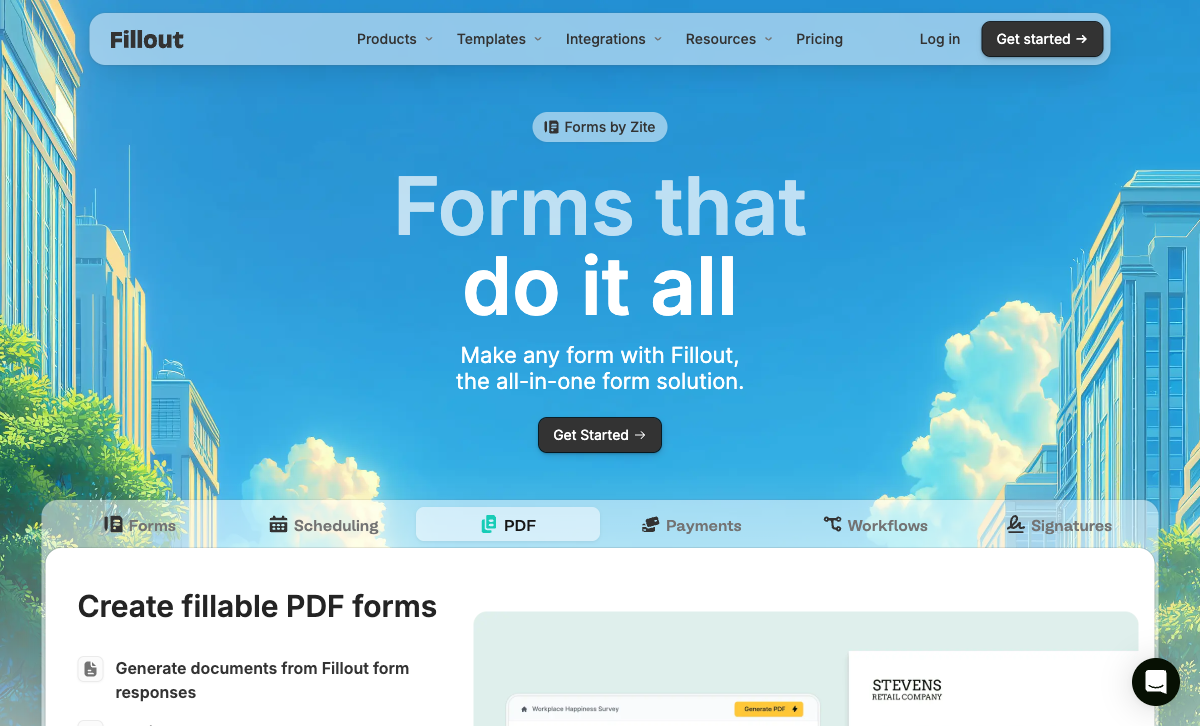
A Fillout form is live as soon as you build it, on a hosted page or embedded as a popup, slider, side tab or full screen. No server, no PHP version, no plugin conflict at the worst possible moment. Gravity Forms cannot be used without a self-hosted WordPress install, which is either free infrastructure you already run or an entire dependency you would be taking on for the sake of a form.
Breadth of Product in One Place
Scheduling, PDF generation, payments, workflows and signatures are all Fillout features rather than add-ons to source. Getting the same span out of Gravity Forms means the Elite licence for signatures and surveys, plus Gravity Flow for approvals, plus a PDF add-on, each with its own maintainer and renewal. Fillout also ships a native Amazon S3 integration on the free plan, so uploads can land in your own bucket.
A Free Tier That Is Genuinely Usable for Testing
Fillout's free plan carries 1,000 responses a month, unlimited forms, unlimited seats, conditional logic, calculations, Stripe payments and the full integration list. Gravity Forms has no free plan and no free trial, only an online demo and a 30-day money-back guarantee. Evaluating Gravity Forms properly means buying it first.
Where Gravity Forms Wins
Volume Costs Nothing
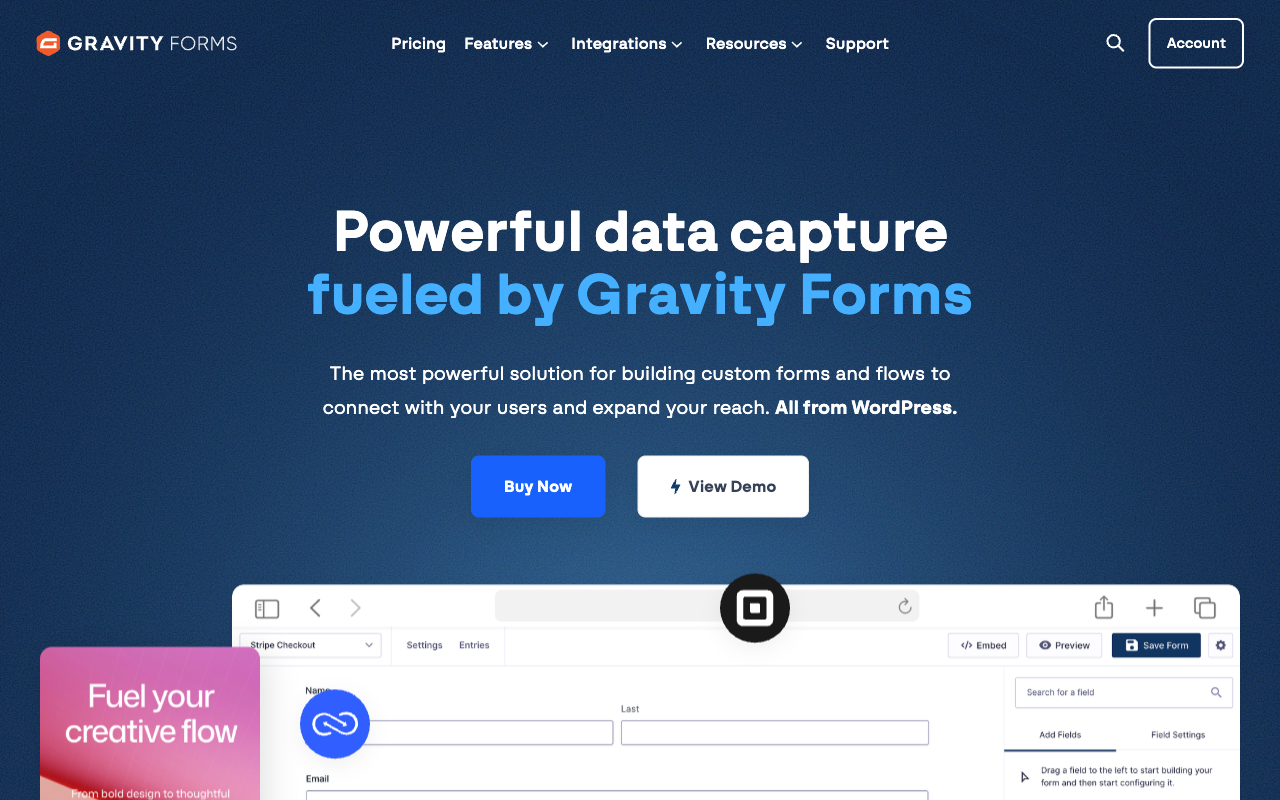
Entries are unlimited on every Gravity Forms licence, from the $59 Basic upward. A form that takes 200 submissions a month and a form that takes 200,000 cost the same, because the only meter is how many sites the licence covers. For a high-traffic lead form, that is a structurally better deal than any per-response plan, and it is the clearest reason a busy WordPress site should not move to Fillout.
Extensibility and Data Ownership
500+ actions and filters, an Add-On Framework and a REST API mean a Gravity Forms install can be bent to do things its vendor never shipped. Entries live in your own database, so backups, retention and location are decisions you make rather than plan features you buy. Fillout gives enterprise buyers regional hosting; Gravity Forms gives everyone the server itself.
Seventeen Years and Five Million Sites
Rocketgenius has been shipping Gravity Forms since 2008, it holds roughly 56% of the WordPress forms category, and it runs on more than five million active sites, including ExxonMobil, Mercedes-Benz and Kroger. Its review record reflects that: 4.7/5 across 240 G2 reviews and 4.6/5 on Capterra. Fillout, founded in 2022, has 30 G2 reviews at 4.6 and a Trustpilot score that has slipped from 4.7 to 3.5 across 48 reviews, with recent complaints about automated systems wrongly flagging accounts. A thin review history is not a verdict, but it is less to read before committing.
Accessibility Out of the Box
Gravity Forms markets WCAG 2.1 AA and Section 508 compliant form output, which matters for public sector and education buyers. Fillout does not publish a WCAG conformance level.
Where Fillout Falls Short
- The response meter: 2,000/month on Starter and 5,000 on Pro, with the jump to unlimited costing $75/month or unpublished bulk packs.
- Stripe only: no PayPal, Square, Braintree or Google Pay, and no tax calculation, invoicing or refund handling.
- Analytics behind the same door as volume: form analytics, conversion tracking and partial submissions all require Business at $75/month.
- Lead-gen sold separately: abandonment recovery, lead enrichment, routing, email validation and ad conversion tracking are the Conversion Kit add-on at $100/month on top of a plan.
- A split identity: the product is now Fillout by Zite, with help docs, changelog and the AI credit pool moved to a parent platform you did not set out to buy.
- No document-style editor or one-question-at-a-time mode.
Where Gravity Forms Falls Short
- WordPress or nothing: no standalone hosted form, no shareable page without a site to put it on.
- No SOC 2: nothing to hand a security reviewer except a description of your own hosting.
- Feature gating: signatures, surveys, quizzes, conversational forms, partial entries, webhooks and coupons are all Elite at $259/year.
- Calculations without conditionals: merge-tag arithmetic only, with a paid third-party perk required for IF logic.
- Fifteen templates and two themes: anything branded goes through whoever can edit theme files.
- No visual reporting: entries are a table in wp-admin, and charts mean the third-party GFChart add-on.
- You are the ops team: core updates, PHP versions, plugin conflicts, security patching and backups are yours, and Rocketgenius changed hands in 2025.
Pricing Comparison
The two price sheets are not measured in the same unit. Fillout bills monthly per workspace and meters responses; Gravity Forms bills annually per number of sites and meters nothing.
Fillout
Gravity Forms
| Product | Plan | Monthly Price | Annual Price (per month) | Free Plan | Free Trial | Limits |
|---|---|---|---|---|---|---|
| Fillout | Free | Free | Free | Yes | No | forms: Unlimited, submissions: 1,000/month, storage: N/A, users: Unlimited, file uploads: 20 MB per file |
| Fillout | Starter | $19/mo | $15/mo billed annually | forms: Unlimited, submissions: 2,000/month, storage: N/A, users: Unlimited, file uploads: 20 MB per file | ||
| Fillout | Pro | $49/mo | $40/mo billed annually | forms: Unlimited, submissions: 5,000/month, storage: N/A, users: Unlimited, file uploads: 20 MB per file | ||
| Fillout | Business | $89/mo | $75/mo billed annually | forms: Unlimited, submissions: Unlimited, storage: N/A, users: Unlimited, file uploads: 1 GB+ | ||
| Fillout | Team bundle | $300/mo | $250/mo billed annually | forms: Unlimited, submissions: Unlimited, storage: 1,000,000 records, users: Unlimited, file uploads: 1 GB+ | ||
| Gravity Forms | Basic | Not listed | $59/mo billed annually | No | No | forms: Unlimited, submissions: Unlimited, storage: WordPress database (self-hosted), users: Unlimited (WordPress users) |
| Gravity Forms | Pro | Not listed | $159/mo billed annually | forms: Unlimited, submissions: Unlimited, storage: WordPress database (self-hosted), users: Unlimited (WordPress users) | ||
| Gravity Forms | Elite | Not listed | $259/mo billed annually | forms: Unlimited, submissions: Unlimited, storage: WordPress database (self-hosted), users: Unlimited (WordPress users) | ||
| Gravity Forms | Nonprofit | Not listed | $129/mo billed annually | forms: Unlimited, submissions: Unlimited, storage: WordPress database (self-hosted), users: Unlimited (WordPress users) |
See Fillout in Action
What Users Say
The review records tell different stories about maturity. Reviewers of Gravity Forms consistently praise reliability and extensibility and consistently complain about the same two things: a dated admin interface and a learning curve that punishes non-technical users. IsItWP's 2026 review scores it 4.6/5 while calling out exactly that curve, and FatLab's assessment lands on associations and nonprofits wanting dependable infrastructure rather than teams wanting a modern editor. Fillout's reviewers like the polish and the integration depth, with Hackceleration's hands-on review praising the all-in-one approach while noting that the advanced features take time to learn.
The Verdict
Gravity Forms wins on WordPress and on volume. If the site is already WordPress, the licence is cheap, entries are unlimited, and the plugin has seventeen years of proof behind it. Take Basic at $59 for contact and enquiry forms, Pro at $159 the moment you need to charge for something, and Elite at $259 if you want signatures, surveys and webhooks in the box.
Fillout wins on everything hosted. No WordPress, no patching, a SOC 2 attestation to hand your reviewer, 50+ integrations from the free tier, and scheduling, PDFs and workflows without sourcing add-ons. Buy Starter at $15/month annual if you are under 2,000 responses, Pro at $40 under 5,000, and treat $75/month Business as the real price if your volume is unpredictable.
The tradeoff underneath both is the same one, stated two ways. Gravity Forms keeps the bill flat by handing you the maintenance, the assembly and the compliance answer. Fillout takes all three off your plate and charges you more as your forms perform better.
Consider Paperform: Neither Meter, Neither Maintenance Job
Paperform is worth a look here because it declines both halves of that tradeoff. It is hosted, so there is no WordPress stack that becomes your problem at 2am, and submissions and seats are unlimited on paid plans within fair use, so a good month does not arrive as an invoice. Metered responses are a tax on your own success, and Paperform does not levy one.
Be clear about the price, because it is the honest weakness. Paperform starts at $49/month billed annually ($59 monthly), which is more than Fillout's $15 Starter and far more than a $59 annual Gravity Forms licence. For a single contact form on a WordPress site, Gravity Forms is the right purchase and we would say so. Paperform is built for the operator running a genuine multi-step process: intake, payment, contract, approval, follow-up.
What the higher number buys is one subscription covering three products. Paperform for forms, Papersign for eSignatures with a real audit trail and countersigning, and Stepper for AI-native workflow automation, on every plan, from one account and one bill. That is the answer to the assembly problem Gravity Forms hands you and to the add-on arithmetic Fillout runs: a Fillout Business plan plus the $100/month Conversion Kit is $175/month before anyone signs a document, against Paperform Business at $124/month annual with signing and automation already included.
On the dimensions above: 4000+ integrations rather than 50; five payment gateways (Stripe, PayPal, Square, Braintree and Google Pay) with subscriptions, coupons, tax rules and refunds built in, rather than Stripe alone or four processors behind a tier upgrade; Excel-style calculations that decide question and page visibility, which conditional email fires, what is pushed to an integration and what the success page says, rather than merge-tag arithmetic with a paid perk for IF logic. Paperform is SOC 2 Type II, GDPR and CCPA compliant, and like both tools here it is not HIPAA compliant and signs no BAAs. It was founded in 2016, is bootstrapped and profitable, and support is part of the seat price rather than a separate enablement fee. There is a 7-day trial with no card.
For the wider field, see our ranking of the best form builders, the best form builders for WordPress if the site is the constraint, or the direct Paperform vs Gravity Forms and Paperform vs Fillout breakdowns.
Frequently Asked Questions
Does Fillout or Gravity Forms work better on a WordPress site?
Gravity Forms is a WordPress plugin, so the form is part of the site itself: it renders in your theme, writes entries to your own database, and hooks into WordPress users, posts and roles. Fillout is a hosted product you embed in a WordPress page as an iframe or popup, which works fine but keeps the data on Fillout's servers and gives you no access to WordPress hooks. If the form needs to register users, gate content or trigger anything inside WordPress, Gravity Forms is the only one of the two that can do it.
Is Gravity Forms cheaper than Fillout over a year?
On licence cost, usually yes. Gravity Forms Basic is $59/year, Pro is $159/year and Elite is $259/year, all with unlimited forms and unlimited entries. Fillout's paid tiers run $15/month annual for Starter (2,000 responses), $40 for Pro (5,000 responses) and $75 for Business (unlimited), which is $180 to $900 a year. The catch on the Gravity Forms side is that the licence is not the whole bill: WordPress hosting, backups and any paid add-on such as a Gravity Wiz perk renew separately, and someone has to keep the stack patched.
Which one handles payments better, Fillout or Gravity Forms?
Gravity Forms supports four processors (Stripe, PayPal, Square and Mollie) but gates all of them behind the Pro licence at $159/year, so the Basic plan cannot take money at all. Fillout supports one processor, Stripe, on every tier including free, with subscriptions, discount codes and free trials built in. If you need PayPal or Square specifically, Gravity Forms Pro is the answer of the two. If Stripe is fine and you want payments working in ten minutes without a plugin install, Fillout is.
Are Fillout and Gravity Forms SOC 2 or HIPAA compliant?
Fillout is SOC 2 Type 2 attested and GDPR compliant. Gravity Forms holds no SOC 2 or ISO 27001 certification, because Rocketgenius sells software rather than hosting: your compliance posture is whatever your own WordPress server is. Neither product is HIPAA compliant and neither signs a BAA, so protected health information rules both out. If a security questionnaire is part of your buying process, Fillout has something to hand the reviewer and Gravity Forms does not.
Which has better conditional logic and calculations?
Both do conditional logic well. Calculations are where they diverge. Fillout includes calculations on the free plan and uses them for scoring and dynamic pricing, though G2 reviewers note that mastering them takes time. Gravity Forms' native calculations are simple merge-tag arithmetic with no IF functions and no nesting; conditionals and exponents require the third-party Gravity Wiz Advanced Calculations perk, bought and renewed from a vendor that is not Rocketgenius.
Fillout or Gravity Forms for a form that ends in a signed contract?
Neither gets you all the way. Fillout has a signature question type from the Starter tier and workflows, but the serious automation quotas sit in the $250/month Team bundle and the AI credits come from a pool shared with the Zite platform. Gravity Forms has signature capture on Elite, which is a drawn image on a form rather than a signing process with an audit trail and countersigning. Both routes end with a separate eSignature subscription for real contracts.
Sources & References
- Fillout Pricing — Fillout, 2026
- Gravity Forms Pricing — Gravity Forms, 2026
- Gravity Forms Review 2026: Is It Worth Your Money? — IsItWP, January 2026
- Fillout Review 2026: We Tested Everything (Builder, Integrations, Automations & Real ROI) — Hackceleration, 2026
Last updated September 22, 2026
Ready to try Paperform?
Create beautiful forms, payment pages, and workflows — no code required.