 By Dean McPherson, Co-founder & CTO, Paperform · Updated
Formstack vs Microsoft Forms: When Is $83/Month Worth It in 2026?
This comparison asks a pointed question: when does a dedicated, paid form builder justify itself against a tool your organisation might already have for free? Microsoft Forms comes included with every Microsoft 365 subscription, which over 400 million people already have. Formstack starts at $83/month (annual) with no free plan, positioning itself as an enterprise workflow platform with forms, document generation, and electronic signatures.
For many organisations, Microsoft Forms handles 80% of form needs without spending a cent beyond their existing M365 license. Formstack earns its price in specific enterprise workflows: HIPAA healthcare forms, Salesforce-native data capture, and document-to-signature pipelines. Here's how to decide whether the remaining 20% of capability justifies nearly $1,000/year.
Who Is Formstack?
Formstack was founded in 2006 in Denver, Colorado. Now backed by private equity (Intellistack), the company has 201-500 employees and sells a workplace productivity platform that bundles forms, document generation, and electronic signatures. Its strongest differentiators are HIPAA compliance, deep Salesforce integration, and the document workflow suite. Formstack recently launched a separate CLM (contract lifecycle management) product under the Intellistack brand, signaling expansion beyond its core form building roots.
Who Is Microsoft Forms?
Microsoft Forms launched in 2016 as part of Microsoft 365 (then Office 365). It's a feature within Microsoft's productivity suite rather than a standalone product, maintained by a company with 10,000+ employees and a market cap exceeding $3 trillion. Forms integrates natively with Teams, Excel, SharePoint, Power Automate, and OneDrive. Its value proposition is simple: if you already pay for M365, you already have a form builder. The tool is designed for surveys, quizzes, polls, and basic data collection, not complex workflows or payment processing.
Quick Verdict
Choose Formstack if:
- You need HIPAA-compliant forms with healthcare-specific features
- You require native Salesforce form integration
- You need forms that generate documents and collect signatures
- Enterprise procurement requires a dedicated forms vendor with SLA
Choose Microsoft Forms if:
- You already have Microsoft 365 and need surveys, quizzes, or feedback forms
- Your forms feed into Power Automate, Teams, or SharePoint workflows
- Budget is the primary constraint and existing M365 tools suffice
- You need enterprise compliance (SOC 2, ISO 27001, FedRAMP) at no extra cost
Feature Comparison
Side-by-side across every feature category.
| Feature | Formstack | Microsoft Forms |
|---|---|---|
| Form Building | ||
| AI form builder . Describe the form you need in plain language and the tool drafts the questions for you. | Yes forms | Yes Microsoft 365 Business Standard with Copilot |
| Templates . The number of ready-made form templates in the tool’s template gallery. | Yes forms | Yes |
| Field types . How many kinds of question or input field the form builder offers, such as text, dropdown, date, file upload and signature. | 20+ (forms) | 8 |
| Conditional logic . Show, hide or skip questions and pages based on how someone has answered earlier questions. | Yes forms | Yes |
| Calculations . Compute totals, scores, prices or dates from answers while the form is being filled in. | Yes forms | No |
| Multi-page forms . Split a long form across several pages that respondents move through in order. | Yes forms | Yes |
| One question at a time . A conversational layout that shows a single question per screen, popular for surveys on mobile. | Yes forms | No |
| Answer piping . Insert a respondent’s earlier answer, such as their name, into later questions or text on the form. | Yes forms | No |
| Pre-filling and hidden fields . Fill in answers ahead of time from a link or existing data, and pass along values the respondent never sees. | Yes forms | Yes |
| File uploads . Let respondents attach files such as documents and photos to their submission. | Yes forms | Yes Microsoft 365 Business Basic |
| E-signatures . Collect a signature, either with a signature field on the form or by sending a document out to be signed. | Yes forms | No |
| Appointment booking . Let respondents pick and book a time slot directly in the form, with availability managed by the tool. | Not recorded | Yes Microsoft 365 Business Basic |
| Quiz scoring . Give answers point values so the form can score quizzes and assessments automatically. | Yes forms | Yes |
| Save and resume . Respondents can leave a form part-way through and come back later to finish it. | Yes forms | No |
| Close forms by date or response limit . Stop accepting submissions automatically on a set date or once a set number of responses has arrived. | Yes forms | Yes |
| Payments | ||
| Payment gateways . The number of payment processors a form can take payments through. Where a vendor’s full count isn’t recorded, the cell lists the gateways we confirmed. | 3 (forms) Stripe, Authorize.net, PayPal | No |
| Subscriptions and recurring payments . Charge respondents on a repeating schedule, such as monthly or annually, from a form. | Yes forms | No |
| Product sales . Sell products from a form, with product listings, quantities and an order total. | Yes forms | No |
| Conditional pricing . Change the price or add fees automatically based on the answers given in the form. | Yes forms | No |
| Coupons and discounts . Offer discount codes that respondents can apply to a payment or subscription on the form. | Yes forms | No |
| Tax calculations . Add sales tax to payments on the form automatically. | Not recorded | No |
| Refunds . Refund a payment from inside the form tool rather than going to the payment processor. | Not recorded | No |
| Design & Customization | ||
| Custom themes . Set your own logo, colours and fonts on forms and save them as reusable themes. | Yes forms | No |
| Custom CSS . Add your own CSS (and in some tools HTML) for styling beyond the built-in theme options. | Yes forms | No |
| Remove vendor branding . Remove the form builder’s own logo or badge so forms carry only your branding. | Yes forms | No |
| Custom domain . Host forms on your own domain, such as forms.yourcompany.com, instead of the vendor’s. | Yes | No |
| Custom form URL . Choose a readable link for a form instead of a random string. | Yes forms | No |
| Emails from your own domain . Send notification and confirmation emails from your own email domain instead of the vendor’s. | Yes | No |
| Multi-language forms . Show a form’s questions, buttons and messages in languages other than English. | Yes forms | Yes |
| Analytics | ||
| Response reports . Built-in summaries and charts of the answers a form has collected. | Yes forms | Yes |
| Form analytics (views and drop-off) . Track how many people view, start and finish a form, and where they abandon it. | Yes forms | No |
| Partial submissions . See the answers people entered before leaving a form without submitting it. | No | No |
| Google Analytics and Meta Pixel . Connect a form to Google Analytics or the Meta (Facebook) Pixel to track visits and conversions. | No | No |
| Custom tracking scripts . Add your own analytics or conversion-tracking scripts to a form. | Not recorded | No |
| AI response insights . AI-written summaries and insights generated from the responses a form has collected. | Not recorded | Yes Microsoft 365 Business Standard with Copilot |
| Collaboration | ||
| Team members . Invite colleagues into the same account to build forms and work with responses together. | Yes forms | Yes Microsoft 365 Business Basic |
| Roles and permissions . Give team members different levels of access, such as admin, editor or viewer. | Yes forms | Yes Microsoft 365 Business Basic |
| Advanced permissions and admin controls . Fine-grained, organisation-wide controls over who can access what, usually on enterprise plans. | Yes enterprise | Yes Microsoft 365 Business Basic |
| Workspaces . Separate spaces or folders for organising forms by team, client or project. | Yes forms | Yes |
| Security | ||
| Two-factor authentication . Users can protect their login with a second step, such as a code from an authenticator app. | Yes forms | Yes |
| Require 2FA for the whole team . Admins can make two-factor authentication mandatory for everyone in the account. | Yes forms | Yes Microsoft 365 Business Basic |
| SSO (SAML) . Team members sign in through your company’s identity provider, such as Okta or Microsoft Entra ID, using SAML single sign-on. | Yes enterprise | Yes Microsoft 365 Business Basic |
| HIPAA compliance . Whether the vendor supports collecting US protected health information under HIPAA, typically by signing a business associate agreement on an eligible plan. | Yes enterprise | Yes |
| SOC 2 . Whether the vendor holds a SOC 2 audit report covering its security controls. | Yes | Yes Microsoft 365 Business Basic |
| GDPR . Whether the vendor states that it complies with the EU General Data Protection Regulation. | Yes forms | Yes |
| Data residency . Choose the region, such as the EU, where your form data is stored. | No | Yes Microsoft 365 Business Basic |
| Store files in your own S3 bucket . Send uploaded files and exports to your own Amazon S3 storage instead of the vendor’s. | Yes forms | No |
| Spam protection (CAPTCHA) . Block bot and spam submissions with reCAPTCHA or a similar challenge. | Yes forms | Not recorded |
| Integrations & API | ||
| Zapier . Connect forms to thousands of other apps through Zapier. | Yes forms | No |
| Make . Connect forms to other apps through Make (formerly Integromat). | Not recorded | No |
| Workflow automation . A built-in builder for multi-step automations that act on submissions, such as approvals, routing and syncing data to other systems. | Yes suite | Yes Microsoft 365 Business Basic |
| Webhooks . Send each new submission to a URL of your choice as soon as it arrives. | Yes forms | No |
| API access . A developer API for reading forms and submissions, or managing them, from your own code. | Yes enterprise | No |
| WordPress plugin . A plugin for adding forms to a WordPress site. | Yes forms | Not recorded |
— means we haven't recorded it for that tool.
Where Formstack Wins
Document Generation and eSignatures
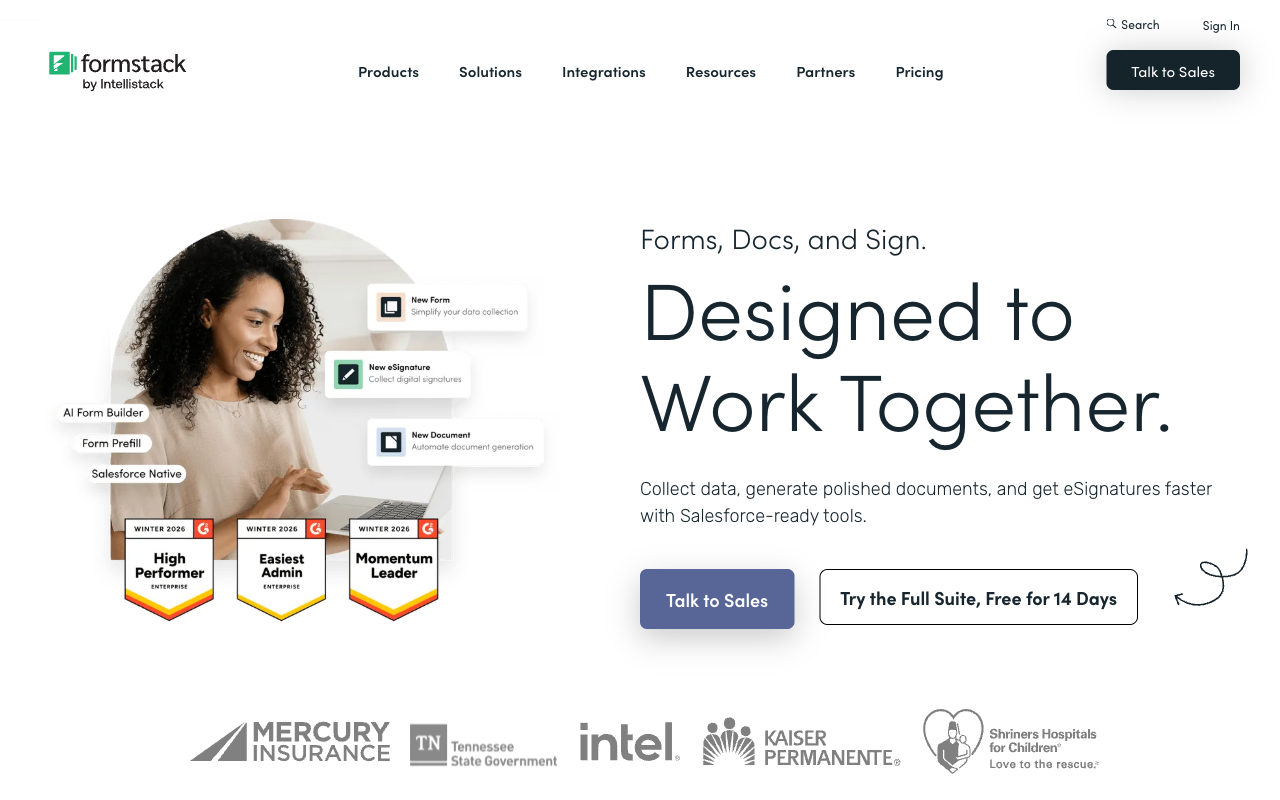
Formstack's Suite plan ($250/month) bundles three products: Forms, Documents, and Sign. A form submission can auto-populate a contract template and send it for electronic signature, all within a single platform. Microsoft Forms has no document generation and no eSignature capability. For organisations that need form-to-document-to-signature workflows (HR onboarding, client agreements, healthcare consent), Formstack consolidates what would otherwise require three separate tools.
Salesforce-Native Forms
Formstack for Salesforce is a dedicated product that lives inside the Salesforce ecosystem — embedding forms in Experience Cloud, reading/writing Salesforce objects directly, and supporting Salesforce Shield encryption. Microsoft Forms has no Salesforce integration beyond what Power Automate can bridge. For Salesforce-centric organisations, Formstack's native integration eliminates the middleware.
Payment Collection
Formstack supports Stripe, PayPal and Authorize.net for payment collection through forms: basic but functional for registration fees, order forms, and donations. Microsoft Forms cannot process payments at all. If any form needs to collect money, Microsoft Forms is immediately out of the running.
Conversion Analytics
Formstack's analytics dashboard tracks views, conversions and abandonment, and its paid Conversion Kit add-on adds field-level bottleneck reports that identify where users abandon forms. Microsoft Forms offers basic response summaries and charts but no conversion analytics, no drop-off tracking, and no field-level performance data. For customer-facing forms where completion rate matters, Formstack's analytics tools help identify and fix friction points.
Where Microsoft Forms Wins
Already Paid For
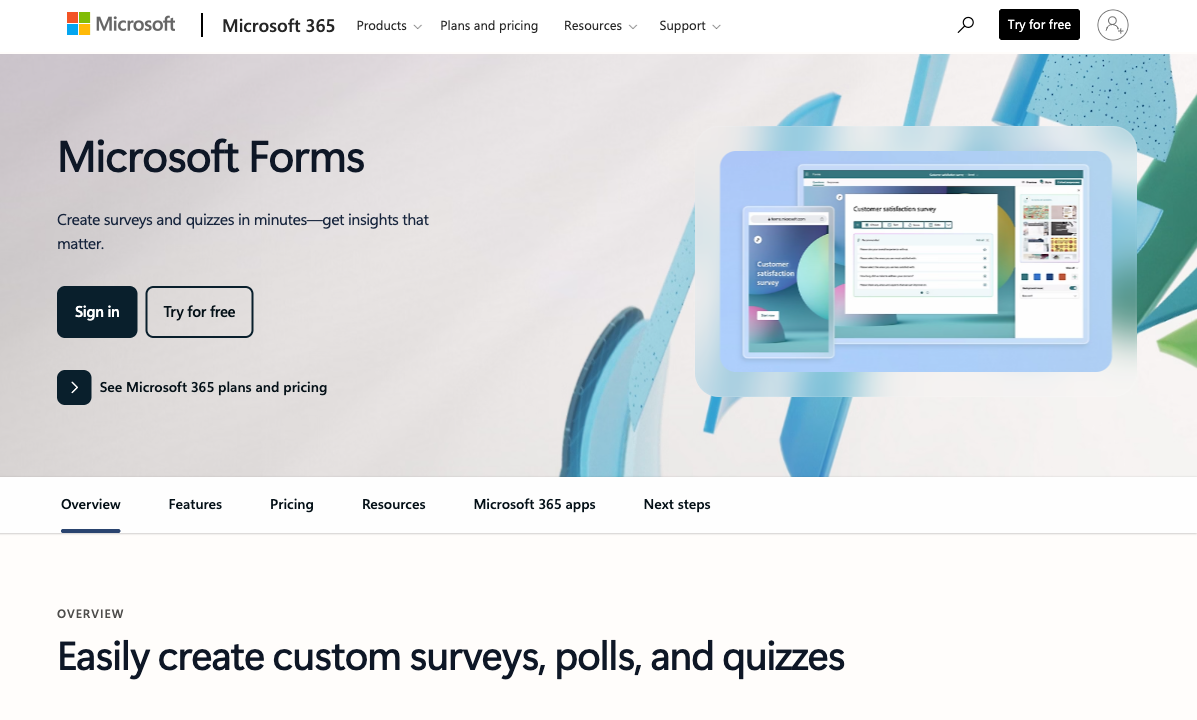
For over 400 million Microsoft 365 users, Forms costs nothing extra. M365 Business Basic starts at $7/user/month billed annually ($8.40 monthly) and includes Forms, Teams, SharePoint, and OneDrive. Formstack starts at $83/month for a single user. For an organisation of 10 people, that's potentially $70/month total for M365 (which includes far more than forms) versus $83/month for Formstack alone. The cost calculus is challenging for Formstack to overcome when M365 is already in the stack.
Microsoft Ecosystem Integration
Microsoft Forms connects natively to Power Automate (workflow automation), Teams (embedded forms in channels), SharePoint (form-driven sites), Excel (automatic data sync), and OneDrive (file storage). For organisations built on Microsoft's stack, this integration depth is unmatched by any standalone form builder. A form response in Teams can trigger a Power Automate flow that creates a Planner task, sends a Teams notification, and logs data to SharePoint, all without third-party connectors.
Enterprise Compliance Posture
Microsoft Forms inherits M365's compliance certifications: SOC 2 Type II, ISO 27001, GDPR, CCPA, HIPAA (with BAA), FedRAMP, and FERPA. These certifications cover the entire M365 platform, including Forms. Formstack holds SOC 2 Type II and offers AES-256 encryption, but HIPAA is a paid add-on on its Forms and Suite plans. For government agencies and heavily regulated industries, Microsoft's compliance portfolio is broader and more established.
Quiz and Assessment Features
Microsoft Forms includes a dedicated quiz mode with automatic scoring, point values, answer feedback, and math equation support, purpose-built for education and training. Formstack has no dedicated quiz mode: graded quizzes have to be built from answer point values and a calculation field. For educators, corporate trainers, and anyone building knowledge assessments, Microsoft Forms is the better tool out of the box.
Where Both Fall Short
- Design limitations: Neither platform produces visually polished, branded forms. Formstack's builder is functional but dated-looking. Microsoft Forms always looks distinctly like a Microsoft product: clean but not customisable. Neither offers a document-style editor, custom fonts, or rich media embedding.
- Limited payment processing: Formstack supports only Stripe, PayPal and Authorize.net: no Square, Braintree, or Google Pay. Microsoft Forms has no payment capability at all. For payment-heavy forms, both platforms underperform compared to dedicated form builders.
- Basic AI form creation: Both platforms now offer AI-assisted form creation: Formstack has an AI-powered form builder, and Microsoft Forms offers Copilot drafting on Microsoft 365 plans that include Copilot. Beyond that, both still rely largely on traditional drag-and-drop builders and manual template selection.
- Template scarcity: Formstack has a modest template library. Microsoft Forms offers even fewer pre-built templates. Neither approaches the tens of thousands of templates available from top competitors.
- Ecosystem lock-in: Both platforms create dependencies. Formstack's deepest value is tied to Salesforce. Microsoft Forms' deepest value is tied to M365. Choosing either means your forms are bound to that ecosystem's future decisions and pricing changes.
Pricing Comparison
The pricing story here is straightforward: one costs money, the other is bundled with software you likely already own.
| Tier | Formstack | Microsoft Forms | Key Difference |
|---|---|---|---|
| Free/Bundled | No free plan. 14-day trial only. | Free with personal MS account (200 responses/form) | Microsoft offers a free entry point; Formstack does not |
| Entry | Forms: $83/mo — 25 forms, 1,000 subs/form, 1 user | M365 Business Basic: $7/user/mo — 400 forms, 5M responses | Microsoft is about 12x cheaper per user and includes far more than forms |
| Suite | Suite: $250/mo — Forms + Documents + Sign, 3 users | No equivalent — no document generation or eSignatures | Formstack's document workflow has no Microsoft Forms equivalent |
| Enterprise | Custom pricing — SSO, unlimited users, dedicated CSM | M365 E5: $57/user/mo — full compliance, security, analytics | Microsoft's enterprise tier includes the entire productivity suite |
All Formstack prices reflect annual billing. Microsoft 365 pricing is per-user/month with annual commitment.
What will it cost you?
Formstack plans
- Forms$83/moForms 25, Submissions 1,000/form, Team 1, Storage 2 GB
- SuiteCheck limits$250/moForms 100, Submissions 5,000/form, Team 3, Storage 10 GB
| Plan | Price | Forms | Submissions | Team | Storage |
|---|---|---|---|---|---|
| Forms | $83/mo | 25 | 1,000/form | 1 | 2 GB |
| SuiteCheck limits | $250/mo | 100 | 5,000/form | 3 | 10 GB |
Microsoft Forms plans
- Free (Personal Microsoft Account)FreeForms 400, Submissions 200/form, Team 1, Storage N/A
- Microsoft 365 Business Basic$7/moForms 400, Submissions 5,000,000/form, Team Per user (1-300 employees), Storage 1 TB OneDrive per user
- Microsoft 365 Business Standard$14/moForms 400, Submissions 5,000,000/form, Team Per user (1-300 employees), Storage 1 TB OneDrive per user
- Microsoft 365 Business Premium$22/moForms 400, Submissions 5,000,000/form, Team Per user (1-300 employees), Storage 1 TB OneDrive per user
- Microsoft 365 Business Standard with Copilot$23.50/moForms 400, Submissions 5,000,000/form, Team Per user (1-300 employees), Storage 1 TB OneDrive per user
- Microsoft 365 Business Premium with Copilot$32/moForms 400, Submissions 5,000,000/form, Team Per user (1-300 employees), Storage 1 TB OneDrive per user
- Microsoft 365 Apps for business$10/moForms 400, Submissions 5,000,000/form, Team Per user (1-300 employees), Storage 1 TB OneDrive per user
| Plan | Price | Forms | Submissions | Team | Storage |
|---|---|---|---|---|---|
| Free (Personal Microsoft Account) | Free | 400 | 200/form | 1 | N/A |
| Microsoft 365 Business Basic | $7/mo | 400 | 5,000,000/form | Per user (1-300 employees) | 1 TB OneDrive per user |
| Microsoft 365 Business Standard | $14/mo | 400 | 5,000,000/form | Per user (1-300 employees) | 1 TB OneDrive per user |
| Microsoft 365 Business Premium | $22/mo | 400 | 5,000,000/form | Per user (1-300 employees) | 1 TB OneDrive per user |
| Microsoft 365 Business Standard with Copilot | $23.50/mo | 400 | 5,000,000/form | Per user (1-300 employees) | 1 TB OneDrive per user |
| Microsoft 365 Business Premium with Copilot | $32/mo | 400 | 5,000,000/form | Per user (1-300 employees) | 1 TB OneDrive per user |
| Microsoft 365 Apps for business | $10/mo | 400 | 5,000,000/form | Per user (1-300 employees) | 1 TB OneDrive per user |
| Product | Plan | Monthly Price | Annual Price (per month) | Free Plan | Free Trial | Limits |
|---|---|---|---|---|---|---|
| Formstack | Forms | $99/mo | $83/mo billed annually | No | 14 days | forms: 25, submissions: 1,000/form, storage: 2 GB, users: 1, file uploads: 2 GB |
| Formstack | Suite | $299/mo | $250/mo billed annually | forms: 100, submissions: 5,000/form, storage: 10 GB, users: 3, file uploads: 10 GB | ||
| Microsoft Forms | Free (Personal Microsoft Account) | Free | Free | Yes | 1 month | forms: 400, submissions: 200/form, storage: N/A, users: 1 |
| Microsoft Forms | Microsoft 365 Business Basic | $8.4/mo | $7/mo billed annually | forms: 400, submissions: 5,000,000/form, storage: 1 TB OneDrive per user, users: Per user (1-300 employees) | ||
| Microsoft Forms | Microsoft 365 Business Standard | $16.8/mo | $14/mo billed annually | forms: 400, submissions: 5,000,000/form, storage: 1 TB OneDrive per user, users: Per user (1-300 employees) | ||
| Microsoft Forms | Microsoft 365 Business Premium | $26.4/mo | $22/mo billed annually | forms: 400, submissions: 5,000,000/form, storage: 1 TB OneDrive per user, users: Per user (1-300 employees) | ||
| Microsoft Forms | Microsoft 365 Business Standard with Copilot | Not listed | $23.5/mo billed annually | forms: 400, submissions: 5,000,000/form, storage: 1 TB OneDrive per user, users: Per user (1-300 employees) | ||
| Microsoft Forms | Microsoft 365 Business Premium with Copilot | Not listed | $32/mo billed annually | forms: 400, submissions: 5,000,000/form, storage: 1 TB OneDrive per user, users: Per user (1-300 employees) | ||
| Microsoft Forms | Microsoft 365 Apps for business | $12/mo | $10/mo billed annually | forms: 400, submissions: 5,000,000/form, storage: 1 TB OneDrive per user, users: Per user (1-300 employees) |
What Users Say
Microsoft Forms generally receives positive marks for simplicity and M365 integration, though users consistently note its limitations for complex forms. Formstack earns praise for its enterprise features but faces criticism on pricing and customer support. A 1.6/5 Trustpilot rating and 3.7/5 value-for-money score on Capterra suggest many users feel the price doesn't match the experience. The common thread: Microsoft Forms is "good enough" for internal use; Formstack is "powerful but expensive" for external workflows.
The Verdict
Microsoft Forms wins for most M365 organisations. If your company already subscribes to Microsoft 365, Forms handles internal surveys, feedback collection, quizzes, and basic data capture at no extra cost. The Power Automate integration, Teams embedding, and enterprise compliance make it the default choice for organisations in the Microsoft ecosystem.
Formstack wins for specialised enterprise workflows. HIPAA healthcare forms, Salesforce-native data capture, and form-to-document-to-signature pipelines are legitimate use cases where Formstack's $83-250/month premium (plus the HIPAA add-on on those plans) is justified. These are capabilities Microsoft Forms simply doesn't offer.
The honest take: most organisations evaluating this comparison should start with Microsoft Forms (which they likely already have) and only add Formstack when they encounter a specific workflow gap — payments, document generation, Salesforce integration, or HIPAA compliance — that Microsoft Forms can't fill. Paying $83/month for basic form building when M365 is already in the stack is hard to justify.
Consider Paperform
If Microsoft Forms is too basic and Formstack is too expensive, Paperform is worth a look for a different reason: it doesn't meter the things that grow. Formstack counts submissions per form and charges per user; Microsoft Forms ties you to per-seat M365 licensing. Paperform's Pro plan is $59/month, or $49/month billed annually, with unlimited submissions and unlimited seats. Adding people or volume doesn't change the bill. Business is $149/month ($124 annually) and adds 10 workspaces, SSO and the Business API. You also get a document-style editor, an Excel-style calculation engine, five payment gateways (Stripe, PayPal, Square, Braintree, Google Pay), and 9,800+ integrations.
The other difference is scope. Formstack's answer to documents and signing is the $250/month Suite; Microsoft's is a separate set of products. One Paperform subscription covers forms (Paperform), eSignatures (Papersign) and workflow automation (Stepper) on every plan, so there's no second or third vendor to stitch together. Paperform isn't the cheapest entry point here — Microsoft Forms is effectively free inside M365, and Formstack's per-form pricing can look smaller on paper for one low-volume form — but it is the option where growth in submissions, seats or automation runs doesn't come with a bill attached. Paperform connects to Microsoft 365 via Zapier and Make, and to Salesforce natively, covering both ecosystems. It's bootstrapped and profitable since 2016, funded by customer revenue with no private equity involvement. It holds SOC 2 Type II, GDPR and CCPA, but it is not HIPAA compliant and signs no BAAs, so healthcare workloads belong with Formstack or M365. See the Formstack alternatives or Microsoft Forms alternatives pages for deeper analysis.
Frequently Asked Questions
When is Formstack worth $83/month over free Microsoft Forms?
Formstack justifies its cost in three specific scenarios: (1) You need HIPAA-compliant forms for healthcare data. Microsoft Forms can be HIPAA-compliant within M365, but Formstack's healthcare-specific features are more purpose-built (HIPAA is a paid add-on on Formstack's Forms and Suite plans, and included on its Salesforce and Enterprise plans). (2) You need integrated document generation and eSignatures. Formstack's Suite bundles forms, documents, and signing into a single workflow pipeline. (3) You're a Salesforce shop — Formstack for Salesforce is a native app that Microsoft Forms cannot replicate. For basic data collection, surveys, and internal forms, Microsoft Forms handles those use cases adequately at no additional cost for M365 subscribers.
Can Microsoft Forms handle payment collection?
No. Microsoft Forms has no payment processing capability whatsoever: no Stripe, no PayPal, no payment fields of any kind. If you need to collect payments through forms, Microsoft Forms is immediately disqualified. Formstack supports Stripe, PayPal and Authorize.net for payment collection, though its payment capabilities are basic compared to dedicated form builders. For payment forms, neither platform is the strongest choice.
Which is better for enterprise compliance?
Microsoft Forms inherits Microsoft 365's enterprise compliance certifications: SOC 2, ISO 27001, GDPR, CCPA, HIPAA (with BAA), FedRAMP, and FERPA. For organisations already on M365, these compliance requirements are already met at no additional cost. Formstack holds SOC 2 Type II and offers AES-256 encryption, with HIPAA as a paid add-on on its Forms and Suite plans (included on Salesforce and Enterprise). For government and highly regulated industries already in the Microsoft ecosystem, Microsoft Forms' compliance posture is stronger and comes bundled with the M365 subscription.
Can I use Microsoft Forms outside of Microsoft 365?
Partially. A free personal Microsoft account gives you access to Microsoft Forms with a 200-response limit per form and basic features. But the real value of Microsoft Forms comes from M365 integration: Power Automate workflows, Teams embedding, SharePoint connections, Excel auto-sync, and co-authoring. Without M365, Microsoft Forms is a very basic survey tool. If you're not in the Microsoft ecosystem, neither Microsoft Forms nor Formstack is the right choice. You'd be better served by a standalone form builder.
Sources & References
- Microsoft Forms vs Formstack — Feature Comparison — G2, 2026
- Best Enterprise Form Builders for 2026 — TechRadar, 2026
Updates
We re-audit the form builders we compare on a regular cadence and log every change here — a public record of what changed and when.
- Updated June 4, 2026 — Updated the AI capabilities note for Formstack and Microsoft Forms: both now offer basic AI-assisted form creation (Formstack's AI form builder and Microsoft Forms' Copilot suggestions), replacing the previous claim that neither platform supported AI form generation.
Unlimited plans are subject to each vendor's fair use policy.
Ready to try Paperform?
Create beautiful forms, payment pages, and workflows — no code required.