 By Dean McPherson, Co-founder & CTO, Paperform · Updated
Formstack vs SurveyMonkey: Which Is Better in 2026?
This is a comparison between two tools that sound similar but serve different purposes. Formstack is an enterprise workflow platform that bundles online forms, document generation, and electronic signatures into a single product suite. SurveyMonkey is a survey specialist — purpose-built for research, feedback collection, and data analysis with over 20 years of methodological expertise.
The overlap is narrow: both collect data through online forms. But Formstack routes that data into business processes and document workflows, while SurveyMonkey analyses it for research insights. Choosing between them depends on whether you need operational workflows or research-grade surveys.
Who Are These Platforms?
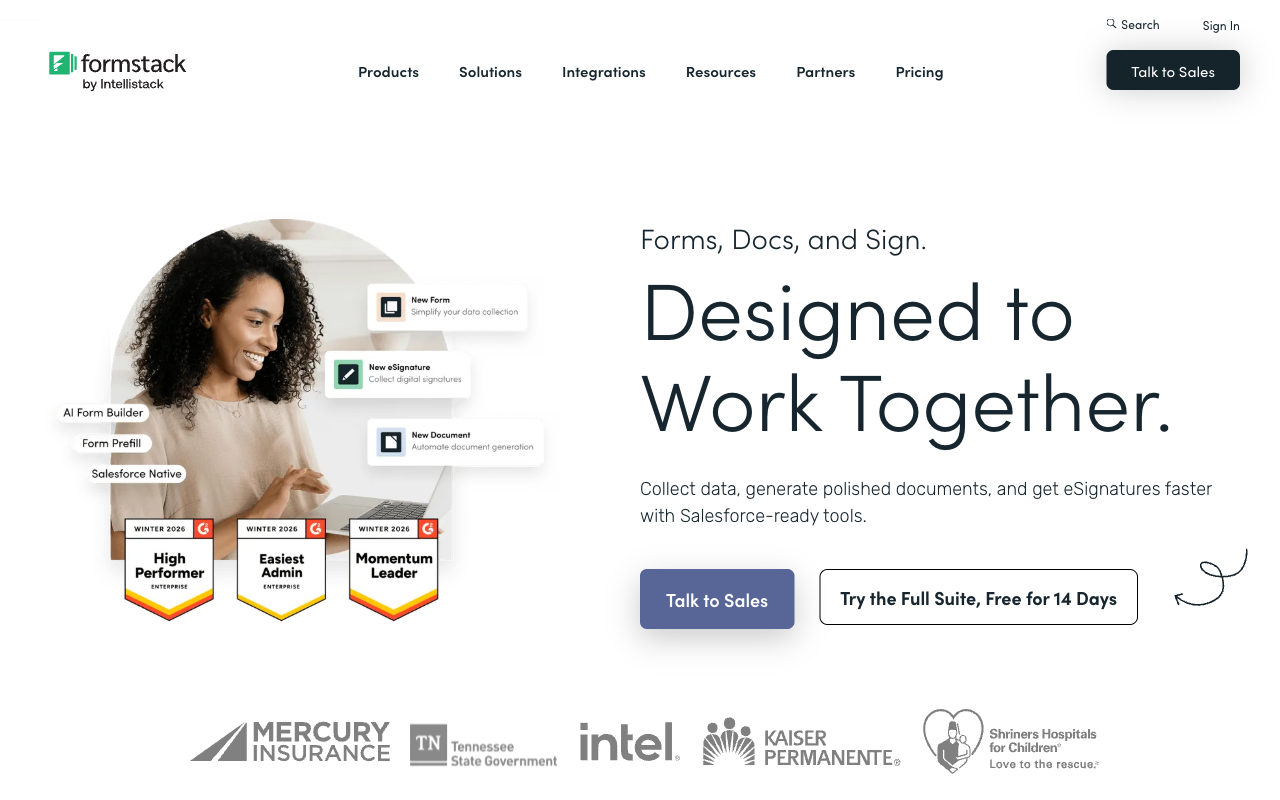
Formstack was founded in 2006 in Indianapolis, originally as a simple form builder. Over nearly two decades, it evolved into a workflow automation platform through acquisitions that added document generation (Formstack Documents, formerly WebMerge) and electronic signatures (Formstack Sign). Now private-equity-backed, Formstack targets mid-market and enterprise teams who need forms, documents, and signatures in a unified system. Pricing starts at $83/month, reflecting its enterprise positioning.
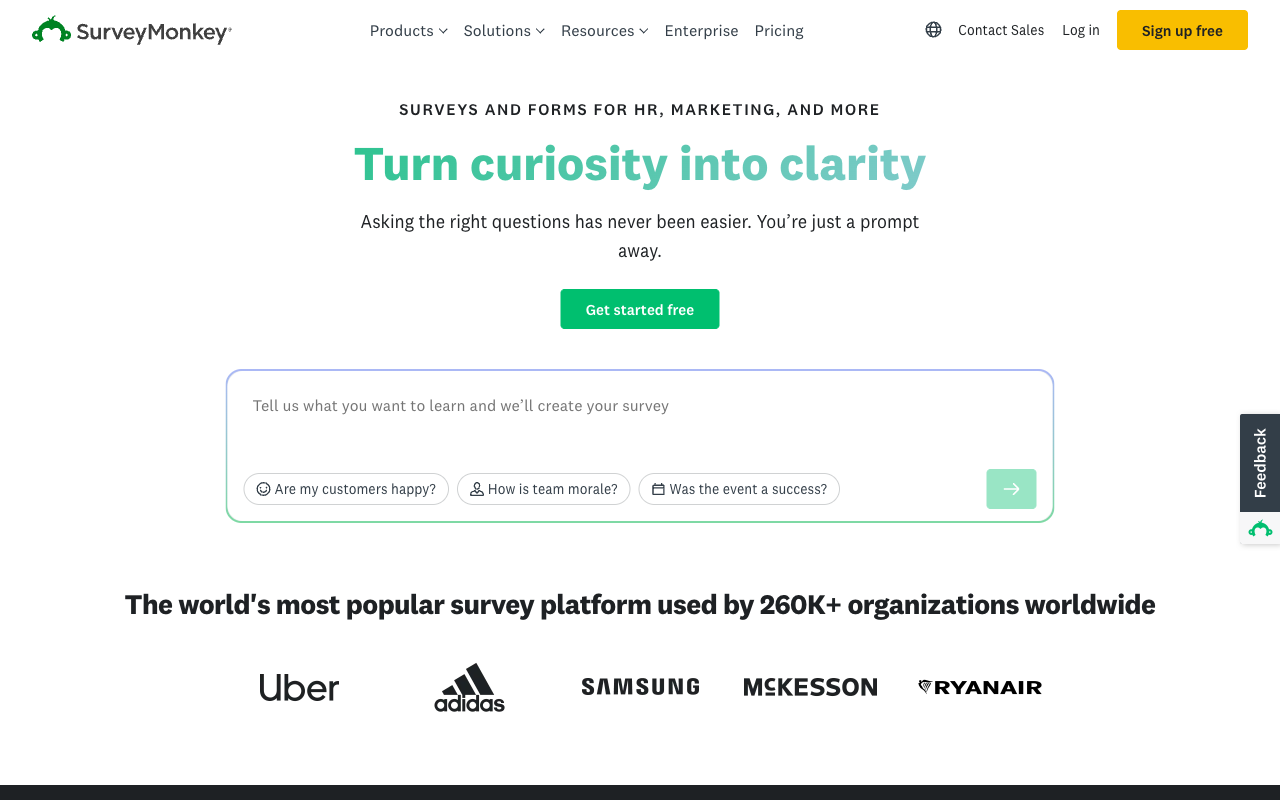
SurveyMonkey was founded in 1999, one of the earliest web survey tools. Now part of Momentive (rebranded in 2021), it serves over 17 million active users across 300,000+ organisations. SurveyMonkey's strength is its survey methodology: question bank, benchmarking data, statistical analysis, and AI-powered insights. Individual plans start at $39/month billed annually, with team and enterprise tiers scaling to $30+/user/month. Its focus has remained consistent for over two decades: surveys and feedback.
Quick Verdict
Choose Formstack if:
- You need forms + document generation + e-signatures in one platform
- Your workflow involves routing form data into contracts, agreements, or PDFs
- You're an enterprise team needing HIPAA compliance and SSO
- You want conditional logic-driven operational forms, not research surveys
Choose SurveyMonkey if:
- Your primary need is surveys: customer feedback, NPS, employee engagement
- You need research-grade analysis: cross-tabs, benchmarking, significance testing
- Budget matters — individual plans start at $39/month vs Formstack's $83/month
- You want AI-powered survey insights and a massive question bank
Feature Comparison
Side-by-side across every feature category.
| Feature | Formstack | SurveyMonkey |
|---|---|---|
| Form Building | ||
| AI form builder . Describe the form you need in plain language and the tool drafts the questions for you. | Yes forms | Yes |
| Templates . The number of ready-made form templates in the tool’s template gallery. | Yes forms | 500+ (Individual Standard) |
| Field types . How many kinds of question or input field the form builder offers, such as text, dropdown, date, file upload and signature. | 20+ (forms) | 20+ |
| Conditional logic . Show, hide or skip questions and pages based on how someone has answered earlier questions. | Yes forms | Yes Individual Standard |
| Calculations . Compute totals, scores, prices or dates from answers while the form is being filled in. | Yes forms | No |
| Multi-page forms . Split a long form across several pages that respondents move through in order. | Yes forms | Yes |
| One question at a time . A conversational layout that shows a single question per screen, popular for surveys on mobile. | Yes forms | Yes |
| Answer piping . Insert a respondent’s earlier answer, such as their name, into later questions or text on the form. | Yes forms | Yes Individual Advantage |
| Pre-filling and hidden fields . Fill in answers ahead of time from a link or existing data, and pass along values the respondent never sees. | Yes forms | Yes Individual Advantage |
| File uploads . Let respondents attach files such as documents and photos to their submission. | Yes forms | Yes Individual Advantage |
| E-signatures . Collect a signature, either with a signature field on the form or by sending a document out to be signed. | Yes forms | No |
| Appointment booking . Let respondents pick and book a time slot directly in the form, with availability managed by the tool. | Not recorded | No |
| Quiz scoring . Give answers point values so the form can score quizzes and assessments automatically. | Yes forms | Yes |
| Save and resume . Respondents can leave a form part-way through and come back later to finish it. | Yes forms | Yes Individual Advantage |
| Close forms by date or response limit . Stop accepting submissions automatically on a set date or once a set number of responses has arrived. | Yes forms | Yes Individual Advantage |
| Payments | ||
| Payment gateways . The number of payment processors a form can take payments through. Where a vendor’s full count isn’t recorded, the cell lists the gateways we confirmed. | 3 (forms) Stripe, Authorize.net, PayPal | 2 (Individual Advantage) Stripe, PayPal |
| Subscriptions and recurring payments . Charge respondents on a repeating schedule, such as monthly or annually, from a form. | Yes forms | No |
| Product sales . Sell products from a form, with product listings, quantities and an order total. | Yes forms | No |
| Conditional pricing . Change the price or add fees automatically based on the answers given in the form. | Yes forms | Yes Individual Advantage |
| Coupons and discounts . Offer discount codes that respondents can apply to a payment or subscription on the form. | Yes forms | No |
| Tax calculations . Add sales tax to payments on the form automatically. | Not recorded | No |
| Refunds . Refund a payment from inside the form tool rather than going to the payment processor. | Not recorded | No |
| Design & Customization | ||
| Custom themes . Set your own logo, colours and fonts on forms and save them as reusable themes. | Yes forms | Yes Individual Standard |
| Custom CSS . Add your own CSS (and in some tools HTML) for styling beyond the built-in theme options. | Yes forms | Yes enterprise |
| Remove vendor branding . Remove the form builder’s own logo or badge so forms carry only your branding. | Yes forms | Yes Individual Premier |
| Custom domain . Host forms on your own domain, such as forms.yourcompany.com, instead of the vendor’s. | Yes | No |
| Custom form URL . Choose a readable link for a form instead of a random string. | Yes forms | Yes Individual Standard |
| Emails from your own domain . Send notification and confirmation emails from your own email domain instead of the vendor’s. | Yes | Yes enterprise |
| Multi-language forms . Show a form’s questions, buttons and messages in languages other than English. | Yes forms | Yes Individual Premier |
| Analytics | ||
| Response reports . Built-in summaries and charts of the answers a form has collected. | Yes forms | Yes |
| Form analytics (views and drop-off) . Track how many people view, start and finish a form, and where they abandon it. | Yes forms | Not recorded |
| Partial submissions . See the answers people entered before leaving a form without submitting it. | No | Yes Individual Advantage |
| Google Analytics and Meta Pixel . Connect a form to Google Analytics or the Meta (Facebook) Pixel to track visits and conversions. | No | Not recorded |
| AI response insights . AI-written summaries and insights generated from the responses a form has collected. | Not recorded | Yes Individual Advantage |
| Collaboration | ||
| Team members . Invite colleagues into the same account to build forms and work with responses together. | Yes forms | Yes Team Advantage |
| Roles and permissions . Give team members different levels of access, such as admin, editor or viewer. | Yes forms | Yes Team Advantage |
| Advanced permissions and admin controls . Fine-grained, organisation-wide controls over who can access what, usually on enterprise plans. | Yes enterprise | Yes enterprise |
| Workspaces . Separate spaces or folders for organising forms by team, client or project. | Yes forms | Yes |
| Security | ||
| Two-factor authentication . Users can protect their login with a second step, such as a code from an authenticator app. | Yes forms | Yes |
| Require 2FA for the whole team . Admins can make two-factor authentication mandatory for everyone in the account. | Yes forms | Yes enterprise |
| SSO (SAML) . Team members sign in through your company’s identity provider, such as Okta or Microsoft Entra ID, using SAML single sign-on. | Yes enterprise | Yes enterprise |
| HIPAA compliance . Whether the vendor supports collecting US protected health information under HIPAA, typically by signing a business associate agreement on an eligible plan. | Yes enterprise | Yes enterprise |
| SOC 2 . Whether the vendor holds a SOC 2 audit report covering its security controls. | Yes | Yes |
| GDPR . Whether the vendor states that it complies with the EU General Data Protection Regulation. | Yes forms | Yes |
| Data residency . Choose the region, such as the EU, where your form data is stored. | No | Yes enterprise |
| Store files in your own S3 bucket . Send uploaded files and exports to your own Amazon S3 storage instead of the vendor’s. | Yes forms | Not recorded |
| Spam protection (CAPTCHA) . Block bot and spam submissions with reCAPTCHA or a similar challenge. | Yes forms | Yes |
| Integrations & API | ||
| Native integrations . Apps the tool connects to directly, without going through a third-party connector such as Zapier or Make. | Not recorded | 200+ |
| Zapier . Connect forms to thousands of other apps through Zapier. | Yes forms | Yes |
| Make . Connect forms to other apps through Make (formerly Integromat). | Not recorded | Yes |
| Workflow automation . A built-in builder for multi-step automations that act on submissions, such as approvals, routing and syncing data to other systems. | Yes suite | Not recorded |
| Webhooks . Send each new submission to a URL of your choice as soon as it arrives. | Yes forms | Yes enterprise |
| API access . A developer API for reading forms and submissions, or managing them, from your own code. | Yes enterprise | Yes enterprise |
| MCP server / AI assistant connector . An official connector, such as an MCP server, that lets AI assistants like Claude or ChatGPT work with your forms and responses. | Not recorded | Yes |
| WordPress plugin . A plugin for adding forms to a WordPress site. | Yes forms | No |
— means we haven't recorded it for that tool.
Where Formstack Wins
Unified Workflow Platform
Formstack's biggest advantage is that forms are just the starting point. A single submission can trigger document generation (Formstack Documents creates PDFs, contracts, and letters from templates), route to electronic signature (Formstack Sign), and feed into downstream systems via integrations. SurveyMonkey collects survey responses and analyses them. It has no document workflow, no e-signatures, and no process automation beyond basic notifications and integrations.
Conditional Logic and Operational Forms
Formstack's conditional logic is built for operational complexity: show/hide fields, skip sections, route submissions to different teams, pre-populate from CRM data, and create multi-step approval workflows. These are operational forms: applications, intake processes, registrations, and compliance forms. SurveyMonkey has skip logic and branching for surveys, but its logic is designed for survey flow, not business process routing.
HIPAA Compliance
Formstack offers HIPAA-compliant form collection on its enterprise plans — critical for healthcare organisations collecting patient data. SurveyMonkey also offers HIPAA compliance on enterprise tiers, but Formstack's document generation and e-signature chain means the entire workflow (collect data, generate consent form, get signature) can remain HIPAA-compliant end-to-end.
Document Generation
Formstack Documents (formerly WebMerge) generates polished PDFs, Word documents, and spreadsheets from form submission data using templates. An HR team collects new hire information and auto-generates an employment contract. A real estate office creates offer letters from inquiry forms. SurveyMonkey has zero document generation capability. It was never designed for this workflow.
Where SurveyMonkey Wins
Survey Methodology and Question Bank
SurveyMonkey has spent over two decades refining survey methodology. Its question bank includes hundreds of expert-written, methodologically validated questions across categories: customer satisfaction, employee engagement, market research, healthcare, education, and events. Questions are pre-tested for bias and clarity. Formstack has no equivalent — you write every question from scratch without methodological guidance.
Analytical Depth
SurveyMonkey's analysis tools are purpose-built for research: cross-tabulation, filtering, trend tracking, sentiment analysis, word clouds, statistical significance testing, and industry benchmarking (compare your NPS against sector averages). Formstack provides basic submission reports and charts. If your goal is to draw conclusions from response data rather than simply collect it, SurveyMonkey's analytics are in a different category.
Price for Survey Use Cases
SurveyMonkey's Advantage Annual plan costs $39/month billed annually ($468/year) and includes unlimited surveys, custom branding, advanced logic, and data exports. Formstack's cheapest plan is $83/month — more than double — and it doesn't include the analytical depth SurveyMonkey offers. For organisations whose primary need is surveys and feedback, SurveyMonkey delivers more relevant functionality at a lower price point.
Brand Recognition and Response Rates
SurveyMonkey is arguably the most recognised survey brand in the world. Recipients trust SurveyMonkey-branded survey links, which can positively impact response rates. The platform's email distribution, reminder system, and audience panel (SurveyMonkey Audience, which recruits respondents from a 175M+ person panel) are all built for maximising survey participation. Formstack has no equivalent audience panel or brand recognition advantage for survey distribution.
AI-Powered Insights
SurveyMonkey has invested heavily in AI: automated survey design suggestions, AI-generated analysis summaries, sentiment detection in open-text responses, and recommended actions based on results. These features are tuned specifically for survey data. Formstack's automation is workflow-oriented (route data, generate documents), not insight-oriented.
Where Formstack Falls Short
- Expensive for simple use cases: Starting at $83/month, Formstack is overpriced if you only need basic forms or surveys. The price reflects the documents + signatures bundle, which not everyone needs.
- No survey methodology: No question bank, no benchmarking, no statistical analysis tools. Building research surveys in Formstack means starting from scratch without methodological guidance.
- Limited analytics: Basic submission reports and charts. No cross-tabulation, no significance testing, no sentiment analysis. Data analysis requires exporting to external tools.
- Private-equity ownership: Formstack is PE-backed, which historically correlates with price increases and cost-cutting. Long-term platform stability is less certain than bootstrapped competitors.
- No audience panel: If you need to reach respondents beyond your own contact list, Formstack offers no built-in solution. SurveyMonkey's Audience panel reaches 175M+ people.
Where SurveyMonkey Falls Short
- No document workflows: SurveyMonkey collects and analyses data. It cannot generate documents, create PDFs from responses, or handle electronic signatures. Any post-survey document workflow requires separate tools.
- Limited as a form builder: SurveyMonkey is a survey tool, not a general-purpose form builder. Complex conditional logic, multi-step approval processes, payment collection, and operational forms are not its strength.
- Basic payment processing: Stripe and PayPal arrive on Individual Advantage, but with no subscriptions, coupons, product catalogue or tax handling. Event registrations, order forms and donation forms quickly outgrow it.
- Response limits on every tier: Paid plans still cap responses, from 1,000 a month on Standard Monthly ($149/month) to 15,000 a year on Advantage ($39/month billed annually), which can frustrate growing teams.
- Per-user pricing for teams: Team plans charge per user ($30+/user/month), which scales expensively for larger organisations. A 10-person team could pay $300+/month.
- Corporate ownership concerns: Now part of Momentive (public company), SurveyMonkey's direction is driven by public market pressures. Frequent rebranding and strategic pivots create platform uncertainty.
Pricing Comparison
| Tier | Formstack | SurveyMonkey | Key Difference |
|---|---|---|---|
| Free | No free plan | Basic: 10 questions per survey, response cap shown only after sign-up | SurveyMonkey has a free tier; Formstack does not |
| Entry Paid | Forms: $83/mo, forms only, 25 forms, 1,000 submissions | Advantage Annual: $39/mo billed annually, 15,000 responses/yr, data exports | SurveyMonkey is less than half the price for individual use |
| Team | Suite: $250/mo, 100 forms, 3 users, documents + signatures | Team Advantage: $30/user/mo, shared library, collaboration | Formstack flat fee vs SurveyMonkey per-user; cost depends on team size |
| Enterprise | Enterprise: custom pricing, SSO, HIPAA, unlimited | Enterprise: custom, admin controls, API, integrations | Both offer enterprise tiers with custom pricing and compliance features |
Formstack's pricing reflects its broader scope (forms + documents + signatures). SurveyMonkey is cheaper for pure survey use cases but scales expensively on per-user team plans.
What will it cost you?
Formstack plans
- Forms$83/moForms 25, Submissions 1,000/form, Team 1, Storage 2 GB
- SuiteCheck limits$250/moForms 100, Submissions 5,000/form, Team 3, Storage 10 GB
| Plan | Price | Forms | Submissions | Team | Storage |
|---|---|---|---|---|---|
| Forms | $83/mo | 25 | 1,000/form | 1 | 2 GB |
| SuiteCheck limits | $250/mo | 100 | 5,000/form | 3 | 10 GB |
SurveyMonkey plans
- Basic (Free)FreeForms Unlimited, Submissions Limited per survey (exact number now only shown after sign-up/login), Team 1, Storage N/A
- Individual Standard$149/momonthly onlyForms Unlimited, Submissions 1,000/month, Team 1, Storage N/A
- Individual Advantage$39/moForms Unlimited, Submissions 15,000 per year, Team 1, Storage N/A
- Individual Premier$139/moForms Unlimited, Submissions 40,000 per year, Team 1, Storage N/A
- Team AdvantageCheck limits$30/moForms Unlimited, Submissions 50,000 per year (shared), Team 3 minimum, Storage N/A
- Team Premier$92/moForms Unlimited, Submissions 100,000 per year (shared), Team 3 minimum, Storage N/A
| Plan | Price | Forms | Submissions | Team | Storage |
|---|---|---|---|---|---|
| Basic (Free) | Free | Unlimited | Limited per survey (exact number now only shown after sign-up/login) | 1 | N/A |
| Individual Standard | $149/momonthly only | Unlimited | 1,000/month | 1 | N/A |
| Individual Advantage | $39/mo | Unlimited | 15,000 per year | 1 | N/A |
| Individual Premier | $139/mo | Unlimited | 40,000 per year | 1 | N/A |
| Team AdvantageCheck limits | $30/mo | Unlimited | 50,000 per year (shared) | 3 minimum | N/A |
| Team Premier | $92/mo | Unlimited | 100,000 per year (shared) | 3 minimum | N/A |
| Product | Plan | Monthly Price | Annual Price (per month) | Free Plan | Free Trial | Limits |
|---|---|---|---|---|---|---|
| Formstack | Forms | $99/mo | $83/mo billed annually | No | 14 days | forms: 25, submissions: 1,000/form, storage: 2 GB, users: 1, file uploads: 2 GB |
| Formstack | Suite | $299/mo | $250/mo billed annually | forms: 100, submissions: 5,000/form, storage: 10 GB, users: 3, file uploads: 10 GB | ||
| SurveyMonkey | Basic (Free) | Free | Free | Yes | No | forms: Unlimited, submissions: Limited per survey (exact number now only shown after sign-up/login), storage: N/A, users: 1 |
| SurveyMonkey | Individual Standard | $149/mo | Not listed | forms: Unlimited, submissions: 1,000/month, storage: N/A, users: 1 | ||
| SurveyMonkey | Individual Advantage | Annual billing only | $39/mo billed annually | forms: Unlimited, submissions: 15,000 per year, storage: N/A, users: 1 | ||
| SurveyMonkey | Individual Premier | Annual billing only | $139/mo billed annually | forms: Unlimited, submissions: 40,000 per year, storage: N/A, users: 1 | ||
| SurveyMonkey | Team Advantage | Annual billing only | $30/mo billed annually | forms: Unlimited, submissions: 50,000 per year (shared), storage: N/A, users: 3 minimum | ||
| SurveyMonkey | Team Premier | Annual billing only | $92/mo billed annually | forms: Unlimited, submissions: 100,000 per year (shared), storage: N/A, users: 3 minimum |
What Users Say
Formstack averages around 4.5/5 on G2, with praise for its workflow automation and document generation but criticism of pricing and a learning curve. SurveyMonkey averages around 4.4/5 on G2, lauded for ease of use and survey design but criticised for limitations on free/basic plans and per-user team pricing. Both platforms have vocal user bases, and the sentiment splits along use-case lines. Users who need surveys love SurveyMonkey. Users who need operational workflows prefer Formstack.
Consider Paperform: The Best of Both Worlds
If you're torn between Formstack's workflow capabilities and SurveyMonkey's survey features, Paperform is worth a look. Paperform combines design-first forms with an Excel-style calculation engine, five payment gateways (Stripe, PayPal, Square, Braintree, Google Pay), built-in e-signatures via Papersign, and conditional logic powerful enough for both operational forms and research surveys.
The bigger structural difference is what gets metered. Formstack caps submissions and seats on its paid tiers, and SurveyMonkey charges per user and limits responses on lower plans — so the bill grows as the work grows. Paperform meters none of those: submissions and seats are unlimited on every paid plan. Pro is $59/month ($49/month billed annually) and Business is $149/month ($124/month annually) with 10 workspaces, SSO and the Business API. SurveyMonkey's $39/month individual plan undercuts that on sticker price, but it buys surveys only, and it starts charging per head the moment a second person needs access.
One subscription also covers three products rather than three vendors: Paperform for forms, Papersign for eSignatures and Stepper for workflow automation, with 9,800+ integrations and 20,000 automation credits on Pro. Founded in 2016 and bootstrapped since day one, Paperform is profitable and independent, with no PE ownership (Formstack) or public market pressures (SurveyMonkey). There's a permanent free plan with no card required, and for teams who need more than surveys but less complexity than Formstack's enterprise suite, Paperform is worth a serious look.
The Verdict
Formstack is the right choice for enterprise document workflows. If your process involves collecting data, generating documents from that data, and getting electronic signatures, all within a HIPAA-compliant environment, Formstack's unified platform eliminates the need to stitch together separate tools. The $83+/month price reflects this enterprise scope.
SurveyMonkey is the right choice for research and feedback. If your primary need is creating methodologically sound surveys, analysing response data with statistical tools, and benchmarking against industry standards, SurveyMonkey's two decades of survey-specific expertise make it the more capable tool at a lower price point.
These are genuinely different products that happen to share a "collects data online" description. Using Formstack for surveys is like using a Swiss Army knife to cut bread — it works, but a bread knife is better. Using SurveyMonkey for document workflows is impossible; it simply doesn't have those features. Match the tool to your actual use case, and the choice becomes obvious. For details on more options, see our Formstack alternatives or SurveyMonkey alternatives analysis.
Frequently Asked Questions
Is Formstack or SurveyMonkey better for customer feedback surveys?
SurveyMonkey is the stronger choice for dedicated survey work. It was built specifically for research-grade surveys: skip logic, randomization, quotas, benchmarking data, statistical significance testing, and a massive question bank backed by methodological expertise. Formstack can build surveys, but its strength lies in operational forms, document workflows, and data routing. If your primary use case is collecting structured feedback, running NPS programmes, or conducting market research, SurveyMonkey's survey-specific tooling is more refined.
Can Formstack replace SurveyMonkey for all use cases?
Not realistically. Formstack excels at forms that feed into business processes: intake forms, applications, registrations, and document workflows with e-signatures. SurveyMonkey excels at research and feedback: employee engagement, customer satisfaction, market research, and academic surveys. They overlap in basic data collection, but their advanced features serve different purposes. Most organisations that need both operational forms and research surveys end up using both tools or finding a single platform like Paperform that bridges both worlds.
Which is more expensive: Formstack or SurveyMonkey?
Formstack is significantly more expensive. Formstack Forms starts at $83/month (billed annually) for their Forms plan, with the Suite plan at $250/month. SurveyMonkey's individual plans start at $39/month billed annually ($149/month for the only month-to-month plan), with team plans from $30/user/month. The price difference reflects scope: Formstack bundles forms, documents, and electronic signatures into an enterprise workflow platform. SurveyMonkey is a focused survey tool. If you only need surveys, SurveyMonkey is far more cost-effective. If you need forms + document generation + e-signatures, Formstack's higher price covers a broader product suite.
Does SurveyMonkey have document signing like Formstack?
No. SurveyMonkey is purely a survey and feedback platform — it has no document generation or e-signature capabilities. Formstack includes Formstack Documents (document automation) and Formstack Sign (electronic signatures) as part of its platform. If your workflow involves collecting form data, generating a contract or agreement from that data, and getting it signed, Formstack handles the entire chain. SurveyMonkey would require integrating with separate tools like DocuSign or PandaDoc for anything involving documents or signatures.
Which platform has better analytics and reporting?
For survey-specific analytics, SurveyMonkey wins convincingly. It offers cross-tabulation, sentiment analysis, word clouds, trend tracking, statistical significance testing, and benchmarking against industry datasets. Formstack provides submission data, basic charts, and integrations with analytics tools, all functional but not purpose-built for research analysis. For operational reporting (form conversion rates, submission volumes, workflow completion), Formstack is adequate. For drawing research conclusions from response data, SurveyMonkey's analytical depth is in a different league.
Sources & References
- Formstack vs SurveyMonkey Comparison — G2, 2026
- Best Online Survey Tools in 2026 — PCMag, 2026
- Formstack Review: Pricing, Features & Alternatives — TechRadar, 2025
Updates
We re-audit the form builders we compare on a regular cadence and log every change here — a public record of what changed and when.
- Updated June 4, 2026 — Refreshed pricing and ratings from the June 2026 audit: Formstack's entry plan was renamed from 'Starter' to 'Forms' (25 forms) and its team tier from 'Teams' to 'Suite' (now $250/mo, 3 users); SurveyMonkey's entry plan was corrected to $39/mo and renamed from 'Advantage' to 'Standard', with team pricing updated to $30/user/mo. Formstack's G2 rating ticked up to 4.5/5.
Unlimited plans are subject to each vendor's fair use policy.
Ready to try Paperform?
Create beautiful forms, payment pages, and workflows — no code required.