 By Dean McPherson, Co-founder & CTO, Paperform · Updated
Google Forms vs SurveyMonkey: Which Is Better in 2026?
Google Forms and SurveyMonkey approach the same problem from different angles. Google Forms is a free, minimal data collection tool. It collects responses and dumps them into a spreadsheet. SurveyMonkey is a professional survey platform built around survey methodology: expert-written question banks, statistical analysis, benchmarking, and respondent panels. One is a tool for collecting answers. The other is a platform for conducting research.
The core tension: Google Forms is "good enough" for most surveys. It handles employee satisfaction. It works fine for event feedback. A quick poll takes 30 seconds. But "good enough" isn't the same as "methodologically sound." If your survey results inform hiring decisions, product roadmaps, marketing budgets, or academic publications, the quality of your questions and analysis tools matters -- and that's where SurveyMonkey justifies its price tag.
This comparison breaks down when free simplicity is genuinely sufficient and when professional survey tools earn their cost. Both are established platforms: Google Forms backed by Alphabet, SurveyMonkey (now Momentive) publicly traded since 2018. Platform stability isn't a concern for either.
Quick Verdict
Choose Google Forms if:
- You need free, unlimited surveys with up to 500,000 responses each
- You're collecting basic feedback, RSVPs, or simple data
- You want responses in Google Sheets with zero setup
- Survey methodology and advanced analytics aren't critical
- You're in the Google Workspace ecosystem
Choose SurveyMonkey if:
- Survey quality and methodology matter for your decisions
- You need expert question banks and benchmarking data
- You want advanced analytics, cross-tabs, and significance testing
- You need to survey people outside your existing contacts (Audience panels)
- You're running professional market research or academic studies
Feature Comparison
Google Forms is a basic form builder that can make surveys. SurveyMonkey is a survey platform with decades of methodology built in. The feature comparison below reflects that fundamental difference in purpose.
| Feature | Google Forms | SurveyMonkey |
|---|---|---|
| Form Building | ||
| AI form builder . Describe the form you need in plain language and the tool drafts the questions for you. | Yes Business Standard | Yes |
| Templates . The number of ready-made form templates in the tool’s template gallery. | 20+ | 500+ (Individual Standard) |
| Field types . How many kinds of question or input field the form builder offers, such as text, dropdown, date, file upload and signature. | 12 | 20+ |
| Conditional logic . Show, hide or skip questions and pages based on how someone has answered earlier questions. | Yes | Yes Individual Standard |
| Calculations . Compute totals, scores, prices or dates from answers while the form is being filled in. | No | No |
| Multi-page forms . Split a long form across several pages that respondents move through in order. | Yes | Yes |
| One question at a time . A conversational layout that shows a single question per screen, popular for surveys on mobile. | Not recorded | Yes |
| Answer piping . Insert a respondent’s earlier answer, such as their name, into later questions or text on the form. | Not recorded | Yes Individual Advantage |
| Pre-filling and hidden fields . Fill in answers ahead of time from a link or existing data, and pass along values the respondent never sees. | Yes | Yes Individual Advantage |
| File uploads . Let respondents attach files such as documents and photos to their submission. | Yes | Yes Individual Advantage |
| E-signatures . Collect a signature, either with a signature field on the form or by sending a document out to be signed. | Yes Business Standard | No |
| Appointment booking . Let respondents pick and book a time slot directly in the form, with availability managed by the tool. | Yes | No |
| Quiz scoring . Give answers point values so the form can score quizzes and assessments automatically. | Yes | Yes |
| Save and resume . Respondents can leave a form part-way through and come back later to finish it. | Yes | Yes Individual Advantage |
| Close forms by date or response limit . Stop accepting submissions automatically on a set date or once a set number of responses has arrived. | Yes | Yes Individual Advantage |
| Payments | ||
| Payment gateways . The number of payment processors a form can take payments through. Where a vendor’s full count isn’t recorded, the cell lists the gateways we confirmed. | No | 2 (Individual Advantage) Stripe, PayPal |
| Subscriptions and recurring payments . Charge respondents on a repeating schedule, such as monthly or annually, from a form. | No | No |
| Product sales . Sell products from a form, with product listings, quantities and an order total. | No | No |
| Conditional pricing . Change the price or add fees automatically based on the answers given in the form. | No | Yes Individual Advantage |
| Coupons and discounts . Offer discount codes that respondents can apply to a payment or subscription on the form. | No | No |
| Tax calculations . Add sales tax to payments on the form automatically. | No | No |
| Refunds . Refund a payment from inside the form tool rather than going to the payment processor. | No | No |
| Design & Customization | ||
| Custom themes . Set your own logo, colours and fonts on forms and save them as reusable themes. | Yes | Yes Individual Standard |
| Custom CSS . Add your own CSS (and in some tools HTML) for styling beyond the built-in theme options. | No | Yes enterprise |
| Remove vendor branding . Remove the form builder’s own logo or badge so forms carry only your branding. | No | Yes Individual Premier |
| Custom domain . Host forms on your own domain, such as forms.yourcompany.com, instead of the vendor’s. | No | No |
| Custom form URL . Choose a readable link for a form instead of a random string. | No | Yes Individual Standard |
| Emails from your own domain . Send notification and confirmation emails from your own email domain instead of the vendor’s. | Yes Business Starter | Yes enterprise |
| Multi-language forms . Show a form’s questions, buttons and messages in languages other than English. | Not recorded | Yes Individual Premier |
| Analytics | ||
| Response reports . Built-in summaries and charts of the answers a form has collected. | Yes | Yes |
| Form analytics (views and drop-off) . Track how many people view, start and finish a form, and where they abandon it. | No | Not recorded |
| Partial submissions . See the answers people entered before leaving a form without submitting it. | No | Yes Individual Advantage |
| AI response insights . AI-written summaries and insights generated from the responses a form has collected. | Yes Business Standard | Yes Individual Advantage |
| Collaboration | ||
| Team members . Invite colleagues into the same account to build forms and work with responses together. | Yes | Yes Team Advantage |
| Roles and permissions . Give team members different levels of access, such as admin, editor or viewer. | Yes | Yes Team Advantage |
| Advanced permissions and admin controls . Fine-grained, organisation-wide controls over who can access what, usually on enterprise plans. | Yes Business Starter | Yes enterprise |
| Workspaces . Separate spaces or folders for organising forms by team, client or project. | Yes | Yes |
| Security | ||
| Two-factor authentication . Users can protect their login with a second step, such as a code from an authenticator app. | Yes | Yes |
| Require 2FA for the whole team . Admins can make two-factor authentication mandatory for everyone in the account. | Yes Business Starter | Yes enterprise |
| SSO (SAML) . Team members sign in through your company’s identity provider, such as Okta or Microsoft Entra ID, using SAML single sign-on. | Yes Business Starter | Yes enterprise |
| HIPAA compliance . Whether the vendor supports collecting US protected health information under HIPAA, typically by signing a business associate agreement on an eligible plan. | Yes Business Starter | Yes enterprise |
| SOC 2 . Whether the vendor holds a SOC 2 audit report covering its security controls. | Yes Business Starter | Yes |
| GDPR . Whether the vendor states that it complies with the EU General Data Protection Regulation. | Yes Business Starter | Yes |
| Data residency . Choose the region, such as the EU, where your form data is stored. | Yes Business Standard | Yes enterprise |
| Store files in your own S3 bucket . Send uploaded files and exports to your own Amazon S3 storage instead of the vendor’s. | No | Not recorded |
| Spam protection (CAPTCHA) . Block bot and spam submissions with reCAPTCHA or a similar challenge. | Not recorded | Yes |
| Integrations & API | ||
| Native integrations . Apps the tool connects to directly, without going through a third-party connector such as Zapier or Make. | Yes | 200+ |
| Zapier . Connect forms to thousands of other apps through Zapier. | Yes | Yes |
| Make . Connect forms to other apps through Make (formerly Integromat). | Yes | Yes |
| Workflow automation . A built-in builder for multi-step automations that act on submissions, such as approvals, routing and syncing data to other systems. | Yes Business Starter | Not recorded |
| Webhooks . Send each new submission to a URL of your choice as soon as it arrives. | No | Yes enterprise |
| API access . A developer API for reading forms and submissions, or managing them, from your own code. | Yes | Yes enterprise |
| MCP server / AI assistant connector . An official connector, such as an MCP server, that lets AI assistants like Claude or ChatGPT work with your forms and responses. | Not recorded | Yes |
| WordPress plugin . A plugin for adding forms to a WordPress site. | No | No |
— means we haven't recorded it for that tool.
Where Google Forms Wins
Completely Free With Generous Limits
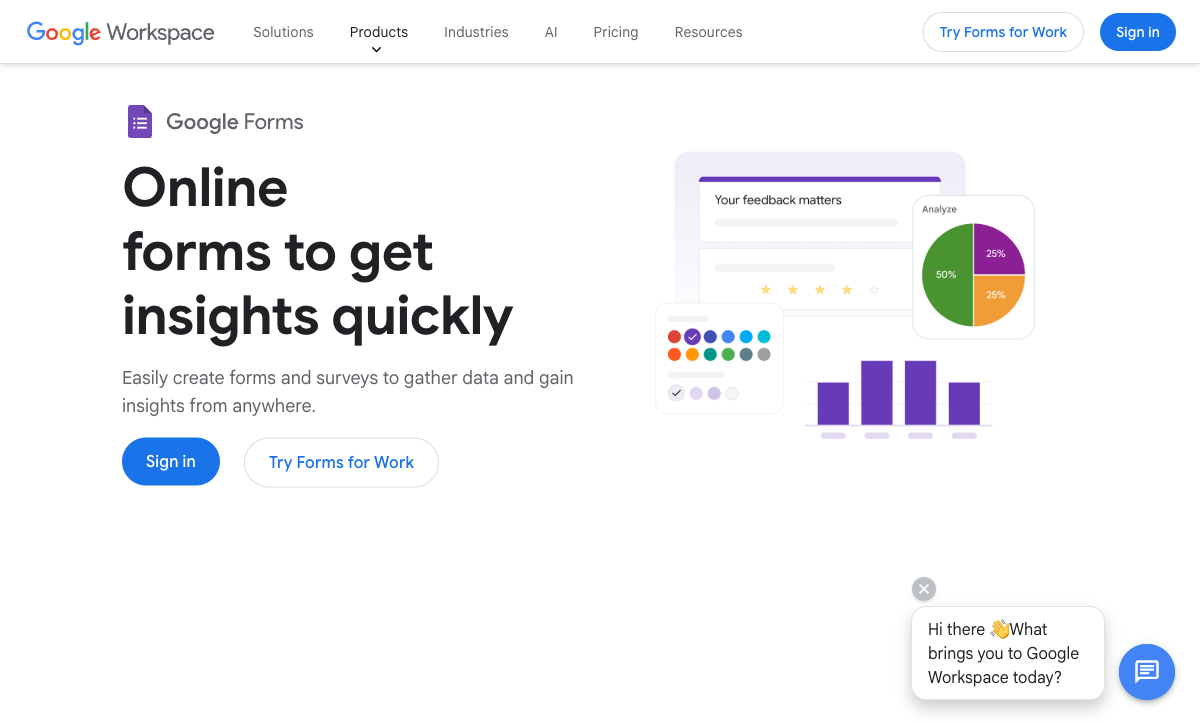
Google Forms offers unlimited surveys, unlimited questions, and up to 500,000 responses per form at zero cost. SurveyMonkey's free plan is almost unusable: 10 questions per survey and a capped number of responses. That's a demo, not a free tier. To do anything meaningful with SurveyMonkey, you need a paid plan starting at $39/month billed annually. For teams that run dozens of surveys per year with thousands of total responses, Google Forms saves $468/year or more in subscription costs. The math is simple: if survey methodology tools don't change your outcomes, the free option is the smart one.
Zero Learning Curve
Google Forms can be learned in under 5 minutes. Open it, add questions, share the link. SurveyMonkey has a more complex interface with question banks, logic configurators, analysis dashboards, and team features that take time to learn. The complexity is justified for professional researchers, but for someone who needs a quick feedback form or event RSVP, SurveyMonkey's feature depth is overhead rather than value. Non-technical team members can create and distribute Google Forms without any training.
Google Sheets Integration
Responses flow directly into Google Sheets -- no configuration, no API, no export step. For teams that already analyse data in Sheets, this native integration eliminates friction. SurveyMonkey can export to Google Sheets and Excel, but it's a manual export or a configured integration rather than a live connection. Google Forms' spreadsheet integration also means you can build custom dashboards, pivot tables, and analyses in Sheets using the raw response data, with no additional tools needed.
Good Enough for Most Surveys
Here's the uncomfortable truth for SurveyMonkey: the vast majority of surveys don't need professional methodology tools. Employee feedback, event satisfaction, meeting polls, volunteer signups, class evaluations, and internal team surveys all work perfectly fine in Google Forms. The question types are adequate (multiple choice, short answer, rating scales, grids), basic charts summarise responses, and Google Sheets handles any custom analysis. SurveyMonkey's premium features (benchmarking, question banks, significance testing) genuinely matter for professional research, but most surveys aren't professional research.
Where SurveyMonkey Wins
Expert Question Banks
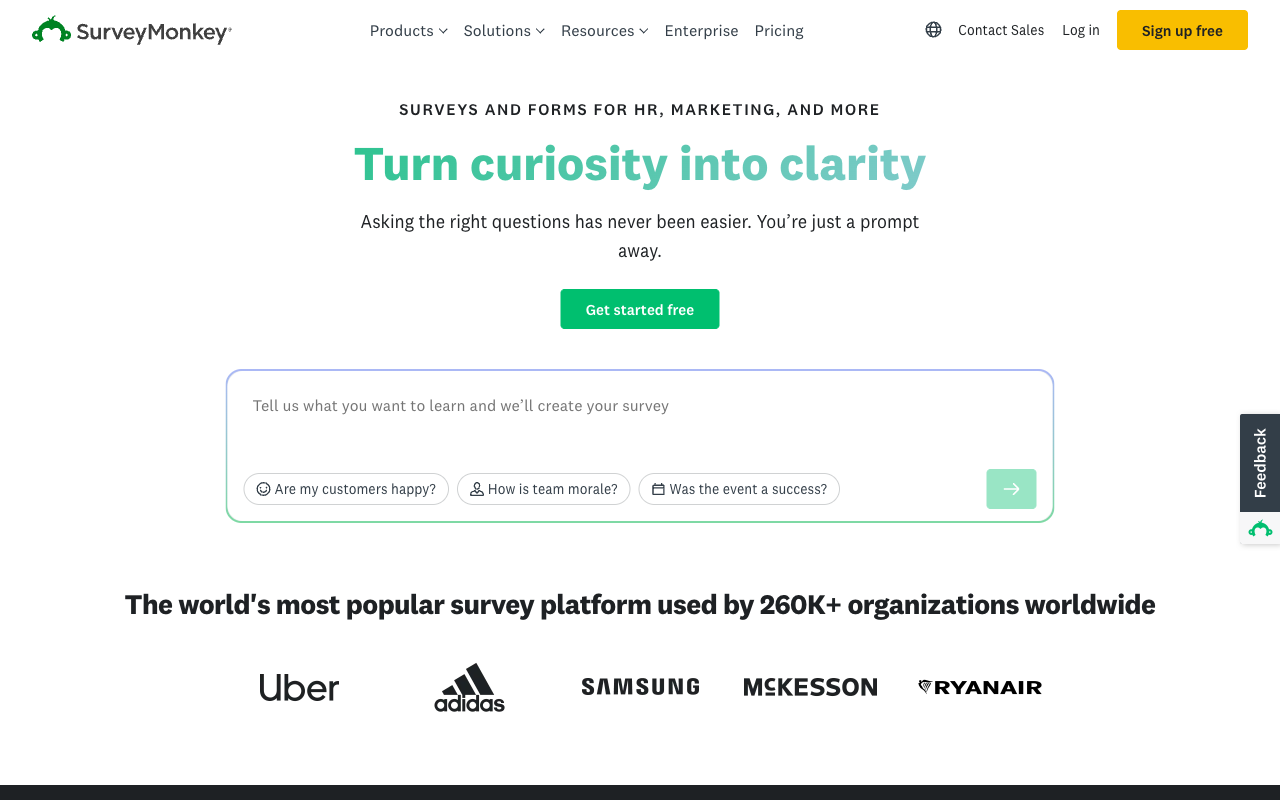
SurveyMonkey offers hundreds of expert-written, methodologically validated questions organised by category: employee engagement, customer satisfaction (NPS, CSAT), market research, healthcare, education, and more. These are more than templates: questions designed by survey methodology experts to reduce bias, improve response quality, and produce statistically reliable results. Google Forms gives you a blank canvas. SurveyMonkey gives you a head start built on decades of survey science. For anyone who isn't a survey design expert (most people), pre-validated questions prevent common mistakes that corrupt data.
Benchmarking and Industry Comparisons
When you use SurveyMonkey's standard question sets (NPS, employee satisfaction, etc.), the platform compares your results against aggregated benchmark data from millions of other surveys. You don't just see that your NPS is 42; you see how that compares to your industry average. Google Forms gives you raw numbers with no context. For business leaders making decisions based on survey data, benchmarks transform "our score is 42" into "our score is 42, which is 15 points above our industry average", a far more useful insight.
SurveyMonkey Audience (Respondent Panels)
Audience is SurveyMonkey's respondent panel service: define your target demographics (age, gender, location, industry, income, education) and SurveyMonkey delivers your survey to matching respondents from a panel of millions. This is the feature Google Forms simply cannot replicate. Google Forms requires you to distribute surveys to your own contacts -- your email list, social media followers, website visitors. If you need responses from people you don't already know (market research, product validation, brand studies), Audience is the only path between these two platforms.
Advanced Analytics
SurveyMonkey's analytics go far beyond basic charts: cross-tabulation (compare responses across demographic segments), statistical significance testing (know whether differences are real or noise), sentiment analysis on open-ended responses, word clouds, and trend tracking across survey waves. Google Forms gives you bar charts and pie charts. For anyone doing serious analysis (identifying which customer segments are most dissatisfied, whether a product change moved satisfaction scores significantly, or which employee concerns vary by department), SurveyMonkey's analytics save hours of manual spreadsheet work.
Methodology Tools
SurveyMonkey includes survey design features that prevent common methodology errors: question randomisation (reduce order bias), A/B testing of question wording, piping (insert previous answers into later questions), quotas (ensure demographic balance), and skip logic that goes beyond basic branching. None of this is flashy. It's the kind of rigour that separates casual data collection from reliable research. Google Forms' section-level branching is the only comparable feature, and it's primitive by comparison.
Team Collaboration and Shared Libraries
SurveyMonkey's team plans include shared survey libraries, brand assets, approved question banks, and collaborative editing with role-based permissions. Large organisations can maintain survey quality standards across departments by controlling which questions, themes, and branding elements are available to team members. Google Forms supports basic sharing and collaboration, but there's no concept of a shared question library, approved templates, or brand enforcement across an organisation. For enterprises that need survey governance, SurveyMonkey's team features provide structure that Google Forms lacks, so every department sends professionally crafted, on-brand surveys.
Multilingual Survey Support
SurveyMonkey's Premier plan includes built-in multilingual survey support: create a survey in one language, add translations for additional languages, and distribute a single link that automatically displays the correct language based on respondent preference. Google Forms has no native multilingual support. You'd need to create a separate form for each language and manage distribution manually. For global organisations surveying employees, customers, or research subjects across multiple countries, SurveyMonkey's multilingual tooling eliminates significant manual overhead.
Where Google Forms Falls Short
- No survey methodology tools: No question banks, no benchmarking, no significance testing, no randomisation. You're building surveys blind, relying on your own question-writing ability.
- Basic analytics only: Summary charts and Google Sheets export. No cross-tabulation, no sentiment analysis, no trend tracking without manual spreadsheet work.
- No respondent panels: You can only survey people you can already reach. No way to access representative samples of specific demographics.
- Minimal design customisation: Header image and accent colour only. Professional surveys that represent your brand need more visual control than Google Forms provides. Every Google Form looks identical to every other Google Form.
- No payment processing: Cannot collect payments, donations, or fees through forms. Event registrations with fees, fundraising campaigns, and product orders all require separate payment tools.
Where SurveyMonkey Falls Short
- Nearly unusable free tier: 10 questions per survey and capped responses, with no free trial of paid plans. This forces a paid commitment before you can properly evaluate the platform against Google Forms' free offering.
- Expensive for small teams: Team plans start at $30/user/month (billed annually). For a 5-person team, that's $1,800/year for survey software, hard to justify if you run surveys occasionally rather than constantly.
- Overkill for simple surveys: If you need a quick feedback form or event RSVP, SurveyMonkey's methodology tools are unnecessary complexity. The platform is designed for professional research, not casual data collection. The feature density creates overhead for simple use cases.
- No form-building versatility: SurveyMonkey is a survey tool, not a form builder. It handles payments and file uploads only lightly, has no e-signatures, and isn't built for non-survey use cases. Google Forms, despite being basic, handles a wider variety of data collection scenarios.
- Limited payment capabilities: SurveyMonkey supports basic payment collection through Stripe and PayPal from the Advantage plan, but it's not designed for eCommerce, product sales, or transactional forms.
See Them in Action
The difference between Google Forms and SurveyMonkey becomes most apparent in the post-survey experience. Both platforms let you create and distribute surveys quickly, but SurveyMonkey's analysis dashboard, with cross-tabulation, sentiment analysis, and benchmark comparisons, transforms raw responses into actionable insights. Google Forms gives you a summary page with basic charts and a link to Google Sheets for manual analysis.
For survey creation, both are intuitive. Google Forms is faster for simple surveys (fewer clicks, no account upgrade prompts). SurveyMonkey's editor offers more question types, question bank suggestions, and design options that slow down creation slightly but improve survey quality. The trade-off between speed of creation and quality of output mirrors the broader comparison.
Pricing Comparison
The pricing gap between these two platforms is stark. Google Forms is free for everything. SurveyMonkey charges for anything beyond a basic demo.
| Tier | Google Forms | SurveyMonkey | Key Difference |
|---|---|---|---|
| Free | Unlimited forms, 500,000 responses/form | 10 questions/survey, capped responses | Google Forms is usable free. SurveyMonkey's free tier is a demo. |
| ~$30/user/mo | N/A (still free) | Team Advantage: 3-user minimum, 50,000 responses/yr, question bank, logic | SurveyMonkey's entry tier unlocks methodology tools Google Forms lacks. |
| ~$92/user/mo | N/A | Team Premier: 100,000 responses/yr, advanced branching, multilingual, phone support | Professional research features at a professional research price. |
| Audience Panels | N/A | $1-5+ per response, custom targeting | Google Forms has no equivalent. Access to millions of respondents. |
What will it cost you?
Google Forms plans
- Free (Personal)FreeForms Unlimited, Submissions 500,000 per form, Team 1, Storage 15 GB (shared across Google Drive)
- Business Starter$7/moForms Unlimited, Submissions 500,000 per form, Team Up to 300, Storage 30 GB per user
- Business Standard$14/moForms Unlimited, Submissions 500,000 per form, Team Up to 300, Storage 2 TB per user
- Business Plus$22/moForms Unlimited, Submissions 500,000 per form, Team Up to 300, Storage 5 TB per user
| Plan | Price | Forms | Submissions | Team | Storage |
|---|---|---|---|---|---|
| Free (Personal) | Free | Unlimited | 500,000 per form | 1 | 15 GB (shared across Google Drive) |
| Business Starter | $7/mo | Unlimited | 500,000 per form | Up to 300 | 30 GB per user |
| Business Standard | $14/mo | Unlimited | 500,000 per form | Up to 300 | 2 TB per user |
| Business Plus | $22/mo | Unlimited | 500,000 per form | Up to 300 | 5 TB per user |
SurveyMonkey plans
- Basic (Free)FreeForms Unlimited, Submissions Limited per survey (exact number now only shown after sign-up/login), Team 1, Storage N/A
- Individual Standard$149/momonthly onlyForms Unlimited, Submissions 1,000/month, Team 1, Storage N/A
- Individual Advantage$39/moForms Unlimited, Submissions 15,000 per year, Team 1, Storage N/A
- Individual Premier$139/moForms Unlimited, Submissions 40,000 per year, Team 1, Storage N/A
- Team AdvantageCheck limits$30/moForms Unlimited, Submissions 50,000 per year (shared), Team 3 minimum, Storage N/A
- Team Premier$92/moForms Unlimited, Submissions 100,000 per year (shared), Team 3 minimum, Storage N/A
| Plan | Price | Forms | Submissions | Team | Storage |
|---|---|---|---|---|---|
| Basic (Free) | Free | Unlimited | Limited per survey (exact number now only shown after sign-up/login) | 1 | N/A |
| Individual Standard | $149/momonthly only | Unlimited | 1,000/month | 1 | N/A |
| Individual Advantage | $39/mo | Unlimited | 15,000 per year | 1 | N/A |
| Individual Premier | $139/mo | Unlimited | 40,000 per year | 1 | N/A |
| Team AdvantageCheck limits | $30/mo | Unlimited | 50,000 per year (shared) | 3 minimum | N/A |
| Team Premier | $92/mo | Unlimited | 100,000 per year (shared) | 3 minimum | N/A |
| Product | Plan | Monthly Price | Annual Price (per month) | Free Plan | Free Trial | Limits |
|---|---|---|---|---|---|---|
| Google Forms | Free (Personal) | Free | Free | Yes | 14 days | forms: Unlimited, submissions: 500,000 per form, storage: 15 GB (shared across Google Drive), users: 1, file uploads: Count against the owner's 15 GB Google Account storage |
| Google Forms | Business Starter | $8.4/mo | $7/mo billed annually | forms: Unlimited, submissions: 500,000 per form, storage: 30 GB per user, users: Up to 300, file uploads: Count against the owner's pooled Drive storage | ||
| Google Forms | Business Standard | $16.8/mo | $14/mo billed annually | forms: Unlimited, submissions: 500,000 per form, storage: 2 TB per user, users: Up to 300, file uploads: Count against the owner's pooled Drive storage | ||
| Google Forms | Business Plus | $26.4/mo | $22/mo billed annually | forms: Unlimited, submissions: 500,000 per form, storage: 5 TB per user, users: Up to 300, file uploads: Count against the owner's pooled Drive storage | ||
| SurveyMonkey | Basic (Free) | Free | Free | Yes | No | forms: Unlimited, submissions: Limited per survey (exact number now only shown after sign-up/login), storage: N/A, users: 1 |
| SurveyMonkey | Individual Standard | $149/mo | Not listed | forms: Unlimited, submissions: 1,000/month, storage: N/A, users: 1 | ||
| SurveyMonkey | Individual Advantage | Annual billing only | $39/mo billed annually | forms: Unlimited, submissions: 15,000 per year, storage: N/A, users: 1 | ||
| SurveyMonkey | Individual Premier | Annual billing only | $139/mo billed annually | forms: Unlimited, submissions: 40,000 per year, storage: N/A, users: 1 | ||
| SurveyMonkey | Team Advantage | Annual billing only | $30/mo billed annually | forms: Unlimited, submissions: 50,000 per year (shared), storage: N/A, users: 3 minimum | ||
| SurveyMonkey | Team Premier | Annual billing only | $92/mo billed annually | forms: Unlimited, submissions: 100,000 per year (shared), storage: N/A, users: 3 minimum |
What Users Say
Google Forms is universally praised for being free and simple. The criticism is equally universal: it's too basic for professional use. Users don't passionately love or hate Google Forms. It's a utility, like a calculator.
SurveyMonkey reviews (4.4-4.6/5 across platforms) praise the question banks, analytics, and professional features. The consistent criticism is pricing -- users frequently describe SurveyMonkey as overpriced, especially given the restrictive free tier. The per-user pricing model for team plans is a particular pain point for organisations with occasional survey needs. As Zapier's 2025 survey tools roundup noted, SurveyMonkey remains the most full-featured survey platform but faces increasing competition from cheaper alternatives.
Who Is Each Platform Best For?
Google Forms is ideal for: anyone running basic surveys where methodology isn't critical. Internal team feedback, event RSVPs, class evaluations, quick polls, volunteer signups, and casual data collection. If you need answers and don't need analysis tools, Google Forms is free and immediate. Educators, students, nonprofit organisations, and small teams that collect data without budget constraints.
SurveyMonkey is ideal for: professional researchers, HR teams running engagement surveys with benchmarking, marketing teams conducting market research, product teams running customer satisfaction tracking, and anyone who needs to survey people outside their existing contacts. If survey data informs business decisions with real financial impact, SurveyMonkey's methodology tools reduce the risk of bad data. Enterprises needing survey governance across departments and global organisations requiring multilingual support.
Neither platform is ideal for: businesses that need forms to collect payments, process transactions, capture e-signatures, or trigger multi-step workflows. Neither Google Forms nor SurveyMonkey is a general-purpose form builder; they're data collection tools optimised for surveys. For versatile forms that combine surveys, payments, branding, and automation in one tool, dedicated form builders are the better path.
Need Surveys + Payments + Forms in One Tool?
Google Forms and SurveyMonkey both excel at surveys but lack broader form capabilities. If your business needs surveys and payment collection and branded forms and workflow automation, Paperform fills the gap between these two platforms.
Paperform starts at $49/month billed annually ($59 monthly) -- not the cheapest entry price in this category, but nothing on a paid plan is metered. Submissions, seats and workflow runs are all unlimited, so the bill doesn't move when a campaign lands or the team grows. Response caps and per-seat pricing are a tax on growth, and Paperform doesn't charge it. One subscription also covers all three products: Paperform for forms, Papersign for eSignatures, and Stepper for workflow automation, instead of stitching together a survey tool, a signing tool and an automation platform from three vendors. On top of that you get professional form design, 5 integrated payment gateways, an Excel-style calculation engine (dynamic pricing, scoring, conditional totals) and 9,800+ integrations, covering surveys, order forms, booking pages, lead capture and client intake in one place.
Paperform isn't a survey science platform like SurveyMonkey (no question banks, no benchmarking, no audience panels). But for businesses that need versatile forms that do more than collect data, it's the all-in-one solution that neither Google Forms' simplicity nor SurveyMonkey's specialisation provides. See our Google Forms alternatives and SurveyMonkey alternatives for the full comparison.
The Verdict
Google Forms is the right choice for most surveys. That's not a slight against SurveyMonkey. Most surveys are simple enough that free and basic tools handle them adequately. Employee feedback, event satisfaction, class evaluations, team polls, and casual data collection don't need expert question banks or statistical significance testing. They need a form that collects answers, and Google Forms does that for free. The Google Sheets integration makes basic analysis straightforward, and the collaborative editing lets teams build surveys together without any friction.
SurveyMonkey is the right choice when survey quality directly impacts decisions with real consequences. If you're measuring employee engagement to inform retention strategy, running market research to guide a product launch, or conducting academic research that will be published and scrutinised, SurveyMonkey's methodology tools, benchmarking data, and analytics are worth the investment of $39/month and up (or $30-92 per user per month on team plans). The Audience panel service is the killer feature -- no other platform in this comparison lets you survey representative samples of specific demographics on demand. The expert question banks alone prevent the kind of poorly worded questions that corrupt survey data.
The deciding factor is the stakes of your survey data. Low-stakes surveys (event feedback, team polls, class evaluations) don't need methodology tools, so Google Forms is the obvious choice. High-stakes surveys (employee engagement driving retention strategy, market research informing product launches, brand perception studies guiding marketing spend) benefit from SurveyMonkey's rigour. Match the tool to the decision the data will inform.
For businesses that need more than either platform offers (surveys plus payments, forms plus branding, data collection plus workflow automation), dedicated form builders like Paperform provide the versatility that neither Google Forms' simplicity nor SurveyMonkey's specialisation covers. For more options, see our Google Forms alternatives, SurveyMonkey alternatives, or the full best form builders ranking.
Frequently Asked Questions
Is Google Forms good enough for professional surveys?
For basic surveys (employee feedback, event satisfaction, quick polls), Google Forms is perfectly adequate. It collects responses, feeds them into Google Sheets, and provides basic charts. Where it falls short is survey methodology: no question banks vetted by research experts, no benchmarking against industry data, no statistical significance testing, no advanced analysis tools, and no audience panel access. If your survey results inform business decisions, academic research, or marketing strategy, SurveyMonkey's methodology tools reduce the risk of poorly designed questions leading to misleading data. For casual data collection, Google Forms is fine. For surveys where data quality matters, SurveyMonkey is the professional choice.
How much does SurveyMonkey cost compared to Google Forms?
Google Forms is completely free, with up to 500,000 responses per form. SurveyMonkey's free plan limits you to 10 questions per survey and a capped number of responses (SurveyMonkey no longer publishes the exact figure), barely usable for real work. Paid plans start at $39/month billed annually (Advantage Annual, 15,000 responses a year), and team plans at $30/user/month with a 3-user minimum, with Team Premier at $92/user/month adding advanced branching, multilingual surveys and phone support. SurveyMonkey Audience (paid respondent panels) is priced separately starting around $1-5 per response depending on targeting. The cost gap is significant: Google Forms is $0, while serious SurveyMonkey usage costs $468/year and up.
Can SurveyMonkey do everything Google Forms does?
Yes, and significantly more. SurveyMonkey matches or exceeds every basic feature Google Forms offers: multiple question types, section-based logic, response collection, basic charts. SurveyMonkey then adds expert question banks, benchmarking, advanced analytics, A/B testing of questions, audience panels, multilingual surveys, team collaboration, and compliance features. The only areas where Google Forms has an advantage are price (free vs paid), Google Workspace integration (native vs configured), and simplicity (fewer features means less to learn). If you need a survey tool that does everything and cost isn't a constraint, SurveyMonkey is strictly more capable.
What is SurveyMonkey Audience and does Google Forms have anything similar?
SurveyMonkey Audience is a paid respondent panel service: you define your target demographics (age, location, industry, income) and SurveyMonkey delivers your survey to matching respondents from their panel of millions. This is invaluable for market research, product testing, and brand studies where you need representative data from specific populations, not just responses from people you already know. Google Forms has nothing equivalent. With Google Forms, you're limited to distributing surveys to your own contacts, social media followers, or website visitors. If you need responses from people outside your existing network, SurveyMonkey Audience is the only option between these two.
Which is better for academic or scientific research?
SurveyMonkey, by a significant margin. Academic research requires methodological rigour: validated question types, randomisation, piping, skip logic, data export in SPSS-compatible formats, and sometimes IRB-compliant consent workflows. SurveyMonkey offers all of these. Google Forms offers basic question types and CSV export, functional but lacking the methodology tools researchers need. That said, many student researchers and small-scale academic projects use Google Forms successfully because it's free and "good enough" for preliminary data collection. For published research, funded studies, or any project where methodology will be scrutinised, SurveyMonkey's research-grade features are worth the investment.
Sources & References
- Best Online Form Builder to Use in 2026 -- Top 20 Tools — EmailToolTester, 2026
- Google Forms vs SurveyMonkey: Which Should You Use? — Zapier, 2025
- The Best Survey Tools for 2025 — Zapier, 2025
Updates
We re-audit the form builders we compare on a regular cadence and log every change here — a public record of what changed and when.
- Updated June 4, 2026 — Updated SurveyMonkey pricing to reflect current rates: the 'Team Advantage' plan is now $30/month (was $25) and 'Premier' is $92/month (was $75). Also corrected the free plan response cap from 40 to 25 responses per survey.
Unlimited plans are subject to each vendor's fair use policy.
Ready to try Paperform?
Create beautiful forms, payment pages, and workflows — no code required.