Google Forms vs Tally: Which Is Better in 2026?
Tally beats Google Forms on almost every form-building dimension: question-level logic, calculations, Stripe payments, custom branding and a far better editor, most of it free. Google Forms wins on compliance, with SOC 2, ISO 27001, HIPAA and SSO behind it. Choose Tally for public forms, Google Forms for regulated internal ones.
This is a comparison between two free tools that arrived fifteen years apart. Google Forms shipped in 2008 as a side door into Google Sheets, and its job has never really changed: ask some questions, chart the answers, move on. Tally launched in 2020 with a different premise, which was that nearly everything other builders charge for should be free and the editor should feel like typing in Notion. Both do their job well. The interesting part of the comparison is that they barely overlap on why you would pick them.
Google Forms is chosen because it is already there, sitting in the Workspace account your organisation pays for, covered by the security review that was signed off two years ago. Tally is chosen deliberately, by someone who looked at their form and decided it should not look like a Google Form. Everything below follows from that split.
Quick Verdict
Choose Google Forms if:
- The form is internal and your organisation runs on Google Workspace
- Someone will ask for SOC 2, ISO 27001, FedRAMP or a HIPAA BAA
- You need SSO, admin controls and data residency on the form tool
- Several colleagues need to edit the same form at the same time
- You are building a graded quiz for a classroom or a training course
Choose Tally if:
- A customer, candidate or client will see the form
- You need to take a payment without leaving the form
- The logic is more complicated than jumping between sections
- Responses should land in Notion, Airtable or Slack automatically
- You want branding removed and a custom domain for $24 a month
The Five Numbers That Decide This
| Dimension | Google Forms | Tally |
|---|---|---|
| Pricing | Free forever; Workspace from $7/user/mo annually adds storage and admin, not form features | Free unlimited under fair use; Pro $24/mo annually ($29 monthly); Business $74/mo annually |
| Integrations & API | Around 20 native, nearly all inside Google; response API only, no form-creation API | 1,000+ including Notion, Airtable, Slack, Coda; REST API, signed webhooks and an MCP server |
| Conditional logic | Section jumps only, triggered by multiple choice or dropdown answers | Question-level show/hide, answer piping and a formula editor, all on the free plan |
| Payments | Zero processors. No payment field exists at any tier | One processor: Stripe, including subscriptions. No PayPal, Square, Braintree or Google Pay |
| Compliance | GDPR, CCPA, SOC 2, ISO 27001, HIPAA (under a Workspace BAA), FedRAMP, SSO | GDPR and EU hosting only. No SOC 2, no ISO 27001, no HIPAA, no SSO or 2FA on any plan |
Feature Comparison
The full side-by-side, drawn from our own testing of both products.
| Feature | Google Forms | Tally |
|---|---|---|
| Form Building | ||
| Document-style editor | No | Yes |
| AI form creation | Yes paid | Yes |
| Field types | 11 | 20+ |
| Multi-page forms | Yes | Yes |
| Guided mode (one question at a time) | No | No |
| Conditional logic | Yes | Yes |
| Calculations field | No | Yes |
| AI calculations assistant | No | No |
| Scoring | Yes | Yes |
| AI quiz generation | Yes paid | No |
| Answer piping | No | Yes |
| Pre-filling and hidden fields | Yes | Yes |
| Save and resume | No | No |
| Auto-close by number | Yes | Yes |
| Auto-close by date | Yes | Yes |
| Appointment/booking field | No | No |
| Signature field | No | Yes |
| Color picker field | No | No |
| API-powered dropdowns | No | No |
| Google address search | No | No |
| File uploads | Yes | Yes |
| Formula editor | No | Yes |
| Import from other form builders | No | Yes |
| PDF generation | No | Yes |
| Payments | ||
| Stripe payments | No | Yes |
| PayPal payments | No | No |
| Square payments | No | No |
| Braintree payments | No | No |
| Google Pay | No | No |
| Product sales (eCommerce) | No | Yes |
| Subscriptions | No | Yes |
| Coupons and discounts | No | No |
| Custom pricing rules | No | Yes |
| Tax calculations | No | No |
| Quotes/invoices | No | No |
| Refunds | No | No |
| 3D Secure | No | No |
| Design & Customization | ||
| Template gallery | 20+ | Yes |
| Rich media (images, GIFs, videos) | Yes | Yes |
| Unsplash and Giphy integration | No | No |
| Image editor | No | No |
| Adobe Creative Cloud | No | No |
| Language translation | No | Yes |
| Advanced theming | No | Yes pro |
| Custom form URL | No | Yes |
| Custom domains | No | Yes pro |
| Custom HTML & CSS | No | Yes pro |
| Remove branding | No | Yes pro |
| Custom email domains | Yes Business Starter | Yes pro |
| Analytics | ||
| Submission results and reports | Yes | Yes |
| AI report insights | Yes Business Standard | No |
| Paperform analytics | No | Yes pro |
| Google Analytics & Facebook Pixel | No | Yes pro |
| Custom analytics scripts | No | No |
| Partial submissions | No | Yes pro |
| Answer Insights | No | Yes |
| Collaboration | ||
| Multi-user accounts | Yes | Yes pro |
| User permissions and management | Yes | Yes pro |
| Advanced permissions & admin | Yes Business Starter | No |
| Form sharing (templates) | Yes | Yes |
| Spaces and tag management | No | Yes pro |
| Security | ||
| SOC 2 Type II | Yes | No |
| GDPR compliant | Yes | Yes |
| SSL encryption | Yes | Yes |
| Two-factor authentication | Yes | No |
| Enforce 2FA for all users | Yes Business Starter | No |
| SSO (SAML) | Yes Business Plus | No |
| reCAPTCHA | No | Yes |
| Local data residency | Yes Business Plus | Yes |
| Custom S3 storage (BYO) | No | No |
| Integrations & API | ||
| Native integrations | No | 17+ |
| Zapier | Yes | Yes |
| Make (Integromat) | Yes | Yes |
| Webhooks | No | Yes |
| Standard API | Yes | Yes |
| Business API | No | No |
| WordPress plugin | No | Yes |
| oEmbed support | No | Yes |
| AI assistant connectors (MCP / ChatGPT / Claude) | No | Yes |
| Integration failure alerts | No | Yes |
Where Google Forms Wins
The compliance answer is already written
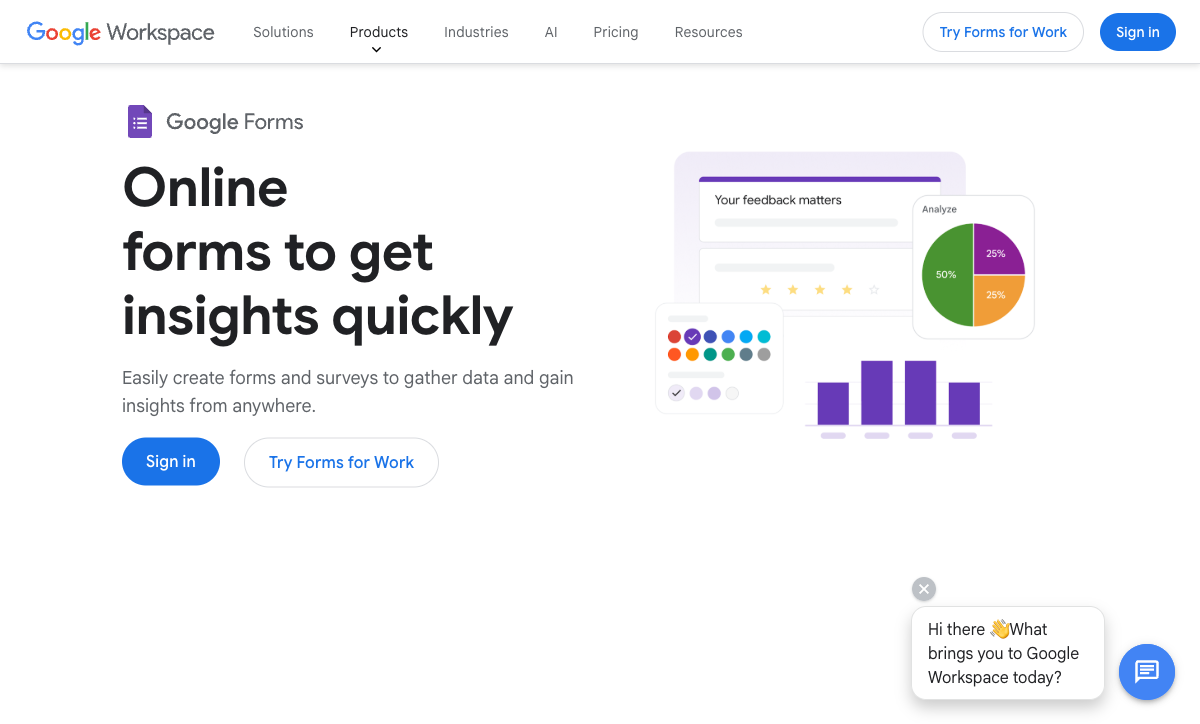
Google Forms carries SOC 2, ISO 27001, FedRAMP, ISO 27701 and HIPAA coverage under a Workspace business associate agreement; Tally publishes GDPR and EU hosting and stops there. For a hospital intake sheet, a government supplier questionnaire or anything an auditor will read, that difference ends the discussion before the editors are even compared. Google Forms also offers SAML SSO, enforced admin policy and data residency controls, none of which Tally has at any price.
Nobody has to be onboarded
Capterra rates Google Forms 4.7 for ease of use across more than 11,500 reviews, and the reason is familiarity rather than design. Everyone in the organisation has filled one in and most have built one. When the form is a room booking sheet or a staff survey, the value of a tool nobody needs to learn is real, and Tally's lovely editor does not beat it because there is nothing to beat.
Real-time co-editing and quizzes
Two people can build a Google Form at the same time, the same way they would edit a Doc, with cursors visible. Tally has team collaboration on Pro but not that live co-authoring experience. Google Forms also has quiz mode with point values, auto-grading and answer feedback, which is why it is entrenched in education through Google Classroom. Tally has no equivalent grading engine.
It never meters you and it never sends an invoice
Unlimited forms and unlimited responses, permanently, with no fair use clause to read. Tally's free plan is the most generous in the paid-form-builder category, but it is bounded by a published fair use policy, and the features most businesses actually want sit behind Pro. Google's form features are identical on the free tier and the $22-per-user Business Plus tier.
Where Tally Wins
The form stops looking like a form
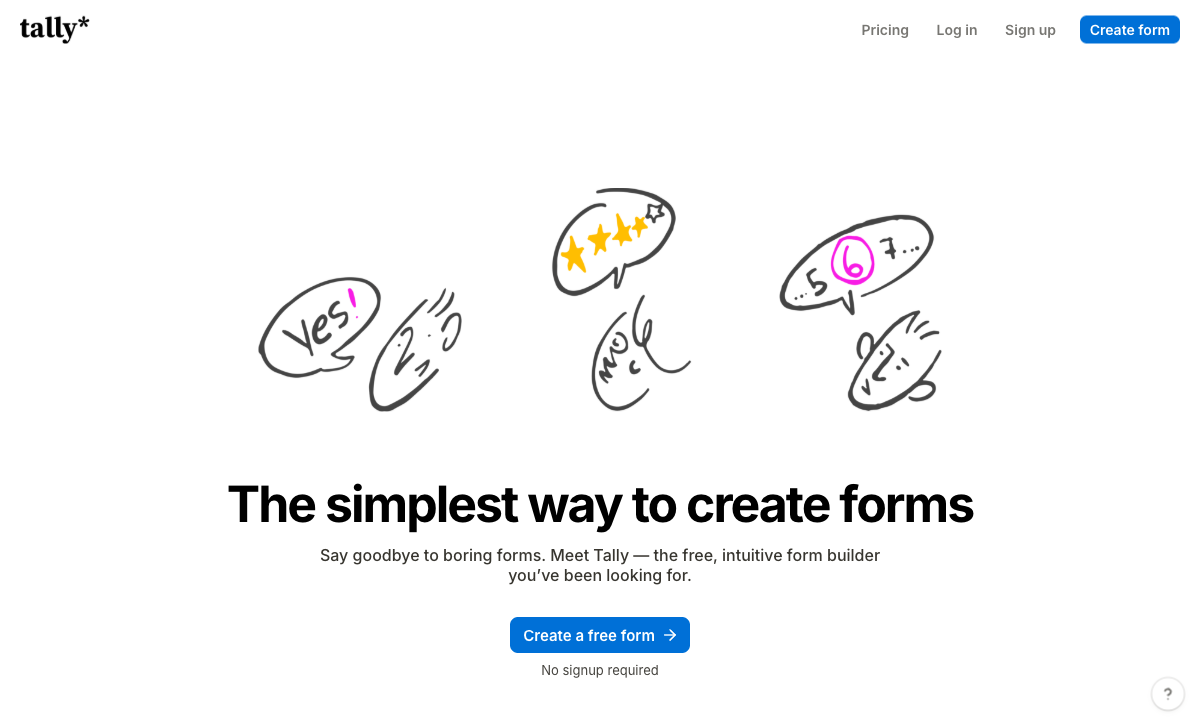
Google Forms gives you a header image, a theme colour, a background colour and four fonts, with Google branding welded on and a docs.google.com URL that cannot be changed. Tally Pro removes its own branding, adds a custom domain, custom CSS, custom email domains and a configurable link preview. For anything a customer sees, this is the reason people migrate, and a Softr comparison of the two lands in the same place.
Logic and calculations that reach individual questions
Tally does question-level conditional logic and has a formula editor for calculations; Google Forms can only jump between sections based on a choice answer. That is the difference between a form that adapts to the person filling it in and a form that forks twice. Tally puts all of it on the free plan. The honest caveat comes from a Hackceleration review of fifteen real users: on large branching forms the logic gets hard to trace, because there is no visual map of what leads where.
Money can change hands
Tally accepts Stripe payments and subscriptions on the free plan. Google Forms accepts none, at any tier, which is the cleanest single gap between the two products. A deposit, a workshop ticket, a paid application fee: in Google Forms each of those is a form link followed by a manual invoice, and in Tally it is a block you drag in.
It connects outward instead of inward
Google Forms has roughly twenty native integrations and nearly all of them are Google products, so anything outside that circle becomes an Apps Script someone in the team maintains. Tally has over a thousand, with native Notion, Airtable, Slack and Coda connections, signed webhooks, a documented REST API and an MCP server. Tally AI also builds, edits and translates forms from a chat window, free on every plan, while Gemini in Google Forms requires a Business Standard Workspace seat at $14 per user per month.
Where Google Forms Falls Short
- No payments at all: no processor, no payment field, no workaround short of a second tool.
- Eleven question types: no signature, no appointment booking, no rating scale beyond a linear one, no matrix.
- Branding is permanent: Google's logo stays and the URL stays on docs.google.com, on free and paid alike.
- No behavioural analytics: forms hosted on Google's domain cannot run Google Analytics, a Meta Pixel or any custom script, so there is no drop-off data.
- No save and resume: respondents can only return if they are signed in to a Google account, which is a barrier for public forms.
- Around twenty templates: against Tally's community library and every other builder on the market.
Where Tally Falls Short
- Stripe or nothing: no PayPal, Square, Braintree or Google Pay, and no coupons, tax rules, quotes or invoicing around the charge.
- No enterprise security: no SOC 2, no ISO 27001, no HIPAA, and no SSO or 2FA even on the $89 a month Business plan, which is the top tier.
- Analytics are paywalled: visit tracking, drop-off data and partial submissions all require Pro, where Google Forms gives response charts free.
- Missing specialist fields: no appointment booking, no address autocomplete, no guided one-question-at-a-time mode, no save and resume.
- No workflow or approvals: anything past submit-and-notify has to be pushed to Zapier, Make or n8n.
- Around ten people: email-only support with no tier to escalate to, and customer support is Tally's weakest G2 sub-rating at 4.5.
See Both in Action
Pricing Comparison
Google Forms is free and stays free; paying Google buys Workspace, not better forms. Tally is free until you want the form to be yours, at which point Pro is $24 a month billed annually or $29 monthly, and Business is $74 a month annually. Neither charges per submission, and Tally includes unlimited team members on both paid tiers.
Google Forms
Tally
| Product | Plan | Monthly Price | Annual Price (per month) | Free Plan | Free Trial | Limits |
|---|---|---|---|---|---|---|
| Google Forms | Free (Personal) | Free | Free | Yes | 14 days | forms: Unlimited, submissions: Unlimited, storage: 15 GB (shared across Google Drive), users: 1, file uploads: Included in 15 GB storage |
| Google Forms | Business Starter | $8.4/mo | $7/mo billed annually | forms: Unlimited, submissions: Unlimited, storage: 30 GB per user, users: Up to 300, file uploads: Included in storage | ||
| Google Forms | Business Standard | $16.8/mo | $14/mo billed annually | forms: Unlimited, submissions: Unlimited, storage: 2 TB per user, users: Up to 300, file uploads: Included in storage | ||
| Google Forms | Business Plus | $26.4/mo | $22/mo billed annually | forms: Unlimited, submissions: Unlimited, storage: 5 TB per user, users: Up to 300, file uploads: Included in storage | ||
| Tally | Free | Free | Free | Yes | No | forms: Unlimited, submissions: Unlimited, storage: N/A, users: 1, file uploads: 10 MB per file |
| Tally | Pro | $29/mo | $24/mo billed annually | forms: Unlimited, submissions: Unlimited, storage: N/A, users: Unlimited, file uploads: Unlimited | ||
| Tally | Business | $89/mo | $74/mo billed annually | forms: Unlimited, submissions: Unlimited, storage: N/A, users: Unlimited |
What Users Say
The rating counts tell you as much as the ratings. Google Forms has over 11,500 Capterra reviews at 4.7 and a 4.6 on G2 under the Google Workspace listing, with value for money at 4.8, which is what happens when the price is zero. Tally scores higher, 4.8 on G2 and 4.9 on Capterra, but across roughly 140 reviews rather than tens of thousands, and its support sub-rating of 4.5 is its softest number. TechRadar's 4-out-of-5 verdict on Google Forms put it well: excellent for basic surveys, thin for anything complex or large-scale.
When Neither One Is Enough
Both of these tools end at the same place, which is the submit button. Tally gets you much further than Google Forms before that point, and if your work genuinely finishes when the response arrives, one of them is the right answer and you should stop here. Paperform is not trying to win that decision.
The wall arrives at a specific point: several brands or clients that have to stay separate, payments with real pricing logic behind them, a contract that has to be signed and filed, an approval chain with a person at each step, or a compliance checklist someone else wrote. Google Forms hands all of that to you unsolved. Tally hands it to Zapier, Make or n8n, which means you become the glue between the form, the signing tool, the automation tool and three separate invoices.
Paperform's answer is one subscription covering forms, Papersign eSignatures and Stepper workflow automation on every plan. Its Excel-style calculation engine is the piece that changes the shape of the work: the same formulas that price a cart also decide which questions and pages appear, which conditional emails fire, what reaches an integration and what the success page says. Payments run through five processors rather than one, with products, subscriptions, coupons, tax and refunds. On the security checklist, Paperform is SOC 2 Type II, GDPR and CCPA compliant with SAML SSO on Business, though like Tally it is not HIPAA compliant and signs no BAAs, so Google Forms under a Workspace agreement still wins that specific case.
Say the price plainly: Pro is $59 a month, or $49 a month billed annually, with Business at $149 ($124 annually). Google Forms is free and Tally Pro is half that, so both undercut it. What the difference buys is that nothing is metered on the way up. Submissions and seats are unlimited on paid plans, so a campaign that lands does not trigger a bill and adding the designer who needs access costs nothing. Support is in the price rather than sold back as an enablement fee, and the company has been bootstrapped and profitable since 2016, which matters when the thing you are buying holds a process rather than a questionnaire. There is a 7-day trial with no card required.
If you want to go deeper on either matchup, see Paperform vs Tally, Paperform vs Google Forms, or the wider field in our ranking of the best form builders. Teams leaving Google specifically should start with Google Forms alternatives.
The Verdict
Tally is the better form builder. It wins on the editor, on logic, on payments, on integrations, on branding and on AI, and most of that is free. For a landing page form, a waitlist, a client enquiry, a paid workshop signup or anything where the reader is not an employee, Tally is the one to use, and the $24 a month for Pro is the least contentious spend in this category.
Google Forms is the better internal tool. Its compliance posture is untouchable here, its collaboration is genuinely best in class, the quiz engine has no Tally equivalent, and it costs nothing forever with no fair use clause attached. When the form lives inside a Workspace organisation and an auditor might read it, there is no argument to have.
The pattern worth noticing is that both tools are excellent at forms and neither attempts what comes after one. If your answer arrives and then has to be priced, signed, approved and filed, that is a different purchase, and it is the one Paperform is built for.
Frequently Asked Questions
Can Tally collect payments when Google Forms cannot?
Yes, and it is the single biggest functional gap between the two. Google Forms has no payment field at any tier, including paid Google Workspace plans, so charging someone means sending a Forms link and then invoicing them separately. Tally includes Stripe payments and subscriptions on its free plan. The limit on Tally's side is that Stripe is the only processor: no PayPal, no Square, no Braintree, no Google Pay, and no coupons, tax rules or invoicing around the charge.
Is Tally actually free, or is it free like Google Forms is free?
They are free in different ways. Google Forms is free because it is a loss leader inside Google Workspace, and the form features are identical on every plan, so paying Google adds storage and admin controls rather than form capability. Tally's free plan is unlimited forms and submissions subject to a published fair use policy, and it includes logic, calculations, Stripe payments, e-signatures and integrations. Tally paywalls the things a business tends to need: branding removal, custom domains, custom CSS, partial submissions and analytics all sit on Pro at $24 a month billed annually.
Which one passes a security questionnaire, Google Forms or Tally?
Google Forms, and it is not close. Google Forms inherits Google Workspace's certifications: SOC 2, ISO 27001, HIPAA coverage under a Workspace BAA, FedRAMP, GDPR and CCPA, plus SSO and data residency controls. Tally publishes GDPR compliance and EU hosting and nothing further. It has no SOC 2, no ISO 27001, no HIPAA, and no SSO or 2FA on any plan including the $89 a month Business tier. If a procurement team is reviewing the tool, that gap usually decides it.
Does Tally have better conditional logic than Google Forms?
Substantially better. Google Forms branches only by jumping between sections based on a multiple choice or dropdown answer, so individual questions cannot be shown or hidden and conditions cannot be chained. Tally does question-level conditional logic plus a formula editor for calculations, both on the free plan. Tally's own weak point is debugging: reviewers report that large branching forms get difficult to trace because there is no visual logic map.
Should I move from Google Forms to Tally for client-facing forms?
For a form that ends at the submit button, yes. A Google Form always carries Google branding and a docs.google.com URL, and neither can be removed at any price. Tally Pro removes branding, adds a custom domain and custom CSS, and lets you set the link preview image and title. Expect $24 a month billed annually for that. What moving to Tally does not fix is what happens after submission: signatures beyond a basic e-signature block, approval routing and multi-brand workspace separation are still elsewhere.
Which is the safer long-term bet, a Google product or a ten-person startup?
The risks run in opposite directions. Google Forms will not disappear, but Google has a long record of deprioritising products that do not serve the core business, and Forms has changed very little in a decade. Tally launched in 2020, is bootstrapped and profitable at roughly $4M ARR with about ten people, and ships constantly, which means fast improvement and no enterprise support tier to escalate to when something breaks on a deadline. Buying either one as a system of record is a judgement about which risk you can live with.
Sources & References
- Google Forms vs Tally: 2026 comparison guide — Softr, 2026
- Tally Review 2026: Honest Verdict + 15 Real User Reviews — Hackceleration, 2026
- Google Forms Review: Is This the Best Free Survey Tool? — TechRadar, 2025
- Typeform AI vs Tally AI vs Google Forms AI — Genesys Growth, 2026
Last updated September 22, 2026
Ready to try Paperform?
Create beautiful forms, payment pages, and workflows — no code required.