 By Dean McPherson, Co-founder & CTO, Paperform · Updated
Microsoft Forms vs Typeform: Which Is Better in 2026?
Microsoft Forms and Typeform could hardly be more different. Microsoft Forms is free, basic, and built for internal use within the Microsoft 365 ecosystem: employee surveys, team polls, training quizzes. Typeform is a premium design tool that treats form completion as a user experience, with one-question-at-a-time conversational flow, animated transitions, and visual polish that makes respondents actually want to finish. One prioritises cost. The other prioritises craft.
The tension between these two reflects a broader question: does form design matter enough to pay for? For internal surveys where employees complete forms because they're asked to, the answer is probably no. Microsoft Forms works fine and costs nothing. For external-facing forms where completion rates directly affect revenue (lead capture, customer feedback, event registration, onboarding), design quality can measurably impact results. Typeform claims 2-3x higher completion rates with its conversational format, and independent studies suggest that one-question-at-a-time interfaces do reduce abandonment.
This comparison covers when free is good enough, when premium design is worth paying for, and whether there's a middle ground that doesn't force you to choose between cost and quality.
Quick Verdict
Choose Microsoft Forms if:
- You already use Microsoft 365 and want a free tool
- Forms are for internal use (employee surveys, team polls)
- Design quality is not a priority
- You need native Teams, Excel, and Power Automate integration
- You need quiz/assessment features with automatic grading
Choose Typeform if:
- Form completion rates directly impact revenue
- You need beautiful, brand-aligned external-facing forms
- The conversational one-at-a-time format fits your audience
- You want native integrations with CRMs and marketing tools
- You're willing to pay $39-129/month for premium UX
Feature Comparison
These platforms compete in different categories entirely. Microsoft Forms is a basic data collection tool. Typeform is a design-forward experience builder. The feature table reflects this gap in ambition and capability.
| Feature | Microsoft Forms | Typeform |
|---|---|---|
| Form Building | ||
| AI form builder . Describe the form you need in plain language and the tool drafts the questions for you. | Yes Microsoft 365 Business Standard with Copilot | Yes |
| Templates . The number of ready-made form templates in the tool’s template gallery. | Yes | 3,000+ |
| Field types . How many kinds of question or input field the form builder offers, such as text, dropdown, date, file upload and signature. | 8 | 20+ |
| Conditional logic . Show, hide or skip questions and pages based on how someone has answered earlier questions. | Yes | Yes |
| Calculations . Compute totals, scores, prices or dates from answers while the form is being filled in. | No | Yes |
| Multi-page forms . Split a long form across several pages that respondents move through in order. | Yes | Yes |
| One question at a time . A conversational layout that shows a single question per screen, popular for surveys on mobile. | No | Yes |
| Answer piping . Insert a respondent’s earlier answer, such as their name, into later questions or text on the form. | No | Yes |
| Pre-filling and hidden fields . Fill in answers ahead of time from a link or existing data, and pass along values the respondent never sees. | Yes | Yes |
| File uploads . Let respondents attach files such as documents and photos to their submission. | Yes Microsoft 365 Business Basic | Yes basic |
| E-signatures . Collect a signature, either with a signature field on the form or by sending a document out to be signed. | No | Yes growth flow |
| Appointment booking . Let respondents pick and book a time slot directly in the form, with availability managed by the tool. | Yes Microsoft 365 Business Basic | Yes business |
| Quiz scoring . Give answers point values so the form can score quizzes and assessments automatically. | Yes | Yes |
| Save and resume . Respondents can leave a form part-way through and come back later to finish it. | No | Yes |
| Close forms by date or response limit . Stop accepting submissions automatically on a set date or once a set number of responses has arrived. | Yes | Yes business |
| Payments | ||
| Payment gateways . The number of payment processors a form can take payments through. Where a vendor’s full count isn’t recorded, the cell lists the gateways we confirmed. | No | 2 (basic) Stripe, PayPal |
| Subscriptions and recurring payments . Charge respondents on a repeating schedule, such as monthly or annually, from a form. | No | Yes basic |
| Product sales . Sell products from a form, with product listings, quantities and an order total. | No | Yes basic |
| Conditional pricing . Change the price or add fees automatically based on the answers given in the form. | No | Yes basic |
| Coupons and discounts . Offer discount codes that respondents can apply to a payment or subscription on the form. | No | Yes basic |
| Tax calculations . Add sales tax to payments on the form automatically. | No | Not recorded |
| Refunds . Refund a payment from inside the form tool rather than going to the payment processor. | No | No |
| Design & Customization | ||
| Custom themes . Set your own logo, colours and fonts on forms and save them as reusable themes. | No | Yes basic |
| Custom CSS . Add your own CSS (and in some tools HTML) for styling beyond the built-in theme options. | No | No |
| Remove vendor branding . Remove the form builder’s own logo or badge so forms carry only your branding. | No | Yes plus |
| Custom domain . Host forms on your own domain, such as forms.yourcompany.com, instead of the vendor’s. | No | Yes enterprise |
| Custom form URL . Choose a readable link for a form instead of a random string. | No | Yes plus |
| Emails from your own domain . Send notification and confirmation emails from your own email domain instead of the vendor’s. | No | Yes plus |
| Multi-language forms . Show a form’s questions, buttons and messages in languages other than English. | Yes | Yes business |
| Analytics | ||
| Response reports . Built-in summaries and charts of the answers a form has collected. | Yes | Yes |
| Form analytics (views and drop-off) . Track how many people view, start and finish a form, and where they abandon it. | No | Yes business |
| Partial submissions . See the answers people entered before leaving a form without submitting it. | No | Yes basic |
| Google Analytics and Meta Pixel . Connect a form to Google Analytics or the Meta (Facebook) Pixel to track visits and conversions. | No | Yes business |
| Custom tracking scripts . Add your own analytics or conversion-tracking scripts to a form. | No | Yes business |
| AI response insights . AI-written summaries and insights generated from the responses a form has collected. | Yes Microsoft 365 Business Standard with Copilot | Yes growth flow |
| Collaboration | ||
| Team members . Invite colleagues into the same account to build forms and work with responses together. | Yes Microsoft 365 Business Basic | Yes plus |
| Roles and permissions . Give team members different levels of access, such as admin, editor or viewer. | Yes Microsoft 365 Business Basic | Yes plus |
| Advanced permissions and admin controls . Fine-grained, organisation-wide controls over who can access what, usually on enterprise plans. | Yes Microsoft 365 Business Basic | Yes enterprise |
| Workspaces . Separate spaces or folders for organising forms by team, client or project. | Yes | Yes |
| Security | ||
| Two-factor authentication . Users can protect their login with a second step, such as a code from an authenticator app. | Yes | Yes |
| Require 2FA for the whole team . Admins can make two-factor authentication mandatory for everyone in the account. | Yes Microsoft 365 Business Basic | Not recorded |
| SSO (SAML) . Team members sign in through your company’s identity provider, such as Okta or Microsoft Entra ID, using SAML single sign-on. | Yes Microsoft 365 Business Basic | Yes enterprise |
| HIPAA compliance . Whether the vendor supports collecting US protected health information under HIPAA, typically by signing a business associate agreement on an eligible plan. | Yes | Yes enterprise |
| SOC 2 . Whether the vendor holds a SOC 2 audit report covering its security controls. | Yes Microsoft 365 Business Basic | Yes |
| GDPR . Whether the vendor states that it complies with the EU General Data Protection Regulation. | Yes | Yes |
| Data residency . Choose the region, such as the EU, where your form data is stored. | Yes Microsoft 365 Business Basic | Yes enterprise |
| Store files in your own S3 bucket . Send uploaded files and exports to your own Amazon S3 storage instead of the vendor’s. | No | Not recorded |
| Spam protection (CAPTCHA) . Block bot and spam submissions with reCAPTCHA or a similar challenge. | Not recorded | Yes plus |
| Integrations & API | ||
| Native integrations . Apps the tool connects to directly, without going through a third-party connector such as Zapier or Make. | Not recorded | 300+ |
| Zapier . Connect forms to thousands of other apps through Zapier. | No | Yes |
| Make . Connect forms to other apps through Make (formerly Integromat). | No | Yes |
| Workflow automation . A built-in builder for multi-step automations that act on submissions, such as approvals, routing and syncing data to other systems. | Yes Microsoft 365 Business Basic | Yes growth flow |
| Webhooks . Send each new submission to a URL of your choice as soon as it arrives. | No | Yes basic |
| API access . A developer API for reading forms and submissions, or managing them, from your own code. | No | Yes |
| MCP server / AI assistant connector . An official connector, such as an MCP server, that lets AI assistants like Claude or ChatGPT work with your forms and responses. | Not recorded | Yes |
| WordPress plugin . A plugin for adding forms to a WordPress site. | Not recorded | No |
— means we haven't recorded it for that tool.
Where Microsoft Forms Wins
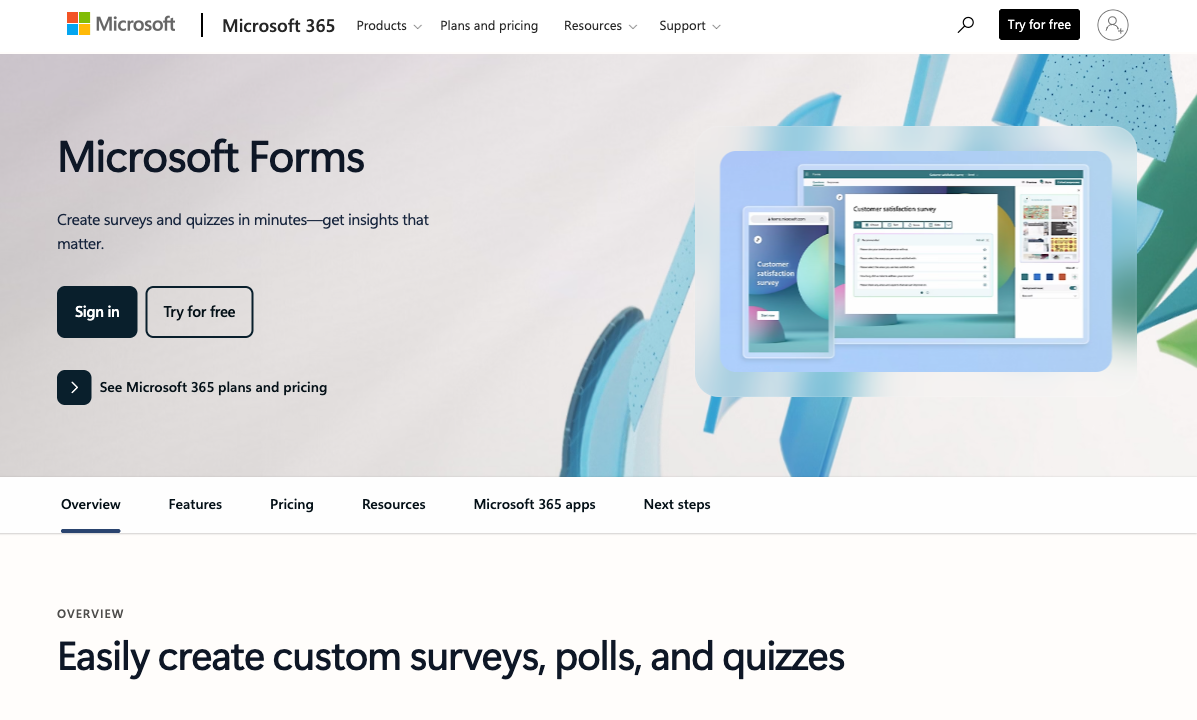
Price: Free with Microsoft 365
The most compelling argument for Microsoft Forms is that it costs nothing if your organisation already pays for Microsoft 365. No additional subscription, no per-form limits worth worrying about, no procurement approval needed. Typeform starts at $39/month for the Basic plan (limited to 100 responses/month) and goes up to $129/month for the Business plan. For internal surveys and simple feedback collection, paying $336-1,092/year (billed annually) for Typeform when Forms is free is difficult to justify.
Native Ecosystem Integration
Microsoft Forms flows natively into Teams, Excel, SharePoint, OneDrive, and Power Automate. Responses populate Excel workbooks in real time. Forms embed as tabs in Teams channels. Power Automate triggers fire instantly on submission. This is first-party infrastructure built by the same company, not a third-party integration that occasionally breaks. For organisations running on Microsoft 365, this native connectivity eliminates entire categories of integration friction.
Quiz and Assessment Tools
Microsoft Forms has purpose-built quiz functionality: point values per question, automatic grading, correct/incorrect answer feedback, and grade exports. For teachers, corporate trainers, and anyone running assessments, these features work well and integrate with Microsoft's education and enterprise tools. Typeform offers quizzes, but they're designed more for marketing engagement than formal assessment.
Simplicity and Speed
Creating a basic survey in Microsoft Forms takes 2-3 minutes. The interface is deliberately minimal: add questions, set options, share the link. No design decisions, no template browsing, no configuration complexity. For a quick team poll or meeting feedback form, this simplicity is valuable. Typeform's design process takes longer because you're making visual and UX decisions at every step.
Real-Time Co-Authoring
Microsoft Forms supports simultaneous collaborative editing. Multiple team members can build and edit the same form at once, with changes appearing in real time. This is the same co-authoring model used in Word, Excel, and PowerPoint online. For teams that build surveys collaboratively, this eliminates the back-and-forth of sharing drafts. Typeform's collaboration features require higher-tier plans and don't offer the same real-time co-editing experience.
Data Residency and Compliance
Microsoft Forms inherits your M365 tenant's compliance posture: SOC 1/2, ISO 27001, GDPR, and data residency configurations. If your organisation stores data in the EU, form responses stay in the EU. For compliance-conscious organisations, this inherited infrastructure avoids evaluating yet another vendor. Typeform has its own GDPR compliance and SOC 2 certification, but represents an additional vendor in your security review process.
Where Typeform Wins
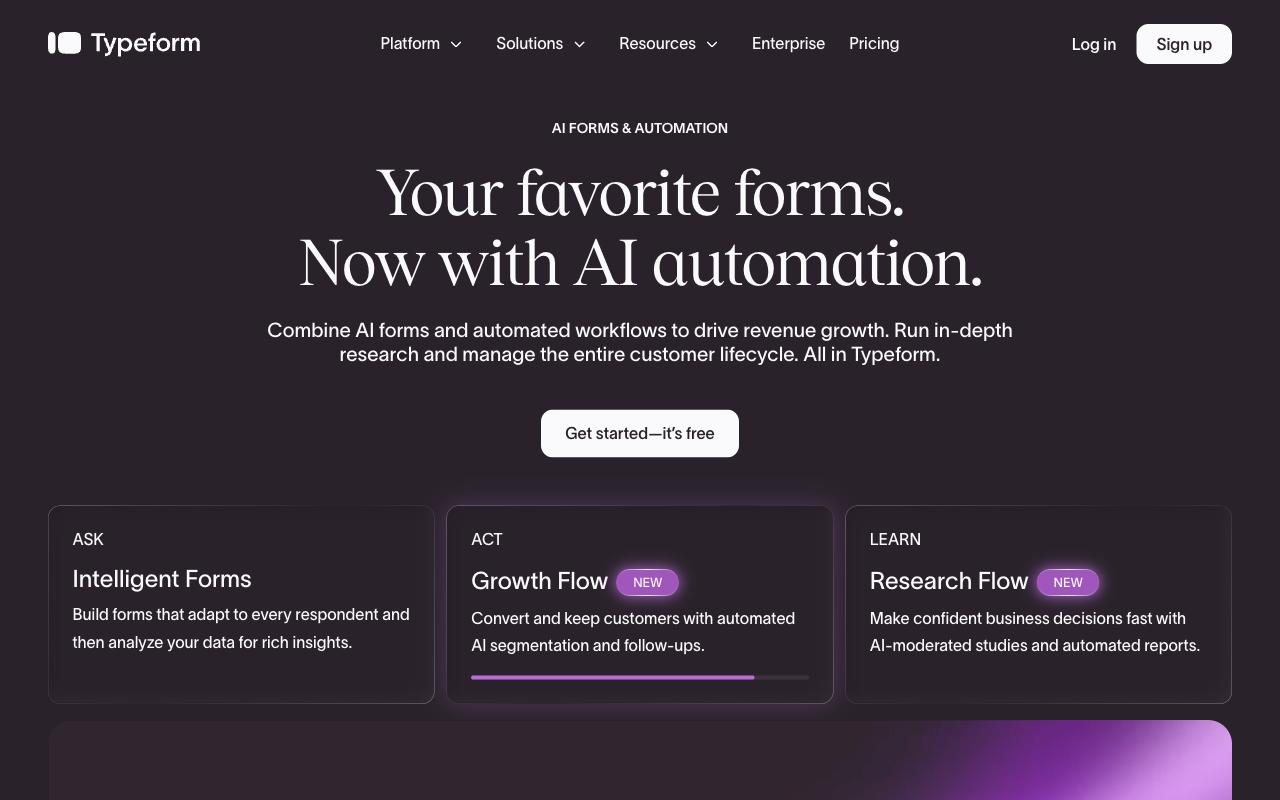
Conversational UX and Design Quality
Typeform's one-question-at-a-time format is its defining feature. Each question fills the screen, animated transitions guide respondents forward, and the experience feels like a conversation rather than a form. The effect is not just aesthetic. It produces measurable results. Typeform's format reduces cognitive load, minimises the intimidation factor of long forms, and creates a sense of progress that encourages completion. For lead capture, customer onboarding, and product feedback where every completed response has monetary value, this UX advantage translates directly to business outcomes.
Brand-Aligned Design
Typeform offers extensive visual customisation: custom fonts, background images, brand colours, logos, and layout options that let forms match your website's design language. Microsoft Forms offers colour themes and a header image -- that's it. For customer-facing touchpoints where brand consistency matters, the gap is stark. A Typeform survey looks like it belongs on your website. A Microsoft Forms survey looks like a Microsoft product.
Logic and Personalisation
Typeform's conditional logic (Logic Jump) creates personalised question paths based on previous answers. Combined with hidden fields, URL parameters, and recall information (inserting previous answers into later questions), Typeform builds dynamic, personalised experiences. Microsoft Forms has basic section branching but no field-level logic, no answer recall, and no hidden field support. For forms that need to adapt based on who's filling them out, Typeform is significantly more capable.
Third-Party Integrations
Typeform connects natively to HubSpot, Salesforce, Slack, Google Sheets, Mailchimp, Airtable, Notion, and hundreds more through Zapier and Make. Microsoft Forms integrates deeply within the M365 ecosystem but has limited connections to non-Microsoft tools beyond Power Automate. If your tech stack includes Slack, HubSpot, or other non-Microsoft tools, Typeform's integration ecosystem is more useful.
Interactive Content Beyond Surveys
Typeform is used for far more than surveys: interactive quizzes, product recommenders, lead qualification flows, and conversational landing pages. The one-question-at-a-time format lends itself to experiences that feel more like apps than forms. A Typeform product finder that asks about preferences and recommends products creates engagement that a Microsoft Forms survey never could. For marketing teams using forms as interactive content, Typeform opens creative possibilities that Microsoft Forms' traditional format can't support.
Respondent Experience Analytics
Typeform provides insights into how respondents interact with your forms: drop-off points, average time per question, and completion funnels. This data helps optimise survey design by showing exactly where respondents abandon the form. Microsoft Forms shows total response counts and basic charts but provides no visibility into the respondent journey. For teams iterating on form performance, Typeform's interaction analytics are a meaningful advantage.
Where Microsoft Forms Falls Short
- No design customisation: Colour themes and header images are the extent of visual control. No custom fonts, no layout flexibility, no way to make forms match your brand.
- No payment collection: Zero payment capability. No Stripe, no PayPal, nothing.
- Basic conditional logic: Section-level branching only. No field-level show/hide, no answer recall, no hidden fields.
- Ecosystem dependency: Full features require Microsoft 365. Minimal value for organisations outside the Microsoft ecosystem.
- Not suited for external-facing forms: Generic appearance, limited branding, no custom domains. Forms look institutional rather than branded.
- No calculation engine: No dynamic pricing, scoring, or computed values within forms.
Where Typeform Falls Short
- Expensive for what you get: $39-129/month for a tool that's primarily about presentation. The Basic plan limits you to 100 responses/month -- a constraint that catches many users off guard.
- Low response limits: 100 responses/month on the Basic plan, 1,000 on Plus, 10,000 on Business. Compared to competitors offering unlimited or higher-volume plans at similar prices, Typeform's limits feel restrictive.
- Conversational format isn't always appropriate: One-question-at-a-time works for short surveys and lead capture but frustrates respondents on longer forms. Multi-page order forms, detailed applications, and complex intake forms often work better in a traditional layout.
- No calculation engine: No Excel-style formulas for dynamic pricing, scoring, or conditional totals. Basic math exists but nothing approaching true computed fields.
- Weak payment integration: Stripe and PayPal only, with no product catalogue or inventory, coupons built as a manual calculation workaround, and refunds handled in Stripe rather than in Typeform.
- E-signatures only at the top: The Signature question needs Growth Flow ($379/month), and it is a signature field rather than a contract-signing product.
Pricing Comparison
The pricing gap is the elephant in the room. Microsoft Forms is free. Typeform starts at $39/month. The real question is whether Typeform's design premium is worth paying for.
| Tier | Microsoft Forms | Typeform | Key Difference |
|---|---|---|---|
| Free | Free with Microsoft account (full features with M365) | Free plan: 10 responses/month, 10 questions/form | Microsoft's free tier is far more usable |
| Basic/Starter | Included with M365 ($7-22/user/mo) | Basic: $39/mo, 100 responses/mo | M365 is cheaper if you already have it |
| Professional | No additional tiers | Plus: $79/mo, 1,000 responses/mo | Typeform charges premium prices for premium UX |
| Business | No additional tiers | Business: $129/mo, 10,000 responses/mo | Typeform's highest tier costs more than most competitors' enterprise plans |
What will it cost you?
Microsoft Forms plans
- Free (Personal Microsoft Account)FreeForms 400, Submissions 200/form, Team 1, Storage N/A
- Microsoft 365 Business Basic$7/moForms 400, Submissions 5,000,000/form, Team Per user (1-300 employees), Storage 1 TB OneDrive per user
- Microsoft 365 Business Standard$14/moForms 400, Submissions 5,000,000/form, Team Per user (1-300 employees), Storage 1 TB OneDrive per user
- Microsoft 365 Business Premium$22/moForms 400, Submissions 5,000,000/form, Team Per user (1-300 employees), Storage 1 TB OneDrive per user
- Microsoft 365 Business Standard with Copilot$23.50/moForms 400, Submissions 5,000,000/form, Team Per user (1-300 employees), Storage 1 TB OneDrive per user
- Microsoft 365 Business Premium with Copilot$32/moForms 400, Submissions 5,000,000/form, Team Per user (1-300 employees), Storage 1 TB OneDrive per user
- Microsoft 365 Apps for business$10/moForms 400, Submissions 5,000,000/form, Team Per user (1-300 employees), Storage 1 TB OneDrive per user
| Plan | Price | Forms | Submissions | Team | Storage |
|---|---|---|---|---|---|
| Free (Personal Microsoft Account) | Free | 400 | 200/form | 1 | N/A |
| Microsoft 365 Business Basic | $7/mo | 400 | 5,000,000/form | Per user (1-300 employees) | 1 TB OneDrive per user |
| Microsoft 365 Business Standard | $14/mo | 400 | 5,000,000/form | Per user (1-300 employees) | 1 TB OneDrive per user |
| Microsoft 365 Business Premium | $22/mo | 400 | 5,000,000/form | Per user (1-300 employees) | 1 TB OneDrive per user |
| Microsoft 365 Business Standard with Copilot | $23.50/mo | 400 | 5,000,000/form | Per user (1-300 employees) | 1 TB OneDrive per user |
| Microsoft 365 Business Premium with Copilot | $32/mo | 400 | 5,000,000/form | Per user (1-300 employees) | 1 TB OneDrive per user |
| Microsoft 365 Apps for business | $10/mo | 400 | 5,000,000/form | Per user (1-300 employees) | 1 TB OneDrive per user |
Typeform plans
- FreeFreeForms Unlimited, Submissions 10/month, Team 1
- Basic$28/moForms Unlimited, Submissions 100/month, Team 1, Storage 1 GB
- PlusMatches$56/moForms Unlimited, Submissions 1,000/month, Team 3, Storage 2 GB
- Business$91/moForms Unlimited, Submissions 10,000/month, Team 5, Storage 4 GB
- Growth Flow$266/moForms Unlimited, Submissions 10,000/month, Team 5, Storage 4 GB
- Talent$119/moForms Unlimited, Submissions 3,000/month, Team 3
| Plan | Price | Forms | Submissions | Team | Storage |
|---|---|---|---|---|---|
| Free | Free | Unlimited | 10/month | 1 | — |
| Basic | $28/mo | Unlimited | 100/month | 1 | 1 GB |
| PlusMatches | $56/mo | Unlimited | 1,000/month | 3 | 2 GB |
| Business | $91/mo | Unlimited | 10,000/month | 5 | 4 GB |
| Growth Flow | $266/mo | Unlimited | 10,000/month | 5 | 4 GB |
| Talent | $119/mo | Unlimited | 3,000/month | 3 | — |
| Product | Plan | Monthly Price | Annual Price (per month) | Free Plan | Free Trial | Limits |
|---|---|---|---|---|---|---|
| Microsoft Forms | Free (Personal Microsoft Account) | Free | Free | Yes | 1 month | forms: 400, submissions: 200/form, storage: N/A, users: 1 |
| Microsoft Forms | Microsoft 365 Business Basic | $8.4/mo | $7/mo billed annually | forms: 400, submissions: 5,000,000/form, storage: 1 TB OneDrive per user, users: Per user (1-300 employees) | ||
| Microsoft Forms | Microsoft 365 Business Standard | $16.8/mo | $14/mo billed annually | forms: 400, submissions: 5,000,000/form, storage: 1 TB OneDrive per user, users: Per user (1-300 employees) | ||
| Microsoft Forms | Microsoft 365 Business Premium | $26.4/mo | $22/mo billed annually | forms: 400, submissions: 5,000,000/form, storage: 1 TB OneDrive per user, users: Per user (1-300 employees) | ||
| Microsoft Forms | Microsoft 365 Business Standard with Copilot | Not listed | $23.5/mo billed annually | forms: 400, submissions: 5,000,000/form, storage: 1 TB OneDrive per user, users: Per user (1-300 employees) | ||
| Microsoft Forms | Microsoft 365 Business Premium with Copilot | Not listed | $32/mo billed annually | forms: 400, submissions: 5,000,000/form, storage: 1 TB OneDrive per user, users: Per user (1-300 employees) | ||
| Microsoft Forms | Microsoft 365 Apps for business | $12/mo | $10/mo billed annually | forms: 400, submissions: 5,000,000/form, storage: 1 TB OneDrive per user, users: Per user (1-300 employees) | ||
| Typeform | Free | Free | Free | Yes | 14 days | forms: Unlimited, submissions: 10/month, users: 1 |
| Typeform | Basic | $39/mo | $28/mo billed annually | forms: Unlimited, submissions: 100/month, storage: 1 GB, users: 1 | ||
| Typeform | Plus | $79/mo | $56/mo billed annually | forms: Unlimited, submissions: 1,000/month, storage: 2 GB, users: 3 | ||
| Typeform | Business | $129/mo | $91/mo billed annually | forms: Unlimited, submissions: 10,000/month, storage: 4 GB, users: 5 | ||
| Typeform | Growth Flow | $379/mo | $266/mo billed annually | forms: Unlimited, submissions: 10,000/month, storage: 4 GB, users: 5 | ||
| Typeform | Talent | $169/mo | $119/mo billed annually | forms: Unlimited, submissions: 3,000/month, users: 3 |
What Users Say
Typeform earns strong ratings (4.5-4.7/5) with users praising the beautiful design, conversational UX, and high completion rates. Complaints focus on pricing, response limits, and the feeling that the tool is expensive relative to its functional depth. Microsoft Forms has fewer dedicated reviews as a standalone product, but feedback consistently highlights simplicity and ecosystem integration as strengths, and limited customisation and basic features as weaknesses.
The pricing complaint deserves attention: Typeform's 100-response limit on the $39/month Basic plan catches many users off guard. Several G2 and Capterra reviews mention upgrading sooner than expected because they hit response caps during their first survey. Microsoft Forms has no meaningful response limits for M365 users, which means the total cost of ownership comparison includes the risk of unexpected tier upgrades on Typeform, not only the subscription price.
Consider Paperform: Nothing Metered, One Subscription
The Microsoft Forms vs Typeform comparison forces a choice between free-but-basic and beautiful-but-metered. Paperform takes the meter out of the equation: professional design quality with unlimited submissions and unlimited seats on every paid plan, starting at $49/month billed annually.
Paperform's document-style editor produces forms that look like designed web pages: clean typography, rich content between fields, embedded images and videos, and a visual polish that Microsoft Forms can't approach. Unlike Typeform's conversational format, Paperform uses a traditional page layout that works equally well for short surveys and long multi-section forms. The design output is closer to Typeform's quality than Microsoft Forms' utility, and it does not sit behind Typeform's $79-129/month tiers.
Beyond design, Paperform includes capabilities neither competitor offers: an Excel-style calculation engine for dynamic pricing and scoring, 5 deeply integrated payment gateways, and 9,800+ integrations that work with Microsoft tools through Zapier and Make. One subscription also covers Papersign for eSignatures and Stepper for workflow automation, so you are not stitching together three vendors and three bills to get a form signed and routed. For teams that want better forms than Microsoft provides without response caps, Paperform bridges the gap.
The Verdict
Microsoft Forms wins on cost and simplicity. For internal surveys, team polls, and training quizzes within a Microsoft 365 organisation, it's free, familiar, and frictionless. The native Teams and Excel integration eliminates setup friction. If your forms are internal-facing and design doesn't matter, paying for Typeform is unnecessary.
Typeform wins on design and completion rates. For external-facing surveys, lead capture, and customer touchpoints where form completion directly impacts revenue, Typeform's conversational UX and visual polish create measurably better experiences. The premium pricing ($39-129/month) is justified when higher completion rates translate to business value.
The gap between these two is also the opportunity: professional design without a meter on it, with capabilities both lack. Paperform fills this space from $49/month billed annually -- a document-style editor that produces polished forms, unlimited submissions and seats, plus payment processing, calculations, and eSignatures that neither Microsoft Forms nor Typeform can match.
Who Is Each Platform Best For?
Microsoft Forms is ideal for: organisations on Microsoft 365 that need simple internal data collection: employee surveys, team feedback, training quizzes, and meeting polls. Best when budget is zero, design doesn't matter, and native Teams/Excel integration is the priority.
Typeform is ideal for: marketing teams, product teams, and customer-facing organisations where form completion rates directly impact results. Best for lead capture, onboarding flows, product feedback, and any scenario where the form experience is part of the brand experience. Worth the premium when higher completion rates justify the cost.
Neither is ideal if: you need professional-looking forms with payment collection, calculations, e-signatures, and workflow automation at a reasonable price. Paperform delivers Typeform-calibre design with no cap on submissions, seats or automation runs, and covers forms, eSignatures and workflow automation under one subscription. For more options, see our Microsoft Forms alternatives analysis.
Related Comparisons
If you are weighing other options, these related comparisons may help:
- Microsoft Forms vs SurveyMonkey -- free basic vs paid survey specialist
- SurveyMonkey vs Typeform -- survey science vs survey design
- Jotform vs Microsoft Forms -- feature-rich paid vs free ecosystem tool
Frequently Asked Questions
Can Microsoft Forms create conversational forms like Typeform?
Not really. Microsoft Forms presents all questions on a single page or uses section-based navigation where respondents move through groups of questions. Typeform's signature one-question-at-a-time format creates a focused, conversational experience that feels like a chat rather than a form. Microsoft Forms can present questions one at a time using sections with single questions, but it lacks the animated transitions, visual focus, and design polish that make Typeform's conversational approach effective. If the conversational UX specifically is what you want, Typeform is the only choice between these two.
Is Typeform worth the price difference over free Microsoft Forms?
It depends entirely on the use case. For internal surveys, team polls, and employee feedback, Microsoft Forms does the job and costs nothing if you have M365. For external-facing forms (lead capture, customer onboarding, brand-aligned surveys, product feedback), Typeform's design quality can measurably improve completion rates. Typeform's own data shows 2-3x higher completion rates compared to traditional form formats. If higher completion rates translate to meaningful business value (more leads, better data, higher conversion), the $39-129/month investment can pay for itself quickly. If you're collecting internal feedback from employees who'll complete it regardless, paying for Typeform is unnecessary.
Which has better integrations?
Typeform has a stronger third-party integration ecosystem: native connections to HubSpot, Salesforce, Slack, Google Sheets, Mailchimp, and hundreds more through Zapier and Make. Microsoft Forms integrates deeply within the M365 ecosystem: Teams, Excel, SharePoint, Power Automate, and Dynamics 365. If you live in Microsoft, Forms connects natively to everything you use. If you use a mix of tools (Slack for chat, HubSpot for CRM, Notion for docs), Typeform's broader integration options are more useful. Neither platform matches Paperform's 9,800+ integrations combined with its calculation engine that passes computed values to downstream tools.
Can I use Typeform for quizzes and assessments?
Yes, but with limitations. Typeform offers quiz functionality with scoring and outcome screens, but it's designed more for interactive content marketing (personality quizzes, product recommenders) than formal assessments. Microsoft Forms has purpose-built quiz features: automatic grading, point assignment per question, correct/incorrect feedback, and results that sync to Excel for grade tracking. For educators and trainers, Microsoft Forms' quiz tools are more practical. For marketing teams creating engaging interactive content, Typeform's visual quiz experience is superior.
Is there a form builder that combines professional design with affordable pricing?
This is the gap between Microsoft Forms (free but basic) and Typeform (beautiful but expensive). Paperform bridges it: a document-style editor that produces professionally designed forms: visually polished pages with rich content, images, and inline fields, rather than Typeform's one-question-at-a-time conversation. Paperform's Pro plan is $49/month billed annually and includes unlimited submissions and unlimited seats, plus payment processing, calculations, e-signatures, and 9,800+ integrations. It is not the cheapest entry point; Typeform's Basic plan starts lower. But nothing you collect is metered, so the price does not move as volume or team size grows. It works with Microsoft tools through Zapier and Make. For teams that want better design than Microsoft Forms without Typeform's premium pricing, Paperform is the practical middle ground.
Sources & References
- The Best Online Form Builders for 2025 — Zapier, 2025
- Typeform vs Google Forms: Which Should You Use? — Zapier, 2025
- Microsoft Forms vs Google Forms: Which Is Better? — Zapier, 2025
Updates
We re-audit the form builders we compare on a regular cadence and log every change here — a public record of what changed and when.
- Updated June 4, 2026 — Updated Typeform pricing across all tiers to reflect a June 2026 audit: 'Basic' rose from $29 to $39/mo, 'Plus' from $59 to $79/mo, and 'Business' from $99 to $129/mo, shifting the overall range from $29-99 to $39-129/month.
Unlimited plans are subject to each vendor's fair use policy.
Ready to try Paperform?
Create beautiful forms, payment pages, and workflows — no code required.