 By Dean McPherson, Co-founder & CTO, Paperform · Updated
Typeform vs WPForms: Which Is Better in 2026?
Typeform (founded 2012, Barcelona, $193M in VC funding) made its name with beautiful one-question-at-a-time conversational forms. WPForms (founded 2016 by Syed Balkhi) is a beginner-friendly WordPress form plugin used by 6 million+ sites. They represent opposite ends of the form builder spectrum: Typeform prioritises design and experience; WPForms prioritises simplicity and WordPress integration.
The choice often comes down to context. If forms are a centrepiece of your user experience (quizzes, onboarding, lead qualification), Typeform's design polish matters. If forms are a utility on your WordPress site (contact, registration, payment), WPForms gets the job done faster and cheaper.
Quick Verdict
Choose Typeform if:
- Form design and user experience are top priorities
- You're building conversational quizzes, surveys, or onboarding flows
- Your forms are platform-independent (not just WordPress)
- Higher completion rates justify the premium cost
Choose WPForms if:
- Your website runs on WordPress
- You need simple contact, registration, or payment forms
- Budget matters and you need cost-effective forms
- You want forms that match your WordPress theme natively
Feature Comparison
| Feature | Typeform | WPForms |
|---|---|---|
| Form Building | ||
| AI form builder . Describe the form you need in plain language and the tool drafts the questions for you. | Yes | Yes basic |
| Templates . The number of ready-made form templates in the tool’s template gallery. | 3,000+ | 2,100+ (basic) |
| Field types . How many kinds of question or input field the form builder offers, such as text, dropdown, date, file upload and signature. | 20+ | 30+ (basic) |
| Conditional logic . Show, hide or skip questions and pages based on how someone has answered earlier questions. | Yes | Yes basic |
| Calculations . Compute totals, scores, prices or dates from answers while the form is being filled in. | Yes | Yes pro |
| Multi-page forms . Split a long form across several pages that respondents move through in order. | Yes | Yes basic |
| One question at a time . A conversational layout that shows a single question per screen, popular for surveys on mobile. | Yes | Yes pro |
| Answer piping . Insert a respondent’s earlier answer, such as their name, into later questions or text on the form. | Yes | No |
| Pre-filling and hidden fields . Fill in answers ahead of time from a link or existing data, and pass along values the respondent never sees. | Yes | Yes basic |
| File uploads . Let respondents attach files such as documents and photos to their submission. | Yes basic | Yes basic |
| E-signatures . Collect a signature, either with a signature field on the form or by sending a document out to be signed. | Yes growth flow | Yes pro |
| Appointment booking . Let respondents pick and book a time slot directly in the form, with availability managed by the tool. | Yes business | No |
| Quiz scoring . Give answers point values so the form can score quizzes and assessments automatically. | Yes | Yes pro |
| Save and resume . Respondents can leave a form part-way through and come back later to finish it. | Yes | Yes pro |
| Close forms by date or response limit . Stop accepting submissions automatically on a set date or once a set number of responses has arrived. | Yes business | Yes pro |
| Payments | ||
| Payment gateways . The number of payment processors a form can take payments through. Where a vendor’s full count isn’t recorded, the cell lists the gateways we confirmed. | 2 (basic) Stripe, PayPal | 6 (Lite (Free)) processors, incl. Stripe, PayPal, Square, Mercado Pago |
| Subscriptions and recurring payments . Charge respondents on a repeating schedule, such as monthly or annually, from a form. | Yes basic | Yes Lite (Free) |
| Product sales . Sell products from a form, with product listings, quantities and an order total. | Yes basic | Yes Lite (Free) |
| Conditional pricing . Change the price or add fees automatically based on the answers given in the form. | Yes basic | Yes pro |
| Coupons and discounts . Offer discount codes that respondents can apply to a payment or subscription on the form. | Yes basic | Yes pro |
| Tax calculations . Add sales tax to payments on the form automatically. | Not recorded | Yes pro |
| Refunds . Refund a payment from inside the form tool rather than going to the payment processor. | No | Yes pro |
| Design & Customization | ||
| Custom themes . Set your own logo, colours and fonts on forms and save them as reusable themes. | Yes basic | Yes basic |
| Custom CSS . Add your own CSS (and in some tools HTML) for styling beyond the built-in theme options. | No | Yes basic |
| Remove vendor branding . Remove the form builder’s own logo or badge so forms carry only your branding. | Yes plus | Yes basic |
| Custom domain . Host forms on your own domain, such as forms.yourcompany.com, instead of the vendor’s. | Yes enterprise | Yes Lite (Free) |
| Custom form URL . Choose a readable link for a form instead of a random string. | Yes plus | Yes pro |
| Emails from your own domain . Send notification and confirmation emails from your own email domain instead of the vendor’s. | Yes plus | Yes basic |
| Multi-language forms . Show a form’s questions, buttons and messages in languages other than English. | Yes business | Yes basic |
| Analytics | ||
| Response reports . Built-in summaries and charts of the answers a form has collected. | Yes | Yes basic |
| Form analytics (views and drop-off) . Track how many people view, start and finish a form, and where they abandon it. | Yes business | Yes pro |
| Partial submissions . See the answers people entered before leaving a form without submitting it. | Yes basic | Yes pro |
| Google Analytics and Meta Pixel . Connect a form to Google Analytics or the Meta (Facebook) Pixel to track visits and conversions. | Yes business | No |
| Custom tracking scripts . Add your own analytics or conversion-tracking scripts to a form. | Yes business | Not recorded |
| AI response insights . AI-written summaries and insights generated from the responses a form has collected. | Yes growth flow | Yes pro |
| Collaboration | ||
| Team members . Invite colleagues into the same account to build forms and work with responses together. | Yes plus | Yes basic |
| Roles and permissions . Give team members different levels of access, such as admin, editor or viewer. | Yes plus | Yes pro |
| Advanced permissions and admin controls . Fine-grained, organisation-wide controls over who can access what, usually on enterprise plans. | Yes enterprise | Yes elite |
| Workspaces . Separate spaces or folders for organising forms by team, client or project. | Yes | Yes Lite (Free) |
| Security | ||
| Two-factor authentication . Users can protect their login with a second step, such as a code from an authenticator app. | Yes | No |
| Require 2FA for the whole team . Admins can make two-factor authentication mandatory for everyone in the account. | Not recorded | No |
| SSO (SAML) . Team members sign in through your company’s identity provider, such as Okta or Microsoft Entra ID, using SAML single sign-on. | Yes enterprise | No |
| HIPAA compliance . Whether the vendor supports collecting US protected health information under HIPAA, typically by signing a business associate agreement on an eligible plan. | Yes enterprise | No |
| SOC 2 . Whether the vendor holds a SOC 2 audit report covering its security controls. | Yes | No |
| GDPR . Whether the vendor states that it complies with the EU General Data Protection Regulation. | Yes | Yes basic |
| Data residency . Choose the region, such as the EU, where your form data is stored. | Yes enterprise | Yes |
| Store files in your own S3 bucket . Send uploaded files and exports to your own Amazon S3 storage instead of the vendor’s. | Not recorded | No |
| Spam protection (CAPTCHA) . Block bot and spam submissions with reCAPTCHA or a similar challenge. | Yes plus | Yes Lite (Free) |
| Integrations & API | ||
| Native integrations . Apps the tool connects to directly, without going through a third-party connector such as Zapier or Make. | 300+ | 30+ (Lite (Free)) |
| Zapier . Connect forms to thousands of other apps through Zapier. | Yes | Yes pro |
| Make . Connect forms to other apps through Make (formerly Integromat). | Yes | Yes pro |
| Workflow automation . A built-in builder for multi-step automations that act on submissions, such as approvals, routing and syncing data to other systems. | Yes growth flow | Not recorded |
| Webhooks . Send each new submission to a URL of your choice as soon as it arrives. | Yes basic | Yes elite |
| API access . A developer API for reading forms and submissions, or managing them, from your own code. | Yes | Yes Lite (Free) |
| MCP server / AI assistant connector . An official connector, such as an MCP server, that lets AI assistants like Claude or ChatGPT work with your forms and responses. | Yes | Yes Lite (Free) |
| WordPress plugin . A plugin for adding forms to a WordPress site. | No | Yes |
— means we haven't recorded it for that tool.
Where Typeform Wins

Design and User Experience
Typeform's conversational format is genuinely beautiful. One question at a time, smooth transitions, full-screen layouts, custom branding, and an experience that feels more like a chat than a form. For user-facing interactions where engagement matters, such as onboarding flows, product quizzes and brand surveys, Typeform's design polish directly impacts completion rates. WPForms produces functional forms, but they're standard multi-field layouts with no design ambition.
Platform Independence
Typeform works anywhere. Embed it on any website (WordPress, Shopify, Webflow, Squarespace), share as standalone links, or use custom domains. WPForms only works on WordPress. If your web presence spans multiple platforms, or if you don't use WordPress at all, Typeform is the only option of the two.
Conversational Logic and Branching
Typeform's Logic Jumps create personalised conversational paths: respondents see different questions based on their answers, giving each user a tailored experience. The one-question-at-a-time format makes branching feel natural rather than technical. WPForms has conditional show/hide fields, but the standard form layout makes branching less experiential and more utilitarian.
Higher Completion Rates
The conversational format consistently produces higher completion rates than traditional forms, particularly for longer surveys (10+ questions). By showing one question at a time and removing the visual overwhelm of a long form, Typeform reduces abandonment. For lead qualification, customer feedback, and any scenario where every response counts, this completion rate advantage can justify the price premium.
Where WPForms Wins
WordPress-Native Integration
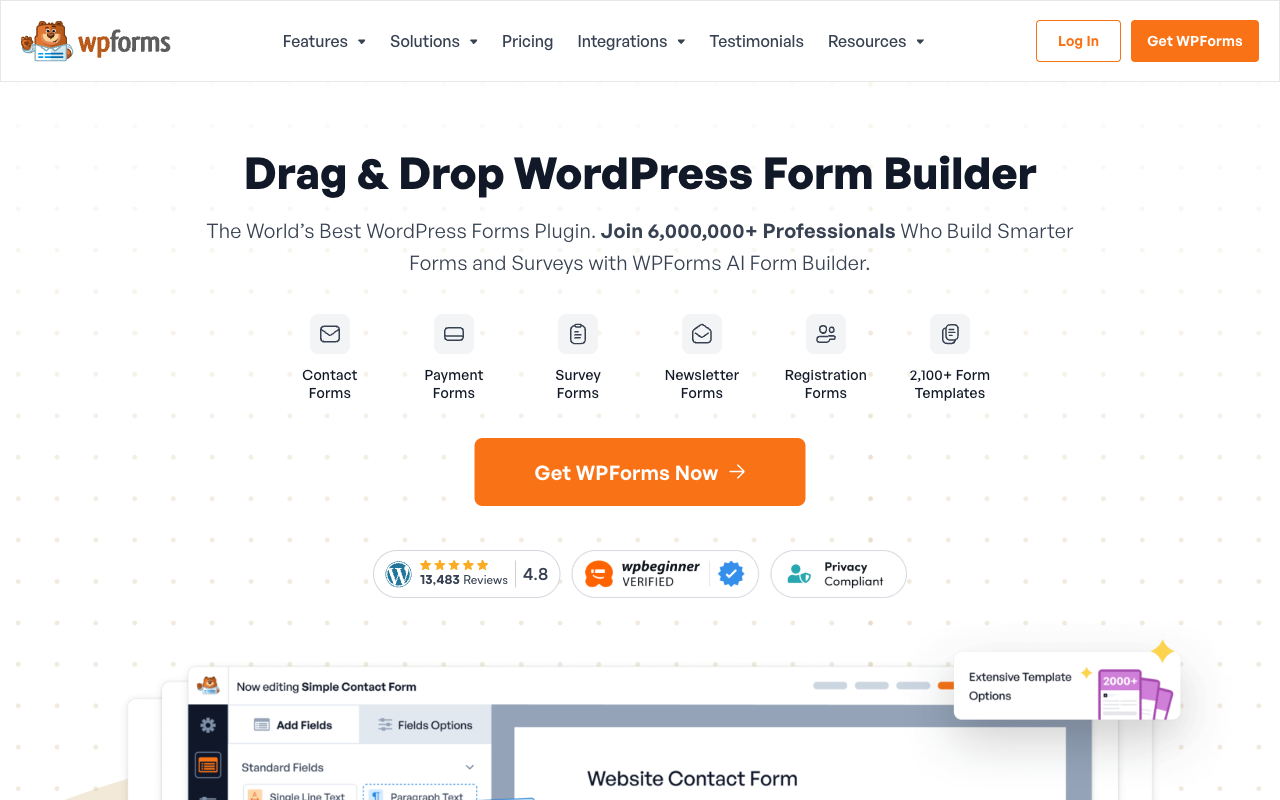
WPForms renders natively within WordPress: no iframes, no external containers, no third-party branding. Forms match your theme, appear inline with page content, and store submissions in your WordPress database. For WordPress site owners who want forms that feel like part of their site rather than an embedded widget, WPForms fits neatly.
Cost-Effectiveness
WPForms Lite is free for basic contact forms. WPForms Pro ($399/year) includes conditional logic, payment fields, file uploads, and unlimited submissions. Typeform's Basic plan ($39/month, $468/year paid monthly, or $336/year billed annually) limits you to 100 responses per month. WPForms Pro costs less per year than Typeform's cheapest plan paid monthly, and only a little more than Basic billed annually — and includes unlimited responses. For WordPress sites that need reliable forms without a premium price tag, WPForms delivers substantially more value per dollar.
Payment Collection
WPForms supports Stripe, PayPal and Square payment fields for order forms, donations and event fees, from the free Lite plugin (with an extra 3% WPForms fee below Pro). Typeform's payment collection is available on its Basic plan ($39/month) via Stripe or PayPal. WPForms handles payments at a fraction of the cost, making it more practical for small businesses and WordPress eCommerce.
Simplicity for Basic Forms
For a contact form, a registration page, or a feedback form, WPForms is faster to set up. Pre-built templates, drag-and-drop fields, embed with a shortcode. Typeform's conversational format is overkill for a 3-field contact form, and the one-question-at-a-time approach makes simple forms feel slower. WPForms matches the task to the tool.
Where Both Fall Short
- Limited calculations: Typeform's logic calculations and WPForms' Calculations addon (Pro) handle scores, prices and totals, but neither is an Excel-style formula engine that carries computed values across pages, emails and integrations.
- E-signatures cost extra: WPForms keeps its signature field for Pro, and Typeform's Signature question needs Growth Flow ($379/month); neither is a contract-signing product.
- Response limits (Typeform): Typeform's response caps ($39/month for 100 responses) make it expensive at scale. WPForms has no response limits, but is WordPress-only.
- VC funding risk (Typeform): $193M in venture capital means Typeform needs to show returns. Pricing has increased steadily, which is a concern for long-term budget planning.
Pricing Comparison
What will it cost you?
Typeform plans
- FreeFreeForms Unlimited, Submissions 10/month, Team 1
- Basic$28/moForms Unlimited, Submissions 100/month, Team 1, Storage 1 GB
- PlusMatches$56/moForms Unlimited, Submissions 1,000/month, Team 3, Storage 2 GB
- Business$91/moForms Unlimited, Submissions 10,000/month, Team 5, Storage 4 GB
- Growth Flow$266/moForms Unlimited, Submissions 10,000/month, Team 5, Storage 4 GB
- Talent$119/moForms Unlimited, Submissions 3,000/month, Team 3
| Plan | Price | Forms | Submissions | Team | Storage |
|---|---|---|---|---|---|
| Free | Free | Unlimited | 10/month | 1 | — |
| Basic | $28/mo | Unlimited | 100/month | 1 | 1 GB |
| PlusMatches | $56/mo | Unlimited | 1,000/month | 3 | 2 GB |
| Business | $91/mo | Unlimited | 10,000/month | 5 | 4 GB |
| Growth Flow | $266/mo | Unlimited | 10,000/month | 5 | 4 GB |
| Talent | $119/mo | Unlimited | 3,000/month | 3 | — |
WPForms plans
- Lite (Free)MatchesFreeForms Unlimited, Submissions Unlimited, Team Unlimited, Storage WordPress database (self-hosted)
- Basic$8.25/moForms Unlimited, Submissions Unlimited, Team Unlimited, Storage WordPress database (self-hosted)
- Plus$16.58/moForms Unlimited, Submissions Unlimited, Team Unlimited, Storage WordPress database (self-hosted)
- Pro$33.25/moForms Unlimited, Submissions Unlimited, Team Unlimited, Storage WordPress database (self-hosted)
- Elite$49.92/moForms Unlimited, Submissions Unlimited, Team Unlimited, Storage WordPress database (self-hosted)
| Plan | Price | Forms | Submissions | Team | Storage |
|---|---|---|---|---|---|
| Lite (Free)Matches | Free | Unlimited | Unlimited | Unlimited | WordPress database (self-hosted) |
| Basic | $8.25/mo | Unlimited | Unlimited | Unlimited | WordPress database (self-hosted) |
| Plus | $16.58/mo | Unlimited | Unlimited | Unlimited | WordPress database (self-hosted) |
| Pro | $33.25/mo | Unlimited | Unlimited | Unlimited | WordPress database (self-hosted) |
| Elite | $49.92/mo | Unlimited | Unlimited | Unlimited | WordPress database (self-hosted) |
| Product | Plan | Monthly Price | Annual Price (per month) | Free Plan | Free Trial | Limits |
|---|---|---|---|---|---|---|
| Typeform | Free | Free | Free | Yes | 14 days | forms: Unlimited, submissions: 10/month, users: 1 |
| Typeform | Basic | $39/mo | $28/mo billed annually | forms: Unlimited, submissions: 100/month, storage: 1 GB, users: 1 | ||
| Typeform | Plus | $79/mo | $56/mo billed annually | forms: Unlimited, submissions: 1,000/month, storage: 2 GB, users: 3 | ||
| Typeform | Business | $129/mo | $91/mo billed annually | forms: Unlimited, submissions: 10,000/month, storage: 4 GB, users: 5 | ||
| Typeform | Growth Flow | $379/mo | $266/mo billed annually | forms: Unlimited, submissions: 10,000/month, storage: 4 GB, users: 5 | ||
| Typeform | Talent | $169/mo | $119/mo billed annually | forms: Unlimited, submissions: 3,000/month, users: 3 | ||
| WPForms | Lite (Free) | Free | Free | Yes | No | forms: Unlimited, submissions: Unlimited, storage: WordPress database (self-hosted), users: Unlimited |
| WPForms | Basic | Not listed | $8.25/mo billed annually | forms: Unlimited, submissions: Unlimited, storage: WordPress database (self-hosted), users: Unlimited | ||
| WPForms | Plus | Not listed | $16.58/mo billed annually | forms: Unlimited, submissions: Unlimited, storage: WordPress database (self-hosted), users: Unlimited | ||
| WPForms | Pro | Not listed | $33.25/mo billed annually | forms: Unlimited, submissions: Unlimited, storage: WordPress database (self-hosted), users: Unlimited | ||
| WPForms | Elite | Not listed | $49.92/mo billed annually | forms: Unlimited, submissions: Unlimited, storage: WordPress database (self-hosted), users: Unlimited |
Typeform: Basic $39/month (100 responses), Plus $79/month (1,000 responses), Business $129/month (10,000 responses). WPForms: Lite free, Pro $399/year (unlimited). For most WordPress site owners, WPForms is the better financial proposition. Typeform's pricing only makes sense when the design experience directly generates enough value (leads, conversions, engagement) to offset the premium.
User Ratings
The Verdict
Use Typeform when form design is a strategic asset for product quizzes, brand surveys, lead qualification flows and onboarding experiences. The conversational format and design polish justify the premium when engagement directly impacts business outcomes.
Use WPForms when forms are a WordPress utility: contact pages, registrations, payment collection, newsletter signups. It's cheaper, simpler, WordPress-native, and handles the everyday form needs that don't require a design-forward experience.
For alternatives that combine design quality with WordPress compatibility and unlimited responses, see the complete form builder ranking.
Consider Paperform
Both tools meter something as you grow: Typeform counts responses, WPForms counts sites and locks features behind licence tiers. Paperform meters none of it — submissions and seats are unlimited on every paid plan, so a good month costs the same as a quiet one. One subscription also covers forms, eSignatures (Papersign) and workflow automation (Stepper), instead of stitching three vendors together. It embeds on WordPress and every other platform, includes five payment gateways, an Excel-style calculation engine, and 9,800+ integrations. Paid plans start at $49/month billed annually — more than WPForms Pro, less than Typeform at any comparable volume. Bootstrapped and profitable since 2016.
Frequently Asked Questions
Can I embed Typeform on WordPress?
Yes. Typeform provides embed codes for WordPress sites, though its official WordPress plugin was closed in April 2025. However, Typeform renders in its own container. Your WordPress theme's styling doesn't apply, and the one-question-at-a-time format takes over the page experience. WPForms renders natively within WordPress, matching your theme and appearing inline with page content. If you want forms that feel like part of your WordPress site, WPForms is the better fit. If you want the Typeform conversational experience, embedding works but feels like a site-within-a-site.
Which is better for lead generation?
Typeform's conversational format typically produces higher completion rates for multi-step lead qualification forms: the one-question-at-a-time approach reduces abandonment. WPForms is better for simple contact forms and quick lead capture where speed matters more than engagement. For longer qualification forms (10+ questions), Typeform's format advantage is real. For short forms (name, email, message), WPForms is faster and simpler.
Which is more expensive?
Typeform is significantly more expensive. Its Basic plan ($39/month) limits you to 100 responses/month. WPForms Lite is free for basic forms; WPForms Pro ($399/year, roughly $33/month) includes conditional logic, payments, and unlimited submissions. Typeform's Plus plan ($79/month) for 1,000 responses costs more than WPForms Pro covers in a year. Unless you specifically need Typeform's conversational design, WPForms delivers better cost-per-form value.
Which has better conditional logic?
Typeform's Logic Jumps create branching conversational flows, showing different questions based on previous answers for a personalised form experience. WPForms' conditional logic shows/hides fields on the same page based on selections. Both work, but Typeform's approach is more dynamic because each question is a full-screen step. For multi-path qualification flows, Typeform is more elegant. For simple show/hide field logic on a standard form, WPForms is sufficient.
Sources & References
- Best Online Form Builder to Use in 2026 — Top 20 Tools — EmailToolTester, 2026
- Typeform vs WPForms: Feature Comparison — G2, 2026
Updates
We re-audit the form builders we compare on a regular cadence and log every change here — a public record of what changed and when.
- Updated June 4, 2026 — Updated Typeform pricing to current rates: Basic now $39/month (was $25), Plus $79/month (was $50), and Business $129/month (was $83). Also corrected WPForms Pro to $399/year (was $199) and noted Typeform payment collection now starts on the Basic plan rather than Plus.
Unlimited plans are subject to each vendor's fair use policy.
Ready to try Paperform?
Create beautiful forms, payment pages, and workflows — no code required.